Category Archives: farming

Can’t Get Away From Factory Farming

I still don’t think of myself as truly vegetarian — just mostly vegetarian, and  I’m sure many vegetarians would consider me not entirely committed, for my viewpoint that it is possible to keep an animal kindly, and at the end of a happy and food-filled life to slaughter it humanely and eat it.  I believe this can be done with respect.  The animal benefits from health care, provisioned food/water/shelter and companionship; the human gets a wealth of supplies (leather, wool, etc) and food.  Everyone benefits.

Unfortunately, somewhere between this red-barn-and-picket-fence idyll and the high-speed modern slaughterhouse, the “mutual respect” thing turned into something where animals are not even afforded the basic respect we give to useful furniture, and I can’t buy into that system.  Thus, mostly vegetarian — enjoying meat but not the hell that animals went through in order to get it to me, I decided I would only eat meat from small, local, family farms, where compassionate farmers could spend enough time with the animals they slaughtered to ensure the process was as quick, painless and humane as possible, and the animals had as wonderful a life as it was possible to provide.  This makes me essentially vegetarian — certainly no restaurant or normal grocery store serves such meat, which must be found at specialty stores or obtained directly from the farms themselves.

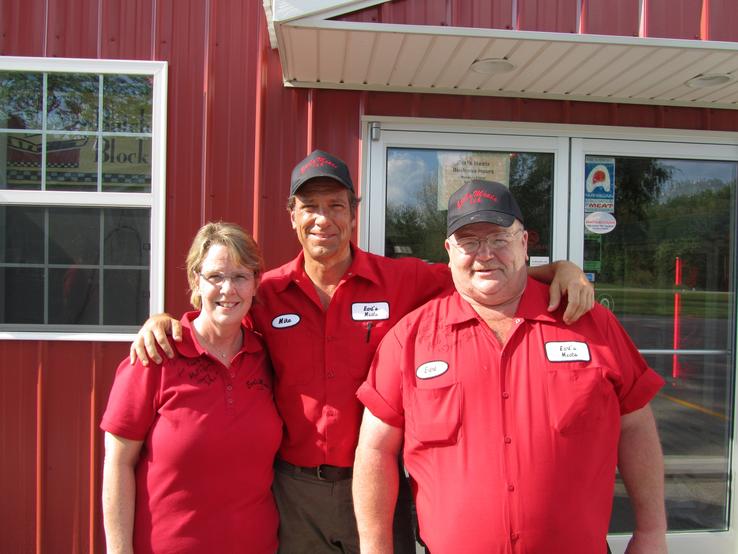
I am now rethinking even this limited meat option.  It had been sitting in the back of my mind that even meat raised at the kindest of farms likely goes through USDA-“overseen” slaughterhouses, with their 3-chickens-a-second conveyor belts, and an episode of “Dirty Jobs” — in which Mike Rowe shadows Earl’s Meats, a mobile butchering operation which travels to clients’ farms, slaughters their stock, and butchers the carcass, producing wrapped meats ready for the kitchen — implied that it is actually required that this happen.  The episode pointed out to me that the meat butchered in this way was unsuitable for sale to the public because it had not been slaughtered in a USDA-inspected slaughterhouse.

This means that any meat to which I have easy, retail access, short of something I have slaughtered personally, has been processed through a USDA slaughter operation and has therefore been in the tender “care” of a high speed slaughter plant, or one of the new USDA-inspected mobile units, which can potentially process 30 head of cattle a day.  This means that it’s time to drop the “small farm” meat and become officially vegetarian, because there is currently no such thing as “humane” meat.

As a side note, here’s the Mobile Slaughter Unit Compliance Guide from the USDA.

When Did This Become Normal?

PigletToday’s water-cooler article (here passed around by the Huffington Post) concerns an undercover video from the group Mercy For Animals (whose web site is usually mercyforanimals.org, but right now it’s redirecting to walmartcruelty.com, which features the original video).  The video, taken at Christensen Farms — or, rather, at one of Christensen Farms’ many subsidiary farms — shows horrific, awful things: sows confined in tiny, body-sized crates, like those used for veal calves; pigs and piglets with untreated, open sores and wounds; piglets being “euthanized” by what the farm — and the industry — euphemistically refers to as “blunt trauma” — i.e., by being swung by their hind legs and slammed into the floor head-first; and newborn piglets having their tails docked — and being castrated — with dull clippers, and without anesthesia.

What gets me is the quote from the Official Industry Representative:

“We have reviewed the video and have noted no exceptions to our company procedures or industry.” — Christensen Farms chief executive, Robert Christensen

And it’s entirely true.  There’s not a thing in that video that isn’t an official pork industry procedure.  Check it out — here’s the National Pork BoardSwine Care Handbook“:

  • “Stalls allow the sow to stand, lie, eat and drink, but may not allow them to turn around… Varying sizes of gestation stalls can be used without negatively affecting welfare… Sows may be penned in farrowing stalls from late gestation until weaning of the piglets.” (pg 8)
  • After birth, the following procedures may be performed on piglets: Clipping needle teeth; tail docking; ear notching; castration.  Note that only piglets older than 14 days of age “should” receive anesthetics for these procedures.  (pg 9-10)
  • Under Euthanasia, they recommend the National Pork Board booklet, “On Farm Euthanasia of Swine – Options for the Producer“, which describes “blunt trauma” as “effective”, but notes that some people find it “aesthetically objectionable”.  They also support “additional research on methods of neonatal euthanasia” — more ever-useful research into whether or not death is stressful.  (pg 31)
  • The general consensus seems to be that you have four options (pg 37) with a sick or injured pig: treat it (costs money); slaughter it for human consumption (you get paid normally for the carcass); cull it (“substandard slaughter”!) for pet food (you get less money for the carcass); or euthanize it (costs money, plus you have to dispose of the bits).  Which do you think most meat producers will choose?  Why pay to treat an injured animal when you can just kill it a little prematurely instead?

By not paying attention, we’ve created a space in which the things on that video are normal.  They are USDA-approved.  There are people who go to work every day, and cut the testicles out of squealing newborn piglets, and don’t think a thing of it, or, if they do, they don’t say anything for fear of being fired, because everyone else, especially the boss, is acting as though cutting the genitals off a conscious, unanesthetized piglet is appropriate behavior.

It’s possible to raise pigs in other ways.  You can keep farrowing sows on pasture.  You can use actual humane methods of euthanasia on culled piglets.  You can even use anesthetic for castration, or not castrate the piglets at all.  It’s just that it’s expensive to do it that way, and takes more time and effort, and that makes the meat cost more.  So, ironically, we, the consumers, are actually in control of this process: As long as we’re willing to buy cheap pork (and other meat; this stuff isn’t just happening to pigs), producers will keep making it this way.

400 Die In One-Vehicle Crash

Sheep.  Photo by penywise at morguefile.com.

Sheep. Photo by penywise at morguefile.com.

A while ago, I noted a flurry of articles which casually mentioned that, when two barns  at an egg farm burned down, 470,000 chickens died.  No-one seemed to find it a cause for concern that this meant each barn had held 235,000 hens.

Today I noticed many articles about a truckload of sheep which “crashed, rolled, and hung over an Australian overpass” on May 31, 2012.  (As a bonus, that particular article also begins with the highly professional and journalistic sentence “Counting sheep has never been so horrific.”)  Sheep rained over the side of the overpass and fell on motorists below.  This article has a little more detail, and some rather sad photos if you’re feeling brave.

And again, a major point is being missed….

FOUR HUNDRED SHEEP?  On one truck?  Four HUNDRED sheep?

There’s no information about the model of truck involved (there are photos though, including some here, here, and here), but, concerning the maximum size of haulage vehicles, the Roads and Traffic Authority of New South Wales mandates:

A trailer built to carry cattle, sheep, pigs or horses on two or more partly or completely overlapping decks must not have more than 12.5 metres of its length available for the carriage of animals, measured from the inside of the front wall or door of the trailer to the inside of the rear wall or door of the trailer, with any intervening partitions disregarded.

12.5 meters is approximately 37.5 feet.  From the same document, we know the trucks are at most 2.5 m (7.5 ft) wide, so one level of the truck has (37.5 x 7.5) = 281.25 square feet.  281.25 square feet x (let’s be generous, and hope this truck, like this one, has four levels) 4 vertical levels = 1125 square feet in the entire vehicle.  That gives us…2.81 square feet per sheep?  What?  For an animal which can weigh 150-350 poundsThree square feet?  150-200 pounds is about an average human…can you fit in three square feet?  (That’s a little more than three sheets of typing paper, by the way.)

I’m not insane, apparently — this is a real thing, against which people have been protesting for a while.   Why aren’t we hearing more about it?  A Google search for “australian sheep truck” turns up pages and pages of nearly verbatim reposts of this story — why isn’t anyone curious as to how four hundred sheep got onto one truck, or why they are allowed to be crammed in that way?

470,000 Die, Receive Brief Mention In Local Paper

Just a little something I noticed today….

An egg farm near Roggen, Colorado, owned by Boulder Valley Poultry, burned to the ground on April 30.  The extremely brief article (which matches other, extremely brief articles in other papers) declares the event an accident, and winds up by reassuring consumers that their supply of eggs is unlikely to be affected.

Oh, yeah, and 470,000 hens died.  In two barns.

What an interesting, unremarked, casual aside.  These aren’t unbelievably huge buildings.  235,000 chickens in each one?  To give each chicken one square foot of floor space in an open-floor plan (an extremely minimal investment), the barns would need to be 100 ft x 2,350 ft (almost half a mile long).  How densely were these chickens packed?

Also, “many local producers have agreed to step up production”.  How do you do that, I wonder?

Book Review: Meat Market: Animals, Ethics, and Money

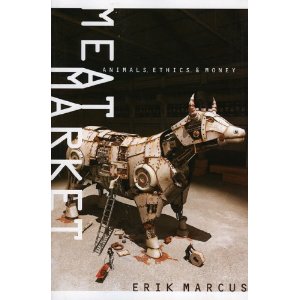
Meat Market: Animals Ethics and MoneyMeat Market: Animals, Ethics, and Money, by Erik Marcus, is an interesting, if brief, read, and a good answer to the question “What are these hippie freaks whining about, anyway?”  It’s not a perfect introduction — I’m still looking for the best way to suggest to, say, my parents that they not eat factory-farmed animal products — but it’s a good explanation of where one is coming from which doesn’t involve showing one’s audience graphic video of a slaughter plant.

The book begins with a glimpse of how and why small-farm practices become factory farm practices, follows up with an excellent, reasonably impartial, description of common factory farming practices for chickens, pigs, and cattle, and describes some options for what could be done to alter the status quo, along with what is currently being done.  It examines the three facets of the current what-the-hell-is-going-on-here movement (animal welfarists, animal rightists, and vegetarians), describes their goals, actions, and methods, looks at what is working and what isn’t, and suggests an alternative option (complete dismantlement of the system).

The book ends in a flurry of interesting essays and appendices, with subjects ranging from Starting a Local Vegetarian Society to The Ethics of Hunting.  It’s a lot of different viewpoints (although, toward the end, the vegan viewpoint grabs center stage and holds it), and, more, it’s thought-provoking material.

For example, it thoughtfully compares the relative quality of life — inasmuch as we can measure “quality of life” for another species — of various factory-farmed animals.  If you only give up one thing to make farmed animals just a little happier, Marcus says, give up eggs: the hens producing them are confined in ludicrously tiny cages their entire lives, debeaked, crippled, repeatedly force starved, and then slaughtered at the end.  The animal with the “best” relative life is the beef calf, which has a pretty good time of it (out at pasture, with mom) until about six months of age (after which it all goes to hell, but briefly compared to the two years’ close imprisonment of the laying hen).

The other thing that hit me was the reminder that, even though I am carefully purchasing milk from “certified pasture-kept” (and, theoretically, happy) cows, by purchasing milk at all I am contributing to the veal industry.  I am ashamed it didn’t occur to me before — of course!  What are they doing with all the male calves? — but now that I know I am trying to figure out how to get milk out of my diet, or at least minimize it.  Alas, soy milk tastes like liquid Lucky Charms, and unsweetened soy milk has the texture of Elmer’s glue — I am working on it.  In the meantime, I do my best to minimize consumption of milk and cheese….

If you are just starting to look at vegetarianism or veganism or know someone who is, Meat Market isn’t a bad start.  It is not overly preachy and does not use “We can’t kill animals because they are so CUTE!” faux logic — it produces rational, empirical examples which make it difficult not to listen.  I kind of wish it hadn’t ruined milk for me, but I can’t honestly blame the messenger.

Online Learning Tool: Animal Ethics Dilemma

While searching Amazon for more books to eat, I found a mention of a free “online learning tool” called Animal Ethics Dilemma.  It presents five case studies (focusing on the use of genetically modified animals, specifically monkeys, in research; the welfare of farmed chickens; euthanasia of aggressive pets; rehabilitation of wildlife; and slaughter plants) and provides various ways to explore the issues presented by these situations.  It encourages the user to  consider various response options to potentially real-world situations.

Overall, it’s well put together.  It does a decent job of introducing five broad areas of animal welfare.  The exploratory answer options tend to be a little fixed — the tool is trying to introduce the user to five (debatable) points of view (“contractarian“, “utilitarian“, “relational“, “animal rights” and “respect for nature“) and, instead of allowing freeform answers, the tool forces you to choose between five fixed answers, each representing one of the categories.  I don’t honestly believe that any one of these viewpoints is entirely right in all situations, but the division helps to simplify the problems a bit for initial interpretation.

You do have to create a username and password to use the thing, but it’s free, and it never asks for any personal information.  It’s designed to let you create a profile of yourself before experiencing the tool, and compare it to a profile of yourself after working with the tool.  It’s interesting, and it’s not preachy.

For what it’s worth, I personally figure as highly “utilitarian” and “animal rights”.

Colorado Tourists Feel Threatened By Sheepdogs

As someone who used to work extensively with wolves, I have something of a background with, and fondness for, livestock guarding dogs.  These dogs are a primary, generally quite effective, defense for ranchers against local predators, including wolves.  They live and roam with the flock, providing 24 hour protection, at little cost.  The process works via carefully raising dog puppies with the flock, so that the pups become socialized to the sheep — the pups become kind of “honorary sheep” and fiercely defend their adopted “conspecifics”.  This can be protection for both predator and prey.  In Africa, dogs are employed to defend livestock against cheetahs — protecting the stock from the cheetahs, and the cheetahs from the wrath of the livestock owners.

Today I found myself looking at an article which suggests the dogs might be a little too fierce.  The dogs “snarl”, and “on some occasions, chase” tourists around the Molas Pass area in the San Juan National Forest.  I am curious as to how close the tourists are getting — in the wild back country of Colorado, which I recall being a very wide-open place — to the flocks for the dogs to become alarmed.  The dogs generally do not roam far from their flocks and do not usually become aggressive unless they, or the sheep they protect, are directly and closely approached.

In any case, “snarling” and “chasing” things that get too close to the sheep are kind of required behaviors for livestock guarding dogs.  They aren’t trained to be aggressive, but they are not specifically bonded to humans, either.  They are designed to deter the approach of unfamiliar mammals (and that includes humans) to their adopted flock.  Wasn’t that kind of the point?

However, this is just a briefly trending argument between two groups of people (ranchers and tourists) who want to use the same piece of land for two different activities, and it isn’t a particularly new thing (people have been arguing about land use for years and years).  What is most interesting to me is the photo accompanying the article I first saw (which was not the original, source article).  The original, source article has photos of Akbash guard dogs doing what they do 99% of the time — standing in a field, quietly surrounded by sheep.  The article I first saw used a “file photograph” of two dogs fighting to illustrate the exact same story.  Also, contrast the two titles: the original title, “Problem dogs in backcountry?“, and the title of the story with the fighting dog photo, “Fierce sheepdogs alarming tourists in SW Colorado“.

Same article, two entirely different slants — brought about simply by changing the title and the accompanying photo.  Another good reason to always check the source of an article, no matter where it’s published.  (For full disclosure, the photo I used for this post came from this site.)

One Step Forward, One Step Back: Gassing Chickens

via Cheetah100, Flickr Creative Commons

As described in many, many, many books and videos (but especially accessibly by this book, in case you’re interested), large slaughterhouses can process so many animals per hour that workers on the assembly line can have to deal with as many as one animal every five seconds (depending on species).  This causes “sloppy workmanship” on the part of the workers, manifesting itself in animals “stunned” badly or not at all, injuries to animals and workers as conscious animals are “stuck”, “legged”, or dunked in tanks of scalding water…um, anyway, high speeds in large slaughterhouses are bad, primarily because handling so many animals, so quickly, makes it possible for humane killing methods to “miss”, and for animals to go through the butchering process not only alive, but conscious.

There seems to be a movement afoot that at first looks like a great idea: some factories here and there have picked up on the idea of “sedating”/”stunning”/”gassing” the animals with carbon dioxide to make sure they are unconscious before being killed.  On the one hand, this is a great step forward.  A slaughterhouse is actually considering the needs of the animals it is processing and trying to make the experience less stressful for them.  Yes, the slaughterhouse will benefit from this: the birds will be less damaged on packaging (less wasted meat) and of course they will be able to put “humanely slaughtered” on all their packaging, so it’s not as though it’s all altruistic, but still: baby steps.

On the other hand — speaking as someone who has personally “euthanized” hundreds of mice via carbon dioxide and seen others do so — this is not a foolproof answer.  CO2 euthanasia is only a quiet, peaceful death if it is performed very slowly, very carefully, on one animal at a time.  (Even that’s debatable — there’s still a happy section of science cheerfully turning out papers on whether or not CO2 euthanasia is “euthanasia” at all.)  I strongly suspect that the fast-paced world of the high-volume slaughterhouse is not going to combine well with the slow and careful process of humane CO2 euthanasia.  Captive-bolt stunning, which is already used by the factories, is, in itself, a humane procedure.  However, the speed at which a large slaughterhouse operates renders captive-bolt stunning inhumane because proper procedures are unable to be followed and the animals are not properly stunned.  I think the same issues will affect CO2 euthanasia if it is used in high-volume slaughterhouse operations.

First, the size of the operation itself is going to induce pressure to make the process of filling the gas chamber, which should be a carefully monitored, slow procedure, a quick-and-dirty one.  The chicken factory mentioned in the link above, at least, appears to be talking about processing hundreds of birds at a time — according to the article, the containers in which the birds are shipped to the plant will go into a huge CO2 chamber, which will need to be room sized at least.  How to fill such a room?  Recommendations vary, but the average is something like 10% of room air replaced with CO2 per minute — that’s at least ten minutes to fill the chamber with gas.  (There are arguments for and against pre-filling the chamber with gas, or using faster filling speeds, but that discussion must be saved for a different article.)  The chamber will then need to be cleared of gas before workers enter and remove the birds (or the workers will need breathing apparatus).  This is all going to take time, which high-speed workers do not have.

Second, the size of the room is going to affect the facility’s ability to deliver gas properly to every animal.  Birds further from the gas vents will be affected at different rates than birds next to the vents.  Also, since CO2 is heavier than air, the birds at the top of the room will be affected differently than birds at the bottom.  What will assure that every animal: a) is rendered completely unconscious, b) remains unconscious for butchering?  In a room of sufficient size it is possible for the outermost birds at the bottom of the room to be dead while the birds in the center on the top are still conscious.  If workers are filling and emptying the room at high speeds, this problem is actually quite likely.  (There are already documented reports of dogs surviving similar gas chambers at humane shelters.)

Third, many laboratory euthanasia standards recommend euthanizing animals by CO2 one at a time (or in small familiar groups in their home cages).  (However, it should be noted that the official AVMA line on this is that the gas “chambers should not be overcrowded”, and indeed, some facilities routinely toss a bunch of animals all into one cage for euthanasia to save time.)  This is because animals can detect the intrusion of CO2.  They often become alarmed and disoriented before they go down, running, kicking, squealing, and generally acting agitated.  This does not promote quiet, calm, peaceful behavior — this promotes a room full of shrieking, flapping, alarmed and disoriented birds.

Apparently they’ve been trying CO2 euthanasia on pigs tooThis article suggests that all the agitation takes place after loss of consciousness and that the pigs are completely out cold while “convulsions, vocalization, reflex struggling, breath holding, and tachypnea” occur.  I’ll admit I’ve never seen a pig euthanized by CO2, but I must say I have some reservations about how “unconscious” the mice and rats I euthanized were while they underwent “Guedel’s second stage of anesthesia“.

I applaud these factories for trying to make the treatment of the animals with whom they are working more humane.  (I am an animal trainer at heart, and I know to reward “baby steps”, no matter how small.)  However, I believe these factories are not treating the correct problem (which is generally that the facility is trying to process too many animals for its capacity, and using pressured, underpaid, and under-trained workers).

Bad Animal Husbandry Has Consequences

Scared Sheepless by Chris Ayers Design

Image from "The Daily Zoo" by Chris Ayers - http://www.chrisayersdesign.com

Two ranch-hands in Wyoming contracted Campylobacter jejuni infections via castrating lambs with their teeth.

I’m sure that, with some effort, they could have found some other way to do that.

This is one of those situations where I can see both with the eyes of an animal welfarist and with those of a ranch hand.  The animal welfarist says, “Why are you doing that with no anesthetic?!?  With your teeth?  Why are you castrating them at all?  You could just [insert high-maintenance management program, expensive castration alternative, or impossible immediate job switch here]!”  The ranch hand says, “I have 1,600 sheep to do — can you imagine what it would cost, or how long it would take to anesthetize every one?  Or to separate every adult ram, because they’ll fight?”

(Hate this problem?  Ask why they have 1,600 baby sheep — they have such a large flock because they’ve been forced to expand their business to compete with even larger companies, to supply people who buy wool sweaters and ground lamb from enormous box stores.  Buy local, and know what you’re buying.)

Either way, this is another one of those horrible consequences of exceeding the Monkeysphere — the sheep have become items, not individuals — and of assembly-lining the process.  Forced to do something 1,600 times in a short period, the ranch hands found the fastest, lowest-effort way they could in which to do it.  I notice that no-one checked to see if the sheep caught anything from their mouths!

Seeing About Seafood

Since I am both highly calorie-restricted and also doing my level best to avoid factory-farmed meat, it is extremely rare these days to open a menu and see more than one thing I can calorically and morally afford.  I find myself leaning towards seafood these days, for sources of low-calorie, lean protein which are unlikely to involve ghastly intensive farming practices, but of course anything purchased in a restaurant is suspect until investigated.

Today, I took a look at shrimp, which is delightfully low-calorie (when not coated with heavy sauce, or fried), and easily raised domestically, so I am unlikely to be decimating dwindling wild populations.  Shrimp “harvesting” is also reasonably fast and does not involve the inhumane slaughter methods common with large mammals.

Shrimp farming is popular and widespread, which of course invites unfortunate habits by shrimp farmers trying to increase the number of animals they can produce/sustain in an individual pond.  Certainly I cannot cover the entirety of “shrimp farming” in a bite-size blog post, but here is a basic overview of U.S. shrimp farming in .pdf form from Auburn University; here is a more in-depth description from Kentucky State University; and here is a formal collection of overall information from the National Oceanic and Atmospheric Administration.  Here’s one for the Gulf of Mexico from NASA.  For comparison, here is a (likely virus-free) .doc file from the Association  of Southeast Asian Nations (unfortunately with no date) describing shrimp farms in its member countries.

It’s hard to form a universal rule on store-bought or restaurant-purchased shrimp, since it’s coming from so many sources, but fortunately a lot of restaurants are wising up and at least giving lip service to sustainable (and reasonably kind) farming practices.  Here’s the info for Red Lobster, whose menu caused my initial investigation re: seafood.  Hmm, pretty vague on farming practices, but I like that they’ve teamed with an aquarium.  Purchasing the fish at a specialty grocery store is usually safer: here’s the info for Whole Foods Market, which both reassures me that they’re at least trying, and paints a terrifying picture of what some shrimp farms must be doing, in order for Whole Foods to require rules such as these.

Seafood as a whole is generally suspect due to overfishing and overfarming, but there are some good options out there.  Here’s some good advice on picking “kind” and healthy seafood from the Monterey Bay Aquarium, including the Seafood Watch app for Android and iPhone, which can be used to find local restaurants which have chosen to purchase their seafood sustainably.