
Category Archives: news

When Did This Become Normal?

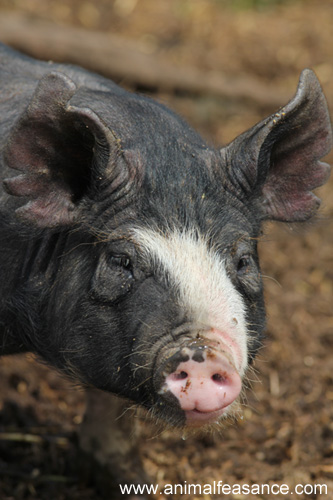
PigletToday’s water-cooler article (here passed around by the Huffington Post) concerns an undercover video from the group Mercy For Animals (whose web site is usually mercyforanimals.org, but right now it’s redirecting to walmartcruelty.com, which features the original video).  The video, taken at Christensen Farms — or, rather, at one of Christensen Farms’ many subsidiary farms — shows horrific, awful things: sows confined in tiny, body-sized crates, like those used for veal calves; pigs and piglets with untreated, open sores and wounds; piglets being “euthanized” by what the farm — and the industry — euphemistically refers to as “blunt trauma” — i.e., by being swung by their hind legs and slammed into the floor head-first; and newborn piglets having their tails docked — and being castrated — with dull clippers, and without anesthesia.

What gets me is the quote from the Official Industry Representative:

“We have reviewed the video and have noted no exceptions to our company procedures or industry.” — Christensen Farms chief executive, Robert Christensen

And it’s entirely true.  There’s not a thing in that video that isn’t an official pork industry procedure.  Check it out — here’s the National Pork BoardSwine Care Handbook“:

  • “Stalls allow the sow to stand, lie, eat and drink, but may not allow them to turn around… Varying sizes of gestation stalls can be used without negatively affecting welfare… Sows may be penned in farrowing stalls from late gestation until weaning of the piglets.” (pg 8)
  • After birth, the following procedures may be performed on piglets: Clipping needle teeth; tail docking; ear notching; castration.  Note that only piglets older than 14 days of age “should” receive anesthetics for these procedures.  (pg 9-10)
  • Under Euthanasia, they recommend the National Pork Board booklet, “On Farm Euthanasia of Swine – Options for the Producer“, which describes “blunt trauma” as “effective”, but notes that some people find it “aesthetically objectionable”.  They also support “additional research on methods of neonatal euthanasia” — more ever-useful research into whether or not death is stressful.  (pg 31)
  • The general consensus seems to be that you have four options (pg 37) with a sick or injured pig: treat it (costs money); slaughter it for human consumption (you get paid normally for the carcass); cull it (“substandard slaughter”!) for pet food (you get less money for the carcass); or euthanize it (costs money, plus you have to dispose of the bits).  Which do you think most meat producers will choose?  Why pay to treat an injured animal when you can just kill it a little prematurely instead?

By not paying attention, we’ve created a space in which the things on that video are normal.  They are USDA-approved.  There are people who go to work every day, and cut the testicles out of squealing newborn piglets, and don’t think a thing of it, or, if they do, they don’t say anything for fear of being fired, because everyone else, especially the boss, is acting as though cutting the genitals off a conscious, unanesthetized piglet is appropriate behavior.

It’s possible to raise pigs in other ways.  You can keep farrowing sows on pasture.  You can use actual humane methods of euthanasia on culled piglets.  You can even use anesthetic for castration, or not castrate the piglets at all.  It’s just that it’s expensive to do it that way, and takes more time and effort, and that makes the meat cost more.  So, ironically, we, the consumers, are actually in control of this process: As long as we’re willing to buy cheap pork (and other meat; this stuff isn’t just happening to pigs), producers will keep making it this way.
Coyote: Compare and Contrast

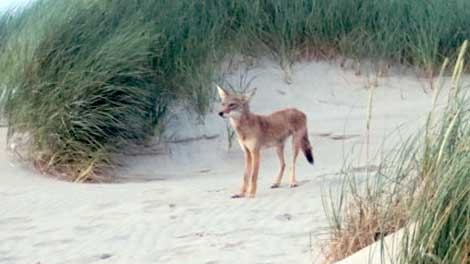
Nehalem Bay State Park coyote

Aggressive coyote at Nehalem Bay State Park. Photo has many attributions — It’s probably from the Oregon Parks & Recreation Department, via a visitor who snapped a photo of what is believed to be the relevant coyote.

On June 21, 2012, a 20-pound female coyote attacked a five-year-old girl in Nehalem Bay State Park in Oregon.  The girl is fine.  The coyote is not, but you wouldn’t know it from this National News article, which reports, both in its headline and in the text of the article, that the offending coyote was “removed” from the park.  That sounds like it was live-trapped and relocated, doesn’t it?  Only at the end of the fourth paragraph do we see what really became of the coyote — apparently it was “safely taken from the park by lethal means“.

“Safely taken”…by “lethal means”?  Not safely for the coyote, surely.

For contrast, here’s an alternative article, about the same event, whose angle implies the coyote was “tracked down and killed”.

Here’s an article that says the girl was “nipped” by the coyote; here’s one that says she was “bitten”; here’s one that says she was “attacked”.  Here’s an article calling the event an “encounter”, using a headline which carefully implies the coyote was not necessarily at fault (“Coyote killed after encounter left 5-year-old girl injured“), and specifically not using the word “bitten”, yet still using the word “attacked” later in the article.  And here’s one that deliberately emphasizes that the attack was made upon a “little girl”.  What do you suppose actually happened?

And, as a bonus, here’s the first article published verbatim by a different news agency without the original byline.  Notice that they changed the headline to include the word “attack”, even though the word “attack” appears nowhere in the article?

This is why I never trust information from just one source.  Journalists are supposed to be unbiased, but it doesn’t often happen that way.

Asking For a Broken Leg: Foal Wrasslin’

Humane and safe youth rodeo, by mettem on morguefile.com

Humane and safe youth rodeo, by mettem on morguefile.com

One of my favorite blogs, Snarky Rider, had a post discussing a rodeo event of which I’d never heard, where groups of three children, about 8-12 years old by the looks of it, run up to a foal, grab it, get one of the kids balanced on its back and race for a finish line.  The original post, with photos, from the Goat Whisperer, is here.  The event disturbed me on several levels, and I thought I’d write about it, because people ought to know this is happening.

The event appears to be the “baby” version of an equally (in fact, much more) unpleasant activity, of which I was also previously unaware, called the “wild horse race” (link goes to video; here’s another), wherein adult humans run up to an adult horse, grab it, and attempt to ride it.  The wild horse race doesn’t just take place at the Yakama Nation “Treaty Days” rodeo — they do it at many rodeos.  In fact, I had a lot of trouble figuring out at exactly which rodeo this particular event took place; it actually appears to have taken place at the “White Swan Junior Rodeo Association Spring Round Up” or “White Swan Junior Rodeo”, which seems to be a different event than the “Yakama Nation Treaty Days” rodeo (which features mostly adults).  There is also a Navajo Nation Treaty Days rodeo, and in fact there’s a whole association governing Native American rodeo in the Western states.

I can’t find a lot of info on the “junior wild horse race”.  It appears to have been held previously: here are some photos from the 2011 event, and from the 2010 event.  The event differs from the “dinner bell derby” or foal race, which is held at multiple rodeos, where foals are temporarily separated from their mothers (who are within sight), taken to one end of the track and released, to run to their mothers, who form the finish line.  (Whether or not this is cruelty may come down to the individual players in each individual event.  The video I saw involved some struggling and smacking to get some nervous babies to stand still and then to run, but the run itself was quite short and they made it to mama in generally good shape.)

That the baby wild horse race is not mentioned widely online does not mean it is not popular.  It just means that it’s not mentioned on the fliers.  Googling for “junior wild horse race” brings up some results, including mentions of such events happening in Rapid City, South Dakota and Chadron, Nebraska.  (Please do not get me started on breeding miniature bulls just for youth rodeo.)  This implies it’s a little more widespread than just one rodeo in Washington state.  On the bright side, they may not all be describing the same event: here are some photos from the Wood Mountain Rodeo’s 2010 junior wild horse race.  There are kids involved, but they are: a) older, b) wearing safety gear, and c) working with adult horses.  Image searching for “junior wild horse race” turns up a couple more photos from different rodeos, again with older kids, safety gear, and adult horses.  Not that I approve of this event in general, but I can think of ways where a “wild horse race” with adult horses and sane older kids/adults in safety gear can be done humanely for all parties, and I can’t imagine a single way it’s possible for three eight-year-olds to humanely — or safely! — aggressively wrestle into submission a three-month-old foal.  (It’s also not something I’d want my eight-year-old — or my foal! — to be learning when it comes to human/animal interaction, but that’s just my personal opinion.)

Hopefully, the White Swan Junior Rodeo Association’s use of extremely young horses and extremely young children in a wrestling contest where they are both just asking to get broken is a lone blip.  (And, as Goat Whisperer suggests, we should be writing the Yakama Nation and asking them, politely, if they have lost their minds.)  Either way, this is another in a long line of very good reasons not to attend or support a rodeo.  Surely in this day and age we can think of more productive things to do with our spare time?


400 Die In One-Vehicle Crash

Sheep.  Photo by penywise at morguefile.com.

Sheep. Photo by penywise at morguefile.com.

A while ago, I noted a flurry of articles which casually mentioned that, when two barns  at an egg farm burned down, 470,000 chickens died.  No-one seemed to find it a cause for concern that this meant each barn had held 235,000 hens.

Today I noticed many articles about a truckload of sheep which “crashed, rolled, and hung over an Australian overpass” on May 31, 2012.  (As a bonus, that particular article also begins with the highly professional and journalistic sentence “Counting sheep has never been so horrific.”)  Sheep rained over the side of the overpass and fell on motorists below.  This article has a little more detail, and some rather sad photos if you’re feeling brave.

And again, a major point is being missed….

FOUR HUNDRED SHEEP?  On one truck?  Four HUNDRED sheep?

There’s no information about the model of truck involved (there are photos though, including some here, here, and here), but, concerning the maximum size of haulage vehicles, the Roads and Traffic Authority of New South Wales mandates:

A trailer built to carry cattle, sheep, pigs or horses on two or more partly or completely overlapping decks must not have more than 12.5 metres of its length available for the carriage of animals, measured from the inside of the front wall or door of the trailer to the inside of the rear wall or door of the trailer, with any intervening partitions disregarded.

12.5 meters is approximately 37.5 feet.  From the same document, we know the trucks are at most 2.5 m (7.5 ft) wide, so one level of the truck has (37.5 x 7.5) = 281.25 square feet.  281.25 square feet x (let’s be generous, and hope this truck, like this one, has four levels) 4 vertical levels = 1125 square feet in the entire vehicle.  That gives us…2.81 square feet per sheep?  What?  For an animal which can weigh 150-350 poundsThree square feet?  150-200 pounds is about an average human…can you fit in three square feet?  (That’s a little more than three sheets of typing paper, by the way.)

I’m not insane, apparently — this is a real thing, against which people have been protesting for a while.   Why aren’t we hearing more about it?  A Google search for “australian sheep truck” turns up pages and pages of nearly verbatim reposts of this story — why isn’t anyone curious as to how four hundred sheep got onto one truck, or why they are allowed to be crammed in that way?

Orangutan Prostitution Appalling, but Thankfully Not “Common”

Orangutan.  Photo courtesy Borneo Orangutan Survival Foundation.

Orangutan. Photo courtesy Borneo Orangutan Survival Foundation.

Another horrible thing wandered across my radar today, under the lively title “Orangutans being used as prostitutes!!”  The attached text (which was written by a random Facebook friend, not a journalist) implied that hundreds of orangutans are being snatched from the trees and used as prostitutes in villages in Borneo.  It included a link to a Care2 petition begging everyone to stop the orangutan prostitution industry.

So, some quick research.  There’s a bunch of stories on this floating about, and they all seem to reference this story, written on October 3, 2007 by Jack Adams of the online magazine Vice, which appears to be something of a news outlet but whose main-page stories (as of 5/27/12) also include articles like “If You Don’t Like The Spurs, You’re A Wall-Eyed Moron” and “Dave Hill Wrote Some Stupid Book“.  The orangutan story is extremely short (9 paragraphs, including the introduction) and does not go into a lot of detail.  It also does not in any way imply that orangutan prostitution happens outside of this one incident.

The interview is with Michele Desilets, director of the Borneo Orangutan Survival Foundation, founded in 1991.  The BOSF web site does not mention Pony or prostitution at all.  Neither does Michele Desilet’s Facebook page.  You would think that if orangutan prostitution was a huge industry (or even an industry at all), there would be mention somewhere.  Instead, we have a tweet from Michele personally (dated April 2012, and directed at someone else who was researching the petition site’s allegation): “The case of Pony the orangutan was the only case we have ever come across of this type.  It is NOT common.”

Is the use of animals of any kind (and, arguably, of humans) in a brothel an unforgivable atrocity?  Yes.  Is it terrible that this happened (and it does seem to have happened), and that the perpetrators won’t be punished (there are no laws forbidding this kind of behavior in Indonesia)?  Yes.  Is this a sad, sad example of how low some people will sink?  Yes.  Are hundreds of orangutans being captured for use in Indonesian brothels?  No.

What is really threatening orangutans?  Habitat loss due to deforestation, related to the palm oil industry.  Want to help stop the idiocy?  Don’t just sign an online petition — get out there and donate some money, try to reduce your use of products containing palm oil, (here’s a handy wallet card!) or, at the very least, Facebook or tweet about the Borneo Orangutan Survival Foundation (or the animal support group of your choice), and get people angry about a problem that actually exists.

470,000 Die, Receive Brief Mention In Local Paper

Just a little something I noticed today….

An egg farm near Roggen, Colorado, owned by Boulder Valley Poultry, burned to the ground on April 30.  The extremely brief article (which matches other, extremely brief articles in other papers) declares the event an accident, and winds up by reassuring consumers that their supply of eggs is unlikely to be affected.

Oh, yeah, and 470,000 hens died.  In two barns.

What an interesting, unremarked, casual aside.  These aren’t unbelievably huge buildings.  235,000 chickens in each one?  To give each chicken one square foot of floor space in an open-floor plan (an extremely minimal investment), the barns would need to be 100 ft x 2,350 ft (almost half a mile long).  How densely were these chickens packed?

Also, “many local producers have agreed to step up production”.  How do you do that, I wonder?

Horrible but Responsible

Foal photo by Taliesin, morguefile.comI read with mixed feelings an article from the Toronto Sun (which appears to be the original source) about the results of a decision ending provincial funding for the area’s harness racing industry.  The article is a tad suspect, because no sources are really named — “a number of sources”, including “an area horseperson, who asked not to be identified”, are quoted as saying “an unknown number” of foals are being euthanized “moments after birth” because breeders are facing an unanticipated, severe economic downturn.

Apparently, the Ontario Lottery and Gaming Commission has decided to stop funding harness racing (and, it appears, other equestrian activities) with a portion of the annual revenue it gets from slot machines.  The Commission will instead be funneling the monies into funding things like hospitals and schools.  The Canadian equine world is not pleased about this, and neither are a lot of people involved in the gaming industry.

Knowing this, the article looks less like “news” and more like a desperate effort to smear those responsible for the shutdown.  I’m interested that they’re not saying, “People are losing jobs!” but “These poor baby horses are being killed!”  This smacks of some media person trying to pull on heartstrings.  It is likely true that someone, somewhere, may be euthanizing some of their herd due to the economic slam.  However, since horse slaughter is legal in Canada, it is much more likely that a breeder finding themselves with extra horses and no money will simply sell the unwanted animals by the pound for slaughter — a much more profitable enterprise than paying a vet for chemical euthanasia and disposal.  Thus I seriously doubt this story — no dates, no names, no sources, no traceable facts — just a lot of people suddenly terrified that the decision is putting people out of a job is funding necessary government programs might result in someone killing baby ponies!

Honestly, if I heard that a breeder was humanely euthanizing their suddenly unwanted foals rather than trying to, say, sell them for slaughter, give them away for free on Craigslist, or just passively neglecting them to death (please don’t make me find links to examples — I assure you there are plenty), I would be amazed that the breeder was taking such responsibility for the animals under their care.  Sure, I’d be happier if they were finding loving homes for the horses, but, in a world of awful realities, there just aren’t enough homes for everybody.  I’d so much rather the breeders took responsibility for making sure the babies under their care never got given to an inappropriate home, sent to slaughter or allowed to slowly starve to death.

The world is really messed up when I read a story (however journalistically dubious) about baby ponies (often accompanied by heart-wrenching photos of adorable, fuzzy baby horses presumably being menaced by this scourge) being euthanized because their owners are threatened by sudden economic crisis, and immediately think, What responsible owners!  Good for them not letting the poor things rot or selling them for meat!

Fox To Guard Hen House, Salmonella at 11

Back when I was in high school, the state in which I was living at the time was having difficulty getting a sufficiently large percentage of students to pass their standardized tests.  Their solution to this problem, of course, was to dumb down the tests, to make it easier for badly educated children to pass them.  It solved the problem (kids aren’t passing the exams) without really solving the problem (the kids are not well educated enough to pass the exams).

The USDA seems to be adopting a similar strategy in their poultry inspection program.  For reasons which have absolutely nothing whatever to do with consumer safety (they claim they are “modernizing an outdated system” but mostly, the move will allow them to eliminate about 800 jobs, and will allow the plants to chew through 70% more birds by speeding the disassembly lines up even more), the Agriculture Department’s Food Safety and Inspection Service (FSIS) wants to allow individual poultry plants to provide their own inspectors rather than use inspectors supplied and trained (and paid) by the government.  (This appears to be the original policy document, which goes into detail about the policy and is even more hair-raising than the New York Times article.)

Apparently, they’ve been trying this program in pilot plants, with the results you’d expect — the “inspectors” are being placed at the end of the line where they can’t see what’s going on, and the increased speed of the lines (up to 200 birds per minute, from the current 140) makes it even less likely that defects will be spotted.  (200 birds a minute is more than three birds per second.  How much detail — mold, disease, defects — can you see if you’re looking at three birds per second?)

To the above point, I’d like to add that the main humane issue in the processing of poultry (and other animals) is the unbelievably immense number of birds being slaughtered — this results in chickens going through part of the slaughter process conscious, among other horrifying things (workers losing fingers; consumers contracting salmonella).  Even assuming multiple lines, how do you humanely slaughter three chickens per second?  How do you “oversee” such a process?  Apparently the USDA has decided to “overlook” it instead.

Increasing the speed of the lines by 70% and reducing the effectiveness of oversight does not sound like an idea with the best interests of either the birds or the consumers at heart.  No wonder the poultry industry has “applauded the Agriculture Department decision.”

(Bonus: check out the photo in that article, of “chickens in an egg farm”.  How many hens are crammed into that tiny space?  At least they’re not debeaked….)

Context is Needed

chimp and tigerThis photograph, from this article (and many others), has been wandering around the net for a bit recently.  The animals are billed as being from the Samut Prakan Crocodile Farm and Zoo near Bangkok, Thailand.

Okay, this is adorable.  However, please think to look closer:

Look in the background of the pictures.  Look at the big cat cubs kept alone in small dog kennels.  There’s a pair of them playing unsupervised on the floor.  Look at the stacks of cheap dog kennels — does this look like a reputable zoo to you?  How reputable does this photo from their “elephant show” (taken from this web site) look?  Check out the reviews on TripAdvisor.com — apparently the primary moneymaker for this facility is selling crocodile skin.  It started life as a crocodile farm and seems to have picked up some random exotics for the extra cash.

Is this what you want to support?  Quit sharing this “cute” picture without the full context.  It encourages people to think you can keep chimps and tigers as pets (hint: bad idea), and it’s generating publicity for a facility which encourages tourists to pose feeding and holding baby exotics (I can only imagine they pay for the privilege), mishandles them in “shows” (more photos here, here, here, and here, and in piles from Google image search), and slaughters crocodiles for leather and meat, as well as encouraging other facilities to do the sameFacilities like this routinely mistreat their animals.  The previous example mentions China, but it happens everywhere, Thailand (and the US) included.  Don’t support this kind of thing.

You like tigers?  Go here and support them.  Love chimps?  Go here and support them.  Put your effort into places that deserve it.  Don’t lend your time or blog space to this facility, unless this is the kind of animal husbandry you wish to support.

Activists’ Surveillance Helicopter Shot Down by Hunters

A while ago I commented on the discovery, by a man flying a model aircraft equipped with a camera, of a “river of blood” behind the Columbia Packing Company, a Dallas, Texas meatpacking plant.  I was interested that the immediate public reaction, in some forums, seemed to be not “What is that river of blood doing there?” but “Wasn’t that photo a violation of the packing company’s privacy rights?”  I felt that that kind of attitude could make it difficult for anyone to document anything — including animal rights violations — which happened to be taking place on private property.

Recently, a South Carolina animal rights group with the acronym S.H.A.R.K. sent a reconnaissance helicopter over a group of hunters who were, on private property (Broxton Bridge Plantation), having a “pigeon (or dove) hunt” (according to them — probably one of these) or a “pigeon shoot” (according to S.H.A.R.K.).  S.H.A.R.K. planned to shoot video of the event.  Of course, the hunters promptly shot down the drone.

Ironically, both the pigeon hunt and the drone launch in this case were apparently perfectly legal.  The shooting of the drone might or might not also be legal, but neither it nor the launching of the helicopter was probably the most enlightened way to make the feuding parties’ respective points.