Category Archives: society

Keeping Animal Abuse Private

A model-aircraft hobbyist recently made an accidental discovery while flying his model airplane, equipped with camera, over the Columbia Packing Company, a Dallas, Texas meatpacking plant: a river of suspiciously red effluence flowing from behind the plant, pouring into the Trinity River.  According to the article, based on the information provided by the hobbyist, “a local investigator was dispatched within 20 minutes, and onside within another 20”, and shortly thereafter the EPA, TCEQ, and Texas Parks and Wildlife executed a search warrant on the plant, finding “a pipe not connected to a waste water system“, apparently deliberately.

The scary part here is the immediate defense brought up (not necessarily by the plant itself, but by people in the comments section of several pages announcing the discovery).  The argument is that the hobbyist was invading the plant’s privacy by taking photographs from his plane.

Where does the right to privacy end?  Is it okay to dump biological agents (e.g., pig blood) into waterways as long as you’re not caught?  Do people who are committing crimes have reasonable expectation of privacy while doing so?  This is one of those questions where I simply do not have the legal background to form an answer.  It’s a complicated mess.  It’s cropped up before, and we’re still arguing about it.

This sort of thing affects the ability of the general public to report problems of all kinds — not just environmental damage but also animal cruelty.  Photographs are some of the best evidence in these cases, and are vital to construction of an effective prosecution.  Making it difficult for photographs or other recorded evidence to be admitted in court is a primary retaliatory response from organizations and individuals caught red-handed by that evidence.  Generally, those interested in recording documentation in order to report issues are instructed to take photographs from a public road so they can avoid having the evidence dismissed amid counter-charges of trespassing.  Well, somewhere above the level of your house or building, the area becomes “public access” again.  How high does a plane need to be flying before it’s out of your curtilage (owned area or property)?  Is Google Maps (which, notably, takes its “street view” photos from the public road, and its aerial photos from satellites) invading our privacy?  By the way, here’s Google’s aerial picture of the packing plant (also, notably, capturing a Very Red River).

It’s kind of important that we answer questions like these, partly because more people are getting access to the kind of technology which lets you fly camera-enabled model planes, but also because companies are using this “privacy” defense to attempt to pass laws preventing people from photographically documenting issues.
In What Way Is This Educational?

Every time I research Horrifying Thing A, I discover Horrifying Things B and C.

This afternoon I visited Horrifying Thing A: “Bodies Revealed“, which succeeds even less at convincing me that it is an entirely education-driven venture than did Gunther von Hagens’ “Body Worlds“, the original exhibition, which I saw years ago in Chicago.  Alas, I am not at this moment equipped to compare them (beyond saying that “Bodies Revealed” is but a sad, faint reflection of “Body Worlds”) or to comment on whether they are “educational” or “exploitative” (probably both, although “Body Worlds” has an edge on being, at some level, actual education).  I am an artist as well as a former worker with large carnivores; I am no stranger to dead things.  The anatomy, as well as the relation to art, fascinates me.  The topic which requires further consideration for me is a more moral angle: what is this exhibition for?  Why should I be giving it money (or not)?  How does it relate to other uses of dead things I have previously encountered, either thought-provoking, ridiculous or theoretically useful?  Why do human carcasses demand a more reverential attitude than do animal carcasses?

While looking around on the “Body Worlds” site for more information about the plastinates, trying to figure out what I did think about it all, I discovered Horrifying Thing B: von Hagens has an online store, in which “qualified users” can purchase actual plastinated human parts (as well as “formalin fixed specimens“).  Little wonder there is no photo available for the “wet whole body specimen, male, covered with skin”.  Okay, I can see how university anatomy departments might be really excited about the opportunity to get one of these, and I certainly support their use in education, but maybe they don’t need a publicly accessible web store.  More stuff for my brain to process (“Is it art?  Is it wholesale exploitationHow can he sell themWhere does he get all these people?  Is education worth the inevitable collateral of people buying these as coffee table decoration?  Is it okay if the bodies are all willing donors?”) later.

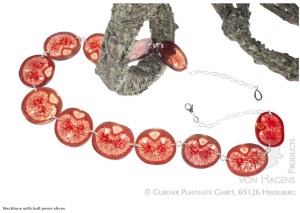
The site also notes that “Body Worlds” has some animal plastinates sprinkled in among the humans (my personal favorite is “Horse and Rider“, which in person embodies the word “awe-inspiring”).  In 2010 the animals got their own exhibition, “Body Worlds of Animals“.  This is, on the whole, all right.  We use dead animals, for better or worse, as educational tools all the time, and I’d rather see a dead animal made useful in some way than tossed in the trash.  However, Horrifying Thing C, today, was the discovery that the “Body Worlds” store is selling jewelry made of delicate, individual slices of plastinated fruit and, er, animal parts:

Those charming red circles are plastinated sagittal sections through a bull penis.  There are, of course, a matching bracelet and earrings.  They seem to have a lot of extra bull penises around the place, don’t they?

While part of me is desperate to get one of these for my mother-in-law, most of me is firmly in the “that ain’t right” camp.  There’s no way this is “educational”, and it’s sort of skirting the edge of being “art”.  I don’t mind animals (and, in many cases, consenting humans) being used for actual education, but I have problems with the gratuitous use of animal parts in art, especially if the animals are slaughtered especially so the art can occur.  I don’t think I need to be buying any of these, even if they are (as is likely) just using slaughter remnants of animals which are being butchered for meat and thoroughly used anyway.  My strongest feeling here, though, is that in no other context would anyone willingly wear goat testicles as fashion accessories.

Can’t Spell “Slaughter” Without Doublespeak

Even though it happens all the time, people hate talking about killing animals.  One of their favorite ways of avoiding the topic is to use euphemisms.  Rather than “killing” animals at the slaughterhouse, they “stun” them; rather than “dismembering” them they “render” or “process” them; and animals do not get crippled or maimed in transit to the slaughterhouse — instead they are “downed” — ad nauseam.

With this in mind: a quiet little law has recently been passed which makes it possible for the US to resume horse slaughter operations.  This sounds gruesome but it might be considered to be of net benefit to the horses.  Horse slaughter was originally banned in the US in order to reduce the number of horses slaughtered for meat, but the same number of horses still got slaughtered after the ban — they just got shipped to Mexico or Canada first.  The only effect of the slaughter ban was to add a horrific multi-day transit in un-air-conditioned cattle trucks to the horses’ experience.  So, we still need to do some work to solve the issue of horses in the slaughterhouse — but, in the meantime, at least we removed that awful transit experience.  Progress.

The Arabian Professional and Amateur Horseman’s Association wanted to show support for the Arabian Horse Association, which came out in favor of this law — but how to show its support without appearing to say, “Oh, good, we’re killing horses again”?  The APAHA decided to use a tragically awful euphemism:

The Arabian Professional and Amateur Horsemen’s Association voted, with unanimous approval, to thank the AHA Board for continuing your support for the re-opening of the equine terminal marketplace, and to join with the AHA in support of the reinstatement of equine processing in the United States.

George Carlin is rolling over in his grave.  The re-opening of the equine terminal marketplaceEquine terminal marketplace!  What on earth is the equine terminal marketplace?  They’re not going to slaughter — they’re going shopping!

Whether you support the rescinding of the ban or not — aren’t we all mature enough to admit, out loud, that humans kill animals for meat?  How are we supposed to solve the problem if we can’t even admit that it exists?  What was wrong with “We are happy that steps are being taken to reduce the suffering of horses bound for slaughter”?  Honestly, they could have just gone with the last paragraph of the original statement:

There are issues to address, certainly, and many different options available to improve the terminal marketplace, among them mobile slaughter units and live web monitoring of plants. As horsemen, breeders, and horse lovers, we are the ones responsible for dealing with these issues, making sure that the terminal marketplace becomes ever more humane, with a quick and dignified passing, without undue stress, and where the horse can go on to be useful to man after his demise, just as he has been for the last 5000 years.

Dog Joins the Monkeysphere

This is just another instance wherein an animal which comes to community attention as an individual (rather than as an anonymous member of a group) suddenly joins the Monkeysphere and becomes worthy of a social bond.

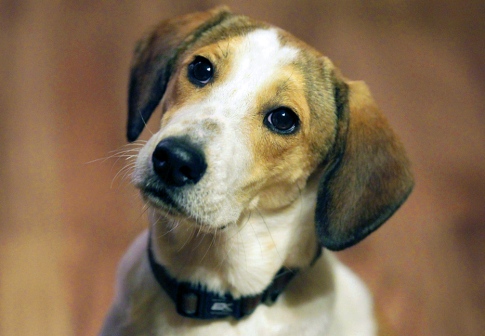
Nobody wanted to adopt an anonymous beagle when he was one of hundreds of unwanted dogs and cats at a shelter in Alabama.  “Hundreds of unwanted dogs and cats” is a huge, vague concept, and it’s hard to form a social bond with, or feel one is personally able to help, “hundreds of unwanted dogs and cats”.  However, once he was brought to national consciousness as an individual dog with a name, people fought over the right to adopt him and a home was almost immediately found.

This is, by the way, why savvy shelters post individual web pages for each animal, with a little story about each, and a name for everybody.  It’s hard to open your heart to “181406M”, but it’s easy to find a soft spot for “Daniel”.

(Daniel, by the way, now has his own blog, and is working to abolish the use of gas chambers for euthanasia of pets in Pennsylvania via Daniel’s Law.  See what you can do when you have a name?)

Letter from an Anonymous Shelter Manager Rings True

This has been traveling around with no reference of source:

“I think our society needs a huge “Wake-up” call. As a shelter manager, I am going to share a little insight with you all…a view from the inside if you will.

First off, all of you breeders/sellers should be made to work in the “back” of an animal shelter for just one day. Maybe if you saw the life drain from a few sad, lost, confused eyes, you would change your mind about breeding and selling to people you don’t even know.”

….click here for the rest.

Speaking as someone who has worked with rescue people, and interviewed (if not worked) and volunteered at multiple animal shelters, I’d just like to second this, and point out that, while the language is a bit emphatic and there may be slight exaggeration for emphasis, the exaggeration is slight.  And the picture of the pile of cats?  Absolutely, 100% true to life, or, rather, true to death.  That’s a full-size walk in freezer, and imagine how many animals the pictured facility must “handle” per year that they needed to purchase such a thing.  And that’s one facility.

Does this piss you off?  Scare you?  Make you want to hug your kitties?  Do something about it.  Donate to your local shelter so it can keep animals longer or pay for kennel cough treatment.  Ask how you can help educate people about adoption and encourage people to adopt.  Above all, don’t get mad at the shelters…they are just dealing, as best they can, with the problem.  They didn’t cause it.  Does this photo, this article, make you sick?  Help your local animal shelter.  Help fix the problem.

Why I Ate A Thanksgiving Turkey

I am not technically vegetarian; I consider myself a compassionate carnivore.  Alas, in this day and age, this results in essential vegetarianism unless I have personally bought the meat/eggs/milk involved.  It’s kind of nice, actually.  I don’t miss meat a lot, and it’s really helping on my diet.  However, this Thanksgiving I did help to dismember and consume a whole turkey as part of some quasi-traditional ritual much of the country seems to go through around this time.

First — since my mother-in-law is lucky enough to live in an area where she can essentially walk out of her house and meet the pasture-raised, humanely-treated turkey in question, she got a bird which had the kindest life anyone could have given it, and whose death was about as humane as it gets.  This qualifies, in my book, as humanely-raised meat.  The bird was appropriately “paid” for its efforts to the household — with food, water, shelter, medical care, and, in the case of this particular bird, even access to the outdoors and conspecifics.  We (via the farmer) gave the turkey a good life in return for several excellent dinners.

Second — we used the whole turkey.  Every little bit of meat, including giblets, bones, neck, bits, and pieces, got thrown into the stock pot and will be used to flavor soups, make noodles, etc., for the next several weeks.  Three families were fed by that bird.  Nothing was wasted, which is only appropriate when you are consuming something so important as another animal.  That turkey was not wasted.

Third — Thanksgiving, or, rather, a family get-together and overall bonding occasion, is not the point to stand up and grind it into people’s faces that their lifestyle choices disagree with yours.  I once had to put down a “vegetarianism for beginners” book which recommended that, when “thoughtlessly” offered meat at a restaurant, I essentially stand up, throw down my napkin, and rip the innocent waitperson a new orifice for daring to offer me animal flesh.  We are all imperfect, and shouting at people is a great way to guarantee they won’t be listening.  There are better times for these delicate, paradigm-rocking conversations.

During the holiday, I also consumed two pieces of not-at-all-humanely-raised sausage, because some poor pig (or, likely, between two and twenty pigs) died for that sausage, and it was going to be thrown away if someone did not eat it.  While I would prefer that humans in general not purchase or eat factory-farmed meat, if someone has purchased it, I would prefer that it not go to waste.  I consider it a crowning injustice to torment, damage, and otherwise torture a living animal only to toss the meat away at the end.  There’s probably another way to look at all this, but that’s how I’m looking at it right now.

Some meat I did not eat this holiday: The path to and from the mother-in-law’s passed a favorite restaurant of mine, at which I have not eaten in years, since long before my switch away from factory-farmed meat.  Despite a distinct fondness for their burgers, the great time which had passed since my last such experience, and the general inaccessibility of the restaurant to me these days, I could not justify the purchase or consumption of meat from that restaurant.  It would not be wasted if I did not eat it, and purchasing it would directly contribute to factory farming; so fries it was.  It wasn’t quite the same without a burger on the side, but I’d rather miss out on a meat patty than contribute to what usually happens to make a commercial, fast-food burger.

An Animal Control Officer Rants…Twice

An Animal Control Officer Rants, Quits On Craigslist (via Buzzfeed)

This is almost certainly not real — in the sense that it is likely not written by a quitting animal control officer in Comox Valley, British Columbia, as an official grumbling rant, at least.  In fact, here it is in a prior (and not necessarily its original) form, as a “best of” Craigslist post from 2006.

Its sentiments certainly ring true, however, despite the dubious veracity of its origin, which is likely why it’s being passed on.  I’ve certainly had similar sentiments occasionally.

It is interesting that these sentiments most often crop up anonymously.  We forward this and repost it, agreeing with it implicitly — why are we not saying it ourselves?

Vegetarian Vegetable Soup

Various health- and ethics-related events have combined to make me extremely interested in obtaining much of my nutrition from vegetable-based sources.  Finding foods which have no meat in them can be, as previously described, a frustrating endeavor.  Meat really is unbelievably pervasive.  Until you’re looking for it, you really don’t see how “everywhere” it is.

Recently I became aware of the existence of “vegetarian vegetable soup“.  It occurred to me, much belatedly as it turns out, to wonder why the manufacturer felt they had to make such a distinction.  Wouldn’t vegetable soup that has meat in it be labeled?  “Vegetable beef soup“, for instance?  Well, no.  Apparently, a lot of vegetable soup is made, at least partly, with chicken stock.  Or beef stock.  Or, as in my (previously) favorite soup, “beef stock”, “beef fat”, and “chicken fat”.

Apparently I am just late to the party and this is, and has always been, very common.  Here’s Martha Stewart doing it.  Some guy from the Food Network.  Emeril.  Here’s Wolfgang Puck at least suggesting you use (his) free-range chicken stock when you make your “vegetable” soup with meat.

I am trying to avoid eating factory-farmed animals.  Soup manufacturers are hiding them in my vegetable soup!  It’s not just Campbell’s, either — I don’t mean to pick on them.  I spent several minutes in my grocery store’s soup aisle turning over cans, and only the “vegetarian vegetable” soups, and one “vegetable” soup, did not feature animals or their derivatives in their ingredients.

I once ate at a steakhouse where meat was so pervasive it appeared in the salads and the vegetable side dishes as well.  The other day I ordered a “tomato and basil” soup which the waiter and the menu both forgot to mention contained large chunks of chicken.  Meat is everywhere!  I keep expecting to find meat in my toothpaste or my toilet paper.

Fortunately, I am not the only one who has noticed meat “hiding” in my food products.  The Carnivore’s Dilemma offers a hint for vegetarians and others looking for animal-free foods: look for the word “pareve” on the label, assuring those keeping kosher that the food contains neither dairy nor meat.  Cyberparent offers a handy list of euphemisms for meat-related products which may be appearing on an ingredients list near you.  And the Vegetarian Society works on “outing” badly-labeled products as well as offering a list of officially approved products which have been determined to be 100% animal-free.  They also have suggestions if you find a badly-labeled product and you’d like to do something about it.

How It’s Made (Well, Partially Anyway)

From the “tactful omission of information” department:

The other day I was on Netflix, eagerly absorbing episodes of a show called How It’s Made, which is like little pieces of mind-candy — bite-sized nuggets of How They Make cast iron cookware, ketchup, swiss army knives, contact lenses…fascinating stuff.

In amongst these mostly neutral items are individual episodes which mention how they make things like pet food, hot dogs, deli sausage, fur coats, smoked ham, black pudding, and bacon.  To watch this show, none of these things seem to involve living animals in production — fur coats, for example, begin with a stack of tanned beaver pelts which apparently grow on trees or simply appear out of some other dimension.  Hot dogs begin with “trimmings”, the origin of which is not discussed in detail.  Hams “come from the hind leg of a pig”, but how they get them off the pig is not mentioned.  In the “pet food” episode, no meat is mentioned, until the very end where they mention that “animal fat” is sprayed on the (up til then) apparently completely vegetarian, wheat- and corn-based food “to make it palatable”.

I know the show isn’t about animal rights or animal welfare, and adding the bit about how they kill the pig/beaver/etc is extraneous to their message.  I just find it interesting (not bad, just interesting) how they gloss over the, er, “sticky” bits of information in their pursuit of a neutral-as-possible sound bite.

Pig or Puppy, the System Still Sucks

I was raised by wolves, or at least by a pack of consummate carnivores.  I find that not a lot of my friends want to talk to me about animal welfare because they think that, by objecting to how we treat our meat and research animals, I’ve become a brainwashed, tree-hugging hippie who’s trying to convert them to veganism.  They like eating their meat, and they get grumpy when they think someone is trying to take it away.

All right.  We all love bacon.  Pigs provide bacon.  You gotta kill pigs to get bacon.  Fine.

Now imagine that there are two ways to get bacon out of a pig (or a puppy).

The first way is an old, slow, traditional way: you raise the pig in a nice big space, let it exercise the muscles you’re going to eat, feed and water it properly, give it love, health care, and shelter, and kill it as humanely as possible.  You clean the carcass carefully, use as much of it as you can, and only keep and slaughter as many pigs as you can kindly handle.  Because you have a lot of time to work with individual animals and to make sure your facilities are clean, this produces clean, fresh bacon — and a lot more of it, off fatter, healthier pigs (or puppies).

The second way is the new, fast, modern way: you raise hundreds of thousands of pigs in small metal boxes in the dark.  You grow them so big, so fast, their legs break.  You fill them to the eyes with antibiotics so they don’t get sick.  You can’t process all the pigs yourself, so you hire (and abuse) minimum-wage workers to do the slaughtering in a partially automated process.  Processing 3,000 pigs an hour (one every two seconds), not all the pigs die before being dismembered.  Something like 20-30% are “legged”, gutted, and dissected alive.  Everything moves so fast there’s no time to clean properly, and carcasses (and everything else) are covered in feces, blood, and other materials.  There’s no time to inspect carcasses properly, either, and diseased animals are packaged up for sale.  When disease is inevitably discovered in your product, instead of slowing down the line, you wash the meat down in chlorine before you package it.

Either way, you end up eating bacon.  But the first way, you’re getting good meat, and the second way, you’re getting meat full of chemical washes, pus, E. coli, and sawdust.

Just for this moment, we’re gonna skip all the animal welfare issues, the worker welfare issues, the adorable little kids dying of E. coli poisoning, and the really cute part where the plants are run and “overseen” by the rich, fat-cat assholes in Washington that you hate, who are even now passing laws to make it easier for them to churn out tainted, sawdust-flavored crap and sell it everywhere.  Boiled down to the basic facts: the current system of food production, which supplies most grocery stores and restaurants, turns out horrible, diseased, scary meat which is doused in chemicals and potentially dangerous for you.

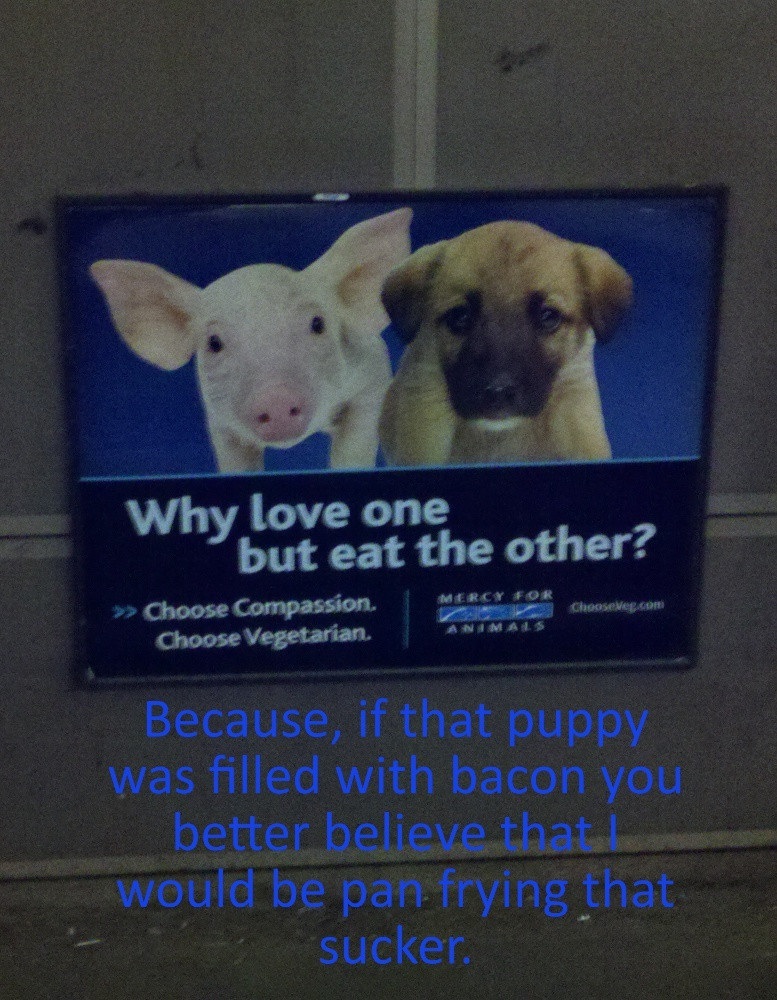
Your status as a carnivore is not in question.  The question is, which pig (or puppy) would you rather eat?