Category Archives: consumerism

Suspicious Origins

Today I was looking at a web site which sold leather belts — the kind for Real Men.  You know the kind: big, hefty belts made to hold guns, not just pants.

One type of belt was touted as being made of “bull” leather, not just “cow” leather, marketing this as being “better” because the bull is full of testosterone, which (according to the web site, but not any other source I can find online) makes for better leather.  I had a question here: one cannot keep mass amounts of bulls easily.  They fight, and they are dangerous.  Where is the store behind this web site getting a bunch of bull skins to make these belts?  Who is keeping bulls to maturity and then skinning them?  And what are they going to do with all that testosterone-tainted meat afterwards?  (Testosterone makes the meat darker and less desirable.)

Perhaps they are just using regular leather — even castrated steers are regularly treated with synthetic testosterone to improve meat yield.

The same company also makes “elephant belts”, which to my horror are made from actual elephant skin.  The site insists they deal only with “legal importers” of elephant hide, which led me to wonder: Where do you find a “legal importer” of parts of an animal it is illegal to kill?  This one surprised me: it appears to be legal to hunt elephants, provided you have the right permits, at least in some parts of Africa, and in theory the “tourism” trade that’s generating is good for the locals and even, possibly, in some roundabout way, the elephants.  Um, that’s great…maybe…but I’m still not buying a belt made of elephant skin.

On a related note, the other day I was at a zoo which had a “touch tank” full of dogfish sharks, and it occurred to me that the zoo probably did not have its own dog shark breeding operation.  Where might be the easiest place for a facility to get large quantities of a shark bred for “animal fodder, fertilizer, and research”?

I’ve walked past “touch tanks” for more than thirty years.  Only now am I wondering where they get all these animals (and it seems likely they have high turnover in those tanks).   A facility at which I worked once (against their own better judgement) bought display animals from a fur farm.  Where is your local zoo getting their critters, and sending their surplus?  Where is your “legal supplier” of elephant skin getting their material?  It’s just an important question to keep in mind: what other industry may I be indirectly supporting by purchasing this product?
Can’t Get Away From Factory Farming

I still don’t think of myself as truly vegetarian — just mostly vegetarian, and  I’m sure many vegetarians would consider me not entirely committed, for my viewpoint that it is possible to keep an animal kindly, and at the end of a happy and food-filled life to slaughter it humanely and eat it.  I believe this can be done with respect.  The animal benefits from health care, provisioned food/water/shelter and companionship; the human gets a wealth of supplies (leather, wool, etc) and food.  Everyone benefits.

Unfortunately, somewhere between this red-barn-and-picket-fence idyll and the high-speed modern slaughterhouse, the “mutual respect” thing turned into something where animals are not even afforded the basic respect we give to useful furniture, and I can’t buy into that system.  Thus, mostly vegetarian — enjoying meat but not the hell that animals went through in order to get it to me, I decided I would only eat meat from small, local, family farms, where compassionate farmers could spend enough time with the animals they slaughtered to ensure the process was as quick, painless and humane as possible, and the animals had as wonderful a life as it was possible to provide.  This makes me essentially vegetarian — certainly no restaurant or normal grocery store serves such meat, which must be found at specialty stores or obtained directly from the farms themselves.

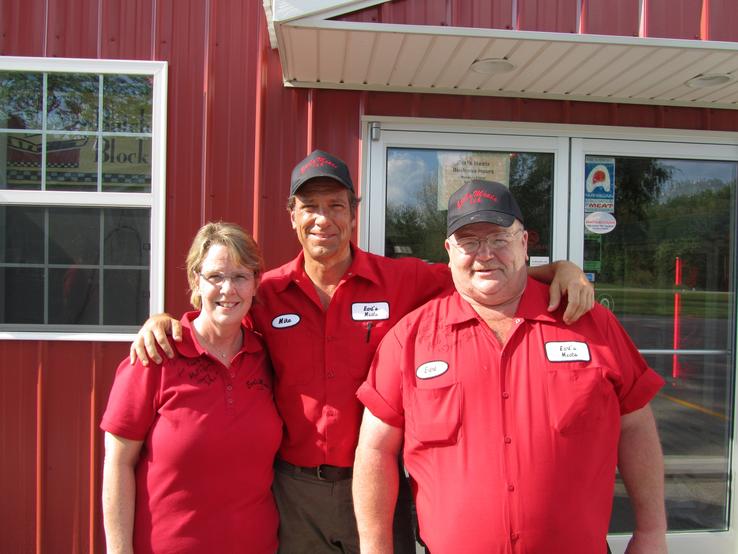
I am now rethinking even this limited meat option.  It had been sitting in the back of my mind that even meat raised at the kindest of farms likely goes through USDA-“overseen” slaughterhouses, with their 3-chickens-a-second conveyor belts, and an episode of “Dirty Jobs” — in which Mike Rowe shadows Earl’s Meats, a mobile butchering operation which travels to clients’ farms, slaughters their stock, and butchers the carcass, producing wrapped meats ready for the kitchen — implied that it is actually required that this happen.  The episode pointed out to me that the meat butchered in this way was unsuitable for sale to the public because it had not been slaughtered in a USDA-inspected slaughterhouse.

This means that any meat to which I have easy, retail access, short of something I have slaughtered personally, has been processed through a USDA slaughter operation and has therefore been in the tender “care” of a high speed slaughter plant, or one of the new USDA-inspected mobile units, which can potentially process 30 head of cattle a day.  This means that it’s time to drop the “small farm” meat and become officially vegetarian, because there is currently no such thing as “humane” meat.

As a side note, here’s the Mobile Slaughter Unit Compliance Guide from the USDA.

In What Way Is This Educational?

Every time I research Horrifying Thing A, I discover Horrifying Things B and C.

This afternoon I visited Horrifying Thing A: “Bodies Revealed“, which succeeds even less at convincing me that it is an entirely education-driven venture than did Gunther von Hagens’ “Body Worlds“, the original exhibition, which I saw years ago in Chicago.  Alas, I am not at this moment equipped to compare them (beyond saying that “Bodies Revealed” is but a sad, faint reflection of “Body Worlds”) or to comment on whether they are “educational” or “exploitative” (probably both, although “Body Worlds” has an edge on being, at some level, actual education).  I am an artist as well as a former worker with large carnivores; I am no stranger to dead things.  The anatomy, as well as the relation to art, fascinates me.  The topic which requires further consideration for me is a more moral angle: what is this exhibition for?  Why should I be giving it money (or not)?  How does it relate to other uses of dead things I have previously encountered, either thought-provoking, ridiculous or theoretically useful?  Why do human carcasses demand a more reverential attitude than do animal carcasses?

While looking around on the “Body Worlds” site for more information about the plastinates, trying to figure out what I did think about it all, I discovered Horrifying Thing B: von Hagens has an online store, in which “qualified users” can purchase actual plastinated human parts (as well as “formalin fixed specimens“).  Little wonder there is no photo available for the “wet whole body specimen, male, covered with skin”.  Okay, I can see how university anatomy departments might be really excited about the opportunity to get one of these, and I certainly support their use in education, but maybe they don’t need a publicly accessible web store.  More stuff for my brain to process (“Is it art?  Is it wholesale exploitationHow can he sell themWhere does he get all these people?  Is education worth the inevitable collateral of people buying these as coffee table decoration?  Is it okay if the bodies are all willing donors?”) later.

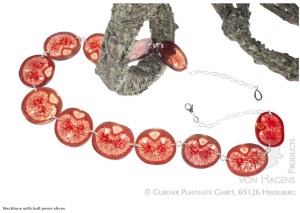
The site also notes that “Body Worlds” has some animal plastinates sprinkled in among the humans (my personal favorite is “Horse and Rider“, which in person embodies the word “awe-inspiring”).  In 2010 the animals got their own exhibition, “Body Worlds of Animals“.  This is, on the whole, all right.  We use dead animals, for better or worse, as educational tools all the time, and I’d rather see a dead animal made useful in some way than tossed in the trash.  However, Horrifying Thing C, today, was the discovery that the “Body Worlds” store is selling jewelry made of delicate, individual slices of plastinated fruit and, er, animal parts:

Those charming red circles are plastinated sagittal sections through a bull penis.  There are, of course, a matching bracelet and earrings.  They seem to have a lot of extra bull penises around the place, don’t they?

While part of me is desperate to get one of these for my mother-in-law, most of me is firmly in the “that ain’t right” camp.  There’s no way this is “educational”, and it’s sort of skirting the edge of being “art”.  I don’t mind animals (and, in many cases, consenting humans) being used for actual education, but I have problems with the gratuitous use of animal parts in art, especially if the animals are slaughtered especially so the art can occur.  I don’t think I need to be buying any of these, even if they are (as is likely) just using slaughter remnants of animals which are being butchered for meat and thoroughly used anyway.  My strongest feeling here, though, is that in no other context would anyone willingly wear goat testicles as fashion accessories.

Baby Steps

from mgessford, via Flickr Creative Commons

I am an animal trainer at heart, and I understand that rewarding companies (with my money) for “baby steps” — tiny movements in the directions I consider “right” — will eventually cause them to take larger steps in those “right” directions.  With that in mind, I gravitate towards things labeled “green”, even if those things are only partly green, or even, as I sometimes find, only faintly greenish.

The pen I bought last night might be the most sideways baby step I’ve seen in a bit.  It annoys me, because the big print (of course) says “BIODEGRADABLE PEN!!  SAVE THE EARTH!  ECO-FRIENDLY!!” and then the tiny print, on the back of the carton, indicates that only “most of” the pen (i.e., the actual body of the pen) is biodegradable.  The ink cartridge, the tip, the spring, and the finger cushion are not biodegradable and go in the trash.  In addition, the “biodegradable” parts of the pen are only biodegradable under certain circumstances.  They will not biodegrade in a landfill — you have to take the pen apart, take the biodegradable bits out and bury them in your yard.

In their defense, the pen company does say on the carton that the pen isn’t all biodegradable.  They even have friendly animations on their web site demonstrating how to disassemble the pen and make sure that the bits which can biodegrade are disposed of appropriately.  (And, of course, if I were really eco-friendly myself, I would have a compost bin to put the pen parts in.  Glass houses, etc.)  In any event, I did actually buy the pen, because it is a baby step in the right direction.  If enough people vote with their wallets, perhaps the company’s next “green” pen will be 70% biodegradable, and their next will be 85% biodegradable.

The whole mess just reminded me of having to look on the back of every product, follow every asterisk, and make sure that “cage free” means “living on grass pasture” and not “packed shoulder to shoulder in an open plan barn”, and that “natural flavors” is not a euphemism for “crushed beetles“.  Sometimes it’s really hard to be earth- and animal-friendly, but, well, we’re all taking baby steps.

Dinners, Dinners Everywhere — Why Can’t I Eat Them?

In my job I have a very small period allotted for lunch, no real ability to leave the office to buy food, and the usual dubious and communal utensils with which to cook anything I choose to bring.  Prefabricated, fast-food or otherwise “convenient” meals strongly appeal to me: quick to cook, taking no brainpower to prepare, and highly portable.  They are also great for portion control — my current diet is big on counting calories and I love little packages which have done all the dirty work for me and don’t tempt me to overeat.

It is a terrible shame that I can’t eat them.

I am avoiding, for hundreds of extremely good reasons that I’m trying to tackle one at a time, factory-farmed meat.  Some of the biggest consumers of factory-farmed meat are the people who are producing these helpful little meals: using the cheapest possible ingredients (including meat) is how they make these meals affordable.  It’s pretty much impossible to find anything cheap and/or convenient which is not made out of factory farmed meat, eggs, or dairy.

The irony is, of course, that meat is generally more expensive than vegetables.  The producers could make their meals even cheaper, and possibly even better for you, by substituting meat with beans or another source of protein in at least some of their dinners.  Instead, they produce dish after dish with meat thrown in.  Going along the freezer case is another exciting revisit to the Monty Python “spam” sketch: pasta with chicken, pasta with beef, pasta with pork; vegetables with chicken; vegetables with beef, vegetables with pork; potatoes with chicken, potatoes with beef, potatoes with pork…spam spam spam spam spam…

The meat in the meals even appears generally in only tiny amounts, almost as an afterthought.  Check out this (fascinating) site which reviews frozen meals — notice it takes scrolling back quite a long way to find a single vegetarian entree — and take note of how much meat there is in each meal.  Wouldn’t it be cheaper and better for everyone to, occasionally, just take the meat out, bill the thing as a vegetable/pasta dish and be done with it?

Killing a Tree for Christmas is a Good Idea?

Christmas treeThis is one of those weird places where my immediate reaction — why do I need to rip a perfectly good tree out of the ground to celebrate a national holiday — is not necessarily the one with which I end up after doing further research.

Every year around this time, I am saddened by the appearance of tree yards, full of perfectly healthy little trees that have been cut down so they can spend a month in someone’s living room and then be tossed out with the trash.  Now, I am aware that trees do not feel pain, and it can’t be argued that tree farms are cruel to the trees — it just seems like a waste to me.  When I began doing research on the subject I was prepared to find environmental groups going bonkers about how the tree farms take up animal habitat, cover the world in pesticides, and produce x percent of “waste” trees which clog up landfills.  And, indeed, I found those articles, or at least the ones about pesticides.  Tree farms actually provide animal habitat, and “waste” trees (as well as “used” trees after the holidays) are taken care of via “treecycling” programs, which appear to recycle about 94% of all trees used in the US.  Impressive!

Instead of a lot of vitriol about tearing down forests and destroying the environment for holiday ornaments, I found this interesting little article from National Geographic explaining why living trees overall use a smaller carbon/water footprint, are biodegradable and can be used to create mulch and/or animal habitat, are not made of non-renewable petroleum products like artificial trees, and how the living tree farms support 100,000 American workers.  This article from the New York Times also points out that the tree farms produce oxygen while they grow, provide animal habitat, and help fix carbon in the soil.  They also provide an alternative crop for farms having difficulty raising other crops on their land.  Both seem to be referring to this 2009 study by Ellipsos, an environmental consulting firm in Montreal, Canada, which concluded that, unless the fake tree was re-used for more than ten years, the real tree was generally the better environmental choice.

Overall, the worst option seems to be the imported (i.e., the cheap) artificial tree, which is made with non-renewable petroleum byproducts in factories that burn fossil fuels for power, and can be contaminated with lead.  The best, or at least the most eco-friendly, option appears to be either to decorate a tree which is already living in your front yard or to purchase a “balled” or potted living tree which can be replanted after the holiday (now there’s a great idea for a tradition).  In the middle, the real tree seems to have edged out the fake, despite my immediate reaction of Why should I kill a tree for this holiday?

Hmm!  Live and learn!

Why I Ate A Thanksgiving Turkey

I am not technically vegetarian; I consider myself a compassionate carnivore.  Alas, in this day and age, this results in essential vegetarianism unless I have personally bought the meat/eggs/milk involved.  It’s kind of nice, actually.  I don’t miss meat a lot, and it’s really helping on my diet.  However, this Thanksgiving I did help to dismember and consume a whole turkey as part of some quasi-traditional ritual much of the country seems to go through around this time.

First — since my mother-in-law is lucky enough to live in an area where she can essentially walk out of her house and meet the pasture-raised, humanely-treated turkey in question, she got a bird which had the kindest life anyone could have given it, and whose death was about as humane as it gets.  This qualifies, in my book, as humanely-raised meat.  The bird was appropriately “paid” for its efforts to the household — with food, water, shelter, medical care, and, in the case of this particular bird, even access to the outdoors and conspecifics.  We (via the farmer) gave the turkey a good life in return for several excellent dinners.

Second — we used the whole turkey.  Every little bit of meat, including giblets, bones, neck, bits, and pieces, got thrown into the stock pot and will be used to flavor soups, make noodles, etc., for the next several weeks.  Three families were fed by that bird.  Nothing was wasted, which is only appropriate when you are consuming something so important as another animal.  That turkey was not wasted.

Third — Thanksgiving, or, rather, a family get-together and overall bonding occasion, is not the point to stand up and grind it into people’s faces that their lifestyle choices disagree with yours.  I once had to put down a “vegetarianism for beginners” book which recommended that, when “thoughtlessly” offered meat at a restaurant, I essentially stand up, throw down my napkin, and rip the innocent waitperson a new orifice for daring to offer me animal flesh.  We are all imperfect, and shouting at people is a great way to guarantee they won’t be listening.  There are better times for these delicate, paradigm-rocking conversations.

During the holiday, I also consumed two pieces of not-at-all-humanely-raised sausage, because some poor pig (or, likely, between two and twenty pigs) died for that sausage, and it was going to be thrown away if someone did not eat it.  While I would prefer that humans in general not purchase or eat factory-farmed meat, if someone has purchased it, I would prefer that it not go to waste.  I consider it a crowning injustice to torment, damage, and otherwise torture a living animal only to toss the meat away at the end.  There’s probably another way to look at all this, but that’s how I’m looking at it right now.

Some meat I did not eat this holiday: The path to and from the mother-in-law’s passed a favorite restaurant of mine, at which I have not eaten in years, since long before my switch away from factory-farmed meat.  Despite a distinct fondness for their burgers, the great time which had passed since my last such experience, and the general inaccessibility of the restaurant to me these days, I could not justify the purchase or consumption of meat from that restaurant.  It would not be wasted if I did not eat it, and purchasing it would directly contribute to factory farming; so fries it was.  It wasn’t quite the same without a burger on the side, but I’d rather miss out on a meat patty than contribute to what usually happens to make a commercial, fast-food burger.

Vegetarian Vegetable Soup

Various health- and ethics-related events have combined to make me extremely interested in obtaining much of my nutrition from vegetable-based sources.  Finding foods which have no meat in them can be, as previously described, a frustrating endeavor.  Meat really is unbelievably pervasive.  Until you’re looking for it, you really don’t see how “everywhere” it is.

Recently I became aware of the existence of “vegetarian vegetable soup“.  It occurred to me, much belatedly as it turns out, to wonder why the manufacturer felt they had to make such a distinction.  Wouldn’t vegetable soup that has meat in it be labeled?  “Vegetable beef soup“, for instance?  Well, no.  Apparently, a lot of vegetable soup is made, at least partly, with chicken stock.  Or beef stock.  Or, as in my (previously) favorite soup, “beef stock”, “beef fat”, and “chicken fat”.

Apparently I am just late to the party and this is, and has always been, very common.  Here’s Martha Stewart doing it.  Some guy from the Food Network.  Emeril.  Here’s Wolfgang Puck at least suggesting you use (his) free-range chicken stock when you make your “vegetable” soup with meat.

I am trying to avoid eating factory-farmed animals.  Soup manufacturers are hiding them in my vegetable soup!  It’s not just Campbell’s, either — I don’t mean to pick on them.  I spent several minutes in my grocery store’s soup aisle turning over cans, and only the “vegetarian vegetable” soups, and one “vegetable” soup, did not feature animals or their derivatives in their ingredients.

I once ate at a steakhouse where meat was so pervasive it appeared in the salads and the vegetable side dishes as well.  The other day I ordered a “tomato and basil” soup which the waiter and the menu both forgot to mention contained large chunks of chicken.  Meat is everywhere!  I keep expecting to find meat in my toothpaste or my toilet paper.

Fortunately, I am not the only one who has noticed meat “hiding” in my food products.  The Carnivore’s Dilemma offers a hint for vegetarians and others looking for animal-free foods: look for the word “pareve” on the label, assuring those keeping kosher that the food contains neither dairy nor meat.  Cyberparent offers a handy list of euphemisms for meat-related products which may be appearing on an ingredients list near you.  And the Vegetarian Society works on “outing” badly-labeled products as well as offering a list of officially approved products which have been determined to be 100% animal-free.  They also have suggestions if you find a badly-labeled product and you’d like to do something about it.

I’m Not The Only One Seeing It….

The 6 Most Horrifying Lies The Food Industry is Feeding You, courtesy of Cracked.com.

And there’s “ammonia-infused hamburger”, right there — a direct result of the meat industry soaking your meat with chemicals rather than slow down the lines so it doesn’t get contaminated in the first place.  Below that we have “free range” chickens raised in giant sheds…which is technically “free range” compared to the industry-standard “five birds to a cage” plan, but is still nothing like the wide open fields you’re thinking about when you see the words “free range”.

Just another note to myself, I’m not the only one seeing this thing….

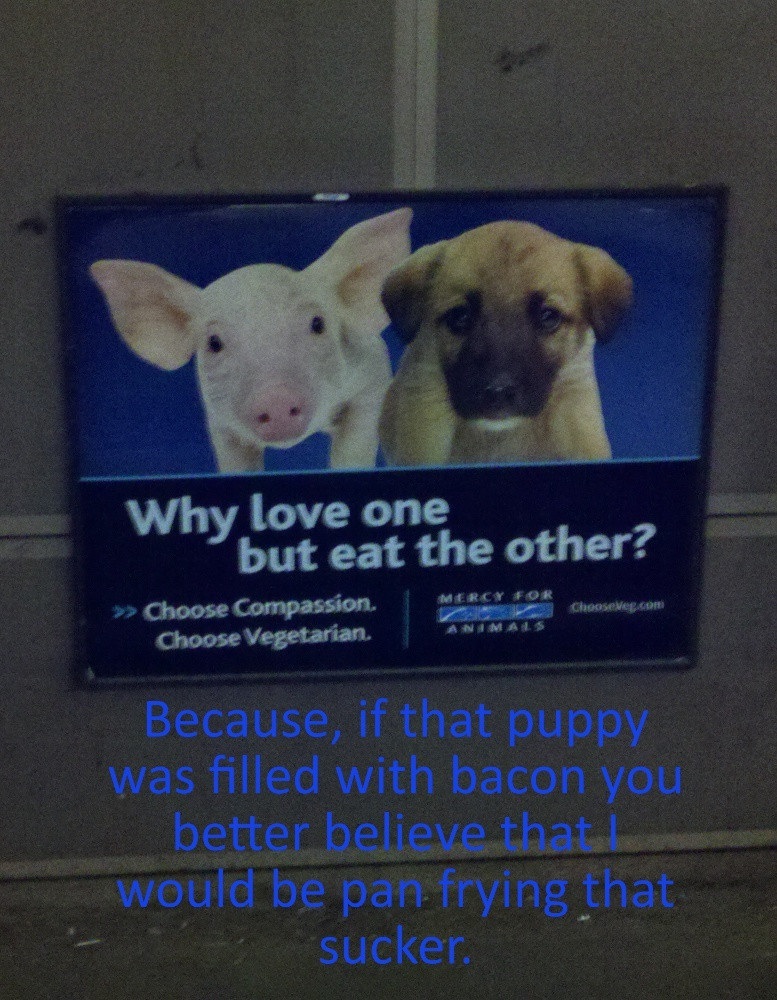
Pig or Puppy, the System Still Sucks

I was raised by wolves, or at least by a pack of consummate carnivores.  I find that not a lot of my friends want to talk to me about animal welfare because they think that, by objecting to how we treat our meat and research animals, I’ve become a brainwashed, tree-hugging hippie who’s trying to convert them to veganism.  They like eating their meat, and they get grumpy when they think someone is trying to take it away.

All right.  We all love bacon.  Pigs provide bacon.  You gotta kill pigs to get bacon.  Fine.

Now imagine that there are two ways to get bacon out of a pig (or a puppy).

The first way is an old, slow, traditional way: you raise the pig in a nice big space, let it exercise the muscles you’re going to eat, feed and water it properly, give it love, health care, and shelter, and kill it as humanely as possible.  You clean the carcass carefully, use as much of it as you can, and only keep and slaughter as many pigs as you can kindly handle.  Because you have a lot of time to work with individual animals and to make sure your facilities are clean, this produces clean, fresh bacon — and a lot more of it, off fatter, healthier pigs (or puppies).

The second way is the new, fast, modern way: you raise hundreds of thousands of pigs in small metal boxes in the dark.  You grow them so big, so fast, their legs break.  You fill them to the eyes with antibiotics so they don’t get sick.  You can’t process all the pigs yourself, so you hire (and abuse) minimum-wage workers to do the slaughtering in a partially automated process.  Processing 3,000 pigs an hour (one every two seconds), not all the pigs die before being dismembered.  Something like 20-30% are “legged”, gutted, and dissected alive.  Everything moves so fast there’s no time to clean properly, and carcasses (and everything else) are covered in feces, blood, and other materials.  There’s no time to inspect carcasses properly, either, and diseased animals are packaged up for sale.  When disease is inevitably discovered in your product, instead of slowing down the line, you wash the meat down in chlorine before you package it.

Either way, you end up eating bacon.  But the first way, you’re getting good meat, and the second way, you’re getting meat full of chemical washes, pus, E. coli, and sawdust.

Just for this moment, we’re gonna skip all the animal welfare issues, the worker welfare issues, the adorable little kids dying of E. coli poisoning, and the really cute part where the plants are run and “overseen” by the rich, fat-cat assholes in Washington that you hate, who are even now passing laws to make it easier for them to churn out tainted, sawdust-flavored crap and sell it everywhere.  Boiled down to the basic facts: the current system of food production, which supplies most grocery stores and restaurants, turns out horrible, diseased, scary meat which is doused in chemicals and potentially dangerous for you.

Your status as a carnivore is not in question.  The question is, which pig (or puppy) would you rather eat?