
Tag Archives: vegetarianism

Why I Ate A Thanksgiving Turkey

I am not technically vegetarian; I consider myself a compassionate carnivore.  Alas, in this day and age, this results in essential vegetarianism unless I have personally bought the meat/eggs/milk involved.  It’s kind of nice, actually.  I don’t miss meat a lot, and it’s really helping on my diet.  However, this Thanksgiving I did help to dismember and consume a whole turkey as part of some quasi-traditional ritual much of the country seems to go through around this time.

First — since my mother-in-law is lucky enough to live in an area where she can essentially walk out of her house and meet the pasture-raised, humanely-treated turkey in question, she got a bird which had the kindest life anyone could have given it, and whose death was about as humane as it gets.  This qualifies, in my book, as humanely-raised meat.  The bird was appropriately “paid” for its efforts to the household — with food, water, shelter, medical care, and, in the case of this particular bird, even access to the outdoors and conspecifics.  We (via the farmer) gave the turkey a good life in return for several excellent dinners.

Second — we used the whole turkey.  Every little bit of meat, including giblets, bones, neck, bits, and pieces, got thrown into the stock pot and will be used to flavor soups, make noodles, etc., for the next several weeks.  Three families were fed by that bird.  Nothing was wasted, which is only appropriate when you are consuming something so important as another animal.  That turkey was not wasted.

Third — Thanksgiving, or, rather, a family get-together and overall bonding occasion, is not the point to stand up and grind it into people’s faces that their lifestyle choices disagree with yours.  I once had to put down a “vegetarianism for beginners” book which recommended that, when “thoughtlessly” offered meat at a restaurant, I essentially stand up, throw down my napkin, and rip the innocent waitperson a new orifice for daring to offer me animal flesh.  We are all imperfect, and shouting at people is a great way to guarantee they won’t be listening.  There are better times for these delicate, paradigm-rocking conversations.

During the holiday, I also consumed two pieces of not-at-all-humanely-raised sausage, because some poor pig (or, likely, between two and twenty pigs) died for that sausage, and it was going to be thrown away if someone did not eat it.  While I would prefer that humans in general not purchase or eat factory-farmed meat, if someone has purchased it, I would prefer that it not go to waste.  I consider it a crowning injustice to torment, damage, and otherwise torture a living animal only to toss the meat away at the end.  There’s probably another way to look at all this, but that’s how I’m looking at it right now.

Some meat I did not eat this holiday: The path to and from the mother-in-law’s passed a favorite restaurant of mine, at which I have not eaten in years, since long before my switch away from factory-farmed meat.  Despite a distinct fondness for their burgers, the great time which had passed since my last such experience, and the general inaccessibility of the restaurant to me these days, I could not justify the purchase or consumption of meat from that restaurant.  It would not be wasted if I did not eat it, and purchasing it would directly contribute to factory farming; so fries it was.  It wasn’t quite the same without a burger on the side, but I’d rather miss out on a meat patty than contribute to what usually happens to make a commercial, fast-food burger.

Seeing About Seafood

Since I am both highly calorie-restricted and also doing my level best to avoid factory-farmed meat, it is extremely rare these days to open a menu and see more than one thing I can calorically and morally afford.  I find myself leaning towards seafood these days, for sources of low-calorie, lean protein which are unlikely to involve ghastly intensive farming practices, but of course anything purchased in a restaurant is suspect until investigated.

Today, I took a look at shrimp, which is delightfully low-calorie (when not coated with heavy sauce, or fried), and easily raised domestically, so I am unlikely to be decimating dwindling wild populations.  Shrimp “harvesting” is also reasonably fast and does not involve the inhumane slaughter methods common with large mammals.

Shrimp farming is popular and widespread, which of course invites unfortunate habits by shrimp farmers trying to increase the number of animals they can produce/sustain in an individual pond.  Certainly I cannot cover the entirety of “shrimp farming” in a bite-size blog post, but here is a basic overview of U.S. shrimp farming in .pdf form from Auburn University; here is a more in-depth description from Kentucky State University; and here is a formal collection of overall information from the National Oceanic and Atmospheric Administration.  Here’s one for the Gulf of Mexico from NASA.  For comparison, here is a (likely virus-free) .doc file from the Association  of Southeast Asian Nations (unfortunately with no date) describing shrimp farms in its member countries.

It’s hard to form a universal rule on store-bought or restaurant-purchased shrimp, since it’s coming from so many sources, but fortunately a lot of restaurants are wising up and at least giving lip service to sustainable (and reasonably kind) farming practices.  Here’s the info for Red Lobster, whose menu caused my initial investigation re: seafood.  Hmm, pretty vague on farming practices, but I like that they’ve teamed with an aquarium.  Purchasing the fish at a specialty grocery store is usually safer: here’s the info for Whole Foods Market, which both reassures me that they’re at least trying, and paints a terrifying picture of what some shrimp farms must be doing, in order for Whole Foods to require rules such as these.

Seafood as a whole is generally suspect due to overfishing and overfarming, but there are some good options out there.  Here’s some good advice on picking “kind” and healthy seafood from the Monterey Bay Aquarium, including the Seafood Watch app for Android and iPhone, which can be used to find local restaurants which have chosen to purchase their seafood sustainably.

Vegetarian Vegetable Soup

Various health- and ethics-related events have combined to make me extremely interested in obtaining much of my nutrition from vegetable-based sources.  Finding foods which have no meat in them can be, as previously described, a frustrating endeavor.  Meat really is unbelievably pervasive.  Until you’re looking for it, you really don’t see how “everywhere” it is.

Recently I became aware of the existence of “vegetarian vegetable soup“.  It occurred to me, much belatedly as it turns out, to wonder why the manufacturer felt they had to make such a distinction.  Wouldn’t vegetable soup that has meat in it be labeled?  “Vegetable beef soup“, for instance?  Well, no.  Apparently, a lot of vegetable soup is made, at least partly, with chicken stock.  Or beef stock.  Or, as in my (previously) favorite soup, “beef stock”, “beef fat”, and “chicken fat”.

Apparently I am just late to the party and this is, and has always been, very common.  Here’s Martha Stewart doing it.  Some guy from the Food Network.  Emeril.  Here’s Wolfgang Puck at least suggesting you use (his) free-range chicken stock when you make your “vegetable” soup with meat.

I am trying to avoid eating factory-farmed animals.  Soup manufacturers are hiding them in my vegetable soup!  It’s not just Campbell’s, either — I don’t mean to pick on them.  I spent several minutes in my grocery store’s soup aisle turning over cans, and only the “vegetarian vegetable” soups, and one “vegetable” soup, did not feature animals or their derivatives in their ingredients.

I once ate at a steakhouse where meat was so pervasive it appeared in the salads and the vegetable side dishes as well.  The other day I ordered a “tomato and basil” soup which the waiter and the menu both forgot to mention contained large chunks of chicken.  Meat is everywhere!  I keep expecting to find meat in my toothpaste or my toilet paper.

Fortunately, I am not the only one who has noticed meat “hiding” in my food products.  The Carnivore’s Dilemma offers a hint for vegetarians and others looking for animal-free foods: look for the word “pareve” on the label, assuring those keeping kosher that the food contains neither dairy nor meat.  Cyberparent offers a handy list of euphemisms for meat-related products which may be appearing on an ingredients list near you.  And the Vegetarian Society works on “outing” badly-labeled products as well as offering a list of officially approved products which have been determined to be 100% animal-free.  They also have suggestions if you find a badly-labeled product and you’d like to do something about it.

A Meaty Amusement

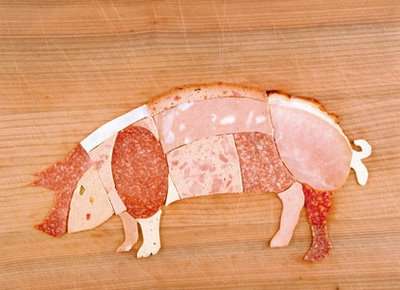
image by Sarah Illenberger

Having gone to a slightly less meat-infused lifestyle, I find it more difficult than it used to be to order in restaurants.  I never realized how pervasive meat was until I tried to find a dish without any in it.

Not that any one restaurant seems to be worse than any other, here’s the lunch and dinner menu from Cracker Barrel.  Even just looking at the photos, everything has meat in it, even the salads (and, yes, the baked beans are made the old-fashioned way, with ham).  Only the desserts come without meat!

And here’s the menu from IHOP, one of my other favorites.  They’re a little better because of the preponderance of (generally meat-free) pancakes, but still — sausage, ham, bacon, eggs, steak, and the “Bacon-N-Beef Burger”, burger with bacon mixed in.

Also, when you order an entree without meat from most of my favorite restaurants, the waitress will ask you, as though you may have forgotten, “Did you want any meat with that?”  I know it’s a required upsell — meat is profitable for them — but sometimes it just sounds macabre!

Other times, the menus remind me strongly of the “Spam” Sketch from Monty Python.  “Meat, meat, meat, meat with beans, meat with rice, meat with potatoes, roasted meat, baked meat, boiled meat, sliced meat, curried meat, raw meat, burnt meat, meat salad, meat pie, meat omelet, meat stir fry, meat sandwich, meat fried rice, meat with more meat, meat with eggs, meat with bread, meat with sauce, meat with pasta…or Lobster Thermidor á Crevétte with a mornay sauce served in a Provençale manner with shallots and aubergines garnished with truffle paté, brandy and with a fried egg on top and meat.”

I Wish to Register a Complaint

I miss meat.  As I’ve mentioned elsewhere, I believe in (compassionate) carnivory and I do not believe there is a moral failing in consuming an animal you have appropriately “paid” (with food, water, shelter, care and affection) for its contributions to your household.  I am happy to eat meat.  However, I prefer not to pay the companies who do not adequately compensate their animals — thus, I do not eat meat at restaurants, picnics, fast food joints, what have you, because they buy their meat from enormous, horrible factory farms.  This leaves me searching, often vainly, for meat which has been slaughtered humanely and raised kindly.  I don’t eat a lot of meat anymore.

It is possible, if one hunts diligently, to find small local farms where the animals see grass and daylight during their lives, have adequate vet care and space, and even (gasp) enjoy species-appropriate social groups.  (I am happy that, because of the prevailing change in attitudes, it is slowly becoming more possible to find these farms.)  I find that my best chance of locating non-factory-farmed meat is at the local, “community” grocery stores.  These stores appear to make at least a token effort to find these humane farms and carry their products.  In turn, I happily give these places my money.  I wish to encourage this behavior.

However, I still find that the meat selection in these stores can leave much to be desired, and the watchwords caveat emptor still apply.  Unless the meat says “free range” (and sometimes not even then), you’re likely looking at factory farmed meat.  Yes, even if there’s a picture of a smiling pig on the wrapper.  Yes, even if it says “organic” and “hormone-free” all over it.  Today, I was almost ambushed by some elk stew meat, ambiguously labeled “Broadleaf”.

In my experience, it is generally very difficult to factory-farm wild game.  I worked with bison for ten years; they are larger and smarter than domestic cattle, and do not tolerate herding, hitting, crowded conditions, or running through cattle chutes — all requirements for “economical”, assembly-line processing — well.  I was initially attracted to the elk meat for this reason.  Fortunately, I still made the wise choice to look up “Broadleaf”, which after much research turned out to likely be Broadleaf Game, based out of California.  Broadleaf sells bison, elk, alligator and boar, which are quite unlikely to be factory farmed due to husbandry issues similar to those mentioned above, but they also sell beef, chicken, various “poultry”, veal and “farm-raised” rabbit, which are very easy to factory farm.  They say things like “hormone-free” on their site, but only the lamb is (vaguely) intimated to be living on grass, and most species do not have any description of their living facilities.

Alas, this is another brand name I won’t be rewarding with my money.  To demonstrate that it is possible to raise and slaughter wild game (or any animal!) kindly, and to advertise it properly, here is the web page for Broken Arrow Ranch, in Texas, and a description of its “field harvesting” technique, which I believe is the most humane way I’ve ever seen to kill an animal, for meat or otherwise (provided the person behind the gun is an excellent shot).

Of course, checking out the web site is only a small part of thorough research on a brand.  Typing search terms like “Broken Arrow Ranch USDA” and “Broken Arrow Ranch humane” into Google would be a good followup, checking for news articles concerning their handling practices and articles on other sites describing the facility.  Sometimes you can find reviews from people who have actually visited the farm, or a Facebook page from the farm with photos.  Ideally, one would be able to visit each facility personally, but, well.  In this exciting old world we can only do our best.

99% of the Time, the System Sucks

I am not a vegetarian, but, 99% of the time, I will not eat meat.

I was raised a confirmed carnivore, and, having worked with animals for many years, I appreciate the food chain as well as anyone else, including the human position on (or near) its top.  I double majored in biology and animal behavior.  I understand that we are all protein in different packages, and that protein moves around the system most efficiently via predation.

The people who taught me that animals are intelligent, living things with their own needs and personalities also taught me that everyone in the household — including the animals — works for their living.  While I took out the trash and cleaned the house, the dog defended it and provided ambiance; the cat caught the mice in the kitchen; the horse carted me around on its back in return for food and care.  Cows, pigs, sheep, and chickens (should) likewise enjoy a peaceful life being cared for, fed, sheltered, and watered before turning in their service, feeding the rest of the household.

Thus I feel that there is no moral imperative not to eat meat.  We are all (and this includes humans) required to work for our place in the world.  If I feed, water, and shelter a cow, and provide her with medical care — if I treat her like any other member of my family — I should be able to ask her for her milk, and, at time of need, provide her with a humane death, and eat her.  She will feed my family (and others!) for a month, properly apportioned.  If I stopped working and paying the bills, I would soon not have a house to live in, or any food to eat.  In the wild, animals work to obtain their own food, water, and shelter.  Why should a cow not have to work for her living?

My issue arises when the life of a captive animal moves from “work” to “slavery” — when the animal is no longer paid for its efforts.  This happens somewhere along the continuum from “small family farm” to “enormous animal factory”.  A farmer handling 20 head of cattle can call each one by name, tell you her birthday and her social rank in the herd, her likes and dislikes, and her medical history.  A farmer with 200 head of cattle has little time to spend with each individual.  A corporation with 200,000 cattle uses a computer to tag and electronically track its bovine “assets”, which become managed by electronic gates and subsystems and by several tiers of employees.

Today, an unimaginable number of animals are “processed” each day.  Large corporations, each encompassing dozens of farms, each farm managing hundreds of thousands of animals, provide most of our meat.  The entropy of such a system is enormous, and even if it began with the animals fed, watered, sheltered, and vetted, soon the edges will wear and corners will be cut.  Animals cannot be paid for their work — they can barely be counted.  When one “unit” “breaks down”, it is simply discarded — there are millions of others to take its place.  There is no time, when herding 10,000 cows a day through the milker, to be patient with a nervous cow, to notice impending mastitis, to separate a single animal to treat a small wound.  The process cannot be stopped.  In such a system, a dead animal is simply one who has reached the end of the assembly line early.  It can still be used: if not for human food, then for pet food, fertilizer, cosmetics.

The animals receive the bare minimum of care necessary to maintain them in an “alive” state, because they are (marginally) more useful alive and certainly easier to transport.  No time can be devoted to anything more than the minimum.  In the rush, things get delayed, ignored, forgotten.  Employees get overwhelmed and frustrated, and take out their anger on the animals.  Procedures are performed en masse, and if individuals cannot cope, they are culled.  The budget is tight, and animals cannot form a union and strike for better pay.

The methods of an animal’s eventual death under such a system — the “humane slaughter” which is such an unbelievable oxymoron it makes my eyes water — is a topic for another post, or perhaps a hundred posts.  It suffices to say that it isn’t, in any sense, the quick death free of pain and fear that all living things should receive.  Nothing about the factory farming system works — especially not for the animals.

Most of our commercially available meat today comes from these titanic animal factories.  While I love eating meat, and do not have any personal problem with eating another animal, I have all sorts of personal issues with the treatment of animals in such factories, and I will not eat animals which came from such places.  This leaves me out of luck at restaurants, most public venues, and other people’s homes — basically anywhere that does not get its meat from a small, family farm which still has a low enough number of animals that they can afford to handle them humanely.  These still exist, fortunately, and are becoming more popular, so now, with careful planning and researching, I am able to locate occasional meat-based products that do not involve the Great Machine.  And thus I am not a vegetarian; but in 99% of cases, I will not eat meat.