
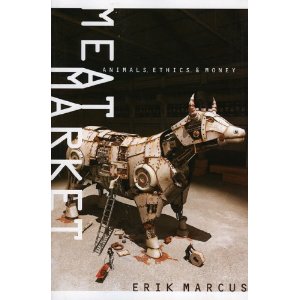
Book Review: Meat Market: Animals, Ethics, and Money

Meat Market: Animals Ethics and MoneyMeat Market: Animals, Ethics, and Money, by Erik Marcus, is an interesting, if brief, read, and a good answer to the question “What are these hippie freaks whining about, anyway?”  It’s not a perfect introduction — I’m still looking for the best way to suggest to, say, my parents that they not eat factory-farmed animal products — but it’s a good explanation of where one is coming from which doesn’t involve showing one’s audience graphic video of a slaughter plant.

The book begins with a glimpse of how and why small-farm practices become factory farm practices, follows up with an excellent, reasonably impartial, description of common factory farming practices for chickens, pigs, and cattle, and describes some options for what could be done to alter the status quo, along with what is currently being done.  It examines the three facets of the current what-the-hell-is-going-on-here movement (animal welfarists, animal rightists, and vegetarians), describes their goals, actions, and methods, looks at what is working and what isn’t, and suggests an alternative option (complete dismantlement of the system).

The book ends in a flurry of interesting essays and appendices, with subjects ranging from Starting a Local Vegetarian Society to The Ethics of Hunting.  It’s a lot of different viewpoints (although, toward the end, the vegan viewpoint grabs center stage and holds it), and, more, it’s thought-provoking material.

For example, it thoughtfully compares the relative quality of life — inasmuch as we can measure “quality of life” for another species — of various factory-farmed animals.  If you only give up one thing to make farmed animals just a little happier, Marcus says, give up eggs: the hens producing them are confined in ludicrously tiny cages their entire lives, debeaked, crippled, repeatedly force starved, and then slaughtered at the end.  The animal with the “best” relative life is the beef calf, which has a pretty good time of it (out at pasture, with mom) until about six months of age (after which it all goes to hell, but briefly compared to the two years’ close imprisonment of the laying hen).

The other thing that hit me was the reminder that, even though I am carefully purchasing milk from “certified pasture-kept” (and, theoretically, happy) cows, by purchasing milk at all I am contributing to the veal industry.  I am ashamed it didn’t occur to me before — of course!  What are they doing with all the male calves? — but now that I know I am trying to figure out how to get milk out of my diet, or at least minimize it.  Alas, soy milk tastes like liquid Lucky Charms, and unsweetened soy milk has the texture of Elmer’s glue — I am working on it.  In the meantime, I do my best to minimize consumption of milk and cheese….

If you are just starting to look at vegetarianism or veganism or know someone who is, Meat Market isn’t a bad start.  It is not overly preachy and does not use “We can’t kill animals because they are so CUTE!” faux logic — it produces rational, empirical examples which make it difficult not to listen.  I kind of wish it hadn’t ruined milk for me, but I can’t honestly blame the messenger.

Context is Needed

chimp and tigerThis photograph, from this article (and many others), has been wandering around the net for a bit recently.  The animals are billed as being from the Samut Prakan Crocodile Farm and Zoo near Bangkok, Thailand.

Okay, this is adorable.  However, please think to look closer:

Look in the background of the pictures.  Look at the big cat cubs kept alone in small dog kennels.  There’s a pair of them playing unsupervised on the floor.  Look at the stacks of cheap dog kennels — does this look like a reputable zoo to you?  How reputable does this photo from their “elephant show” (taken from this web site) look?  Check out the reviews on TripAdvisor.com — apparently the primary moneymaker for this facility is selling crocodile skin.  It started life as a crocodile farm and seems to have picked up some random exotics for the extra cash.

Is this what you want to support?  Quit sharing this “cute” picture without the full context.  It encourages people to think you can keep chimps and tigers as pets (hint: bad idea), and it’s generating publicity for a facility which encourages tourists to pose feeding and holding baby exotics (I can only imagine they pay for the privilege), mishandles them in “shows” (more photos here, here, here, and here, and in piles from Google image search), and slaughters crocodiles for leather and meat, as well as encouraging other facilities to do the sameFacilities like this routinely mistreat their animals.  The previous example mentions China, but it happens everywhere, Thailand (and the US) included.  Don’t support this kind of thing.

You like tigers?  Go here and support them.  Love chimps?  Go here and support them.  Put your effort into places that deserve it.  Don’t lend your time or blog space to this facility, unless this is the kind of animal husbandry you wish to support.

Happy Thoughts: Big Cat Rescue in Tampa, FL

Cameron the lion at Big Cat Rescue, Tampa, FL.

Cameron the lion at Big Cat Rescue, Tampa, FL.

When I first had my eyes opened to the Machine, my first reaction was one of hopelessness: This problem is huge!  How am I supposed to do anything about it?

The easiest thing to do, if you want to help but don’t know where to start, is to support a group which is already doing what you want to do.  If you like exotic cats and the idea of people keeping these animals as “pets” — often chained in basements, locked in miniscule cages, fed inappropriate diets, declawed and even defanged to make them “safer” to keep — is anathema to you, then you may wish to lend your support to Big Cat Rescue in Tampa, Florida.  They have been working to protect big cats since the mid-nineties.

Alex the tiger at Big Cat Rescue in Tampa, FL.

Alex the tiger at Big Cat Rescue, Tampa, FL.

I recently got a chance to visit their facility and was extremely impressed.  They have excellent credentials, an enlightened, realistic and positive outlook, and their staff and volunteers are dedicated and intelligent.  Like all animal facilities, Big Cat Rescue has made some errors, but they are open and honest about them and are working to learn from them and improve.  These are good people, providing rescue for large cats as well as public education, especially for children, which is (I believe) the primary mechanism by which we will eventually be able to change the world.

Tonga, a rare white serval, at Big Cat Rescue, Tampa, FL.

Tonga, a rare white serval, at Big Cat Rescue, Tampa, FL.

They do not breed, buy, sell, or even unnecessarily interact with their animals.  Those cats who do not like humans are kept in areas where tour groups will not bother them.  They don’t sell “picture yourself with a tiger”-type photo opportunities (although they do have excellent photography opportunities without having you in with the cats) and they don’t take the cats to schools — although having a live animal helps to get people interested in your talk, it can send absolutely the wrong messages about keeping exotic cats as pets.  The human staff really are at the service of the cats, and it shows.  This place is wonderful, it’s well-run, and it’s worth some support.

They have an excellent selection of YouTube videos if you’d like to visit virtually, and of course the images in this post were taken there.

Can’t donate money?  There are a lot of other ways you can help out!  Don’t like big cats?  There’s probably another organization in your area that can use your help.  The Machine is a damned big and scary thing, but: a) every little bit helps, and b) working together we can take that mother down.  Happy thoughts!

Online Learning Tool: Animal Ethics Dilemma

While searching Amazon for more books to eat, I found a mention of a free “online learning tool” called Animal Ethics Dilemma.  It presents five case studies (focusing on the use of genetically modified animals, specifically monkeys, in research; the welfare of farmed chickens; euthanasia of aggressive pets; rehabilitation of wildlife; and slaughter plants) and provides various ways to explore the issues presented by these situations.  It encourages the user to  consider various response options to potentially real-world situations.

Overall, it’s well put together.  It does a decent job of introducing five broad areas of animal welfare.  The exploratory answer options tend to be a little fixed — the tool is trying to introduce the user to five (debatable) points of view (“contractarian“, “utilitarian“, “relational“, “animal rights” and “respect for nature“) and, instead of allowing freeform answers, the tool forces you to choose between five fixed answers, each representing one of the categories.  I don’t honestly believe that any one of these viewpoints is entirely right in all situations, but the division helps to simplify the problems a bit for initial interpretation.

You do have to create a username and password to use the thing, but it’s free, and it never asks for any personal information.  It’s designed to let you create a profile of yourself before experiencing the tool, and compare it to a profile of yourself after working with the tool.  It’s interesting, and it’s not preachy.

For what it’s worth, I personally figure as highly “utilitarian” and “animal rights”.

Activists’ Surveillance Helicopter Shot Down by Hunters

A while ago I commented on the discovery, by a man flying a model aircraft equipped with a camera, of a “river of blood” behind the Columbia Packing Company, a Dallas, Texas meatpacking plant.  I was interested that the immediate public reaction, in some forums, seemed to be not “What is that river of blood doing there?” but “Wasn’t that photo a violation of the packing company’s privacy rights?”  I felt that that kind of attitude could make it difficult for anyone to document anything — including animal rights violations — which happened to be taking place on private property.

Recently, a South Carolina animal rights group with the acronym S.H.A.R.K. sent a reconnaissance helicopter over a group of hunters who were, on private property (Broxton Bridge Plantation), having a “pigeon (or dove) hunt” (according to them — probably one of these) or a “pigeon shoot” (according to S.H.A.R.K.).  S.H.A.R.K. planned to shoot video of the event.  Of course, the hunters promptly shot down the drone.

Ironically, both the pigeon hunt and the drone launch in this case were apparently perfectly legal.  The shooting of the drone might or might not also be legal, but neither it nor the launching of the helicopter was probably the most enlightened way to make the feuding parties’ respective points.

Art: Humans as Meat

Today I encountered for the first time the work of artist Cang Xin.  According to his biography on the Saatchi Gallery, Xin “approaches his work as a means to promote harmonious communication with nature. His works have included bathing with lizards, adorning the clothing of strangers, and prostrating himself on icy glaciers: each act representing a ritual of becoming the other.”

Shamanism series, variation one, by Cang Xin, detail

On the topic of becoming the other I found interesting a small pencil triptych of his entitled the Shamanism Series.  The three images each feature dangling animal carcasses above lovingly rendered, disembodied, animal heads; the carcasses are interspersed with hanging, headless, male human torsos, strung up by one leg as if presented, along with the carcasses of the animals, for sale and consumption.  As you move through the triptych the carcasses do not significantly change in detail, but the heads do.  In the first image the heads are all animal (although there is one human foot present); in the second, there are two adult male heads with eyes closed; and in the third, three infantile human heads stare wide-eyed directly at the viewer.  Over the course of the viewing one is more and more directly confronted with the idea of humans as carcasses, humans as meat, humans as nothing more (or less) than the animals pictured around them.

What interests me most about this series of images is that, in endeavoring to transmit to the viewer the idea of humans as meat, the artist cannot bring himself to actually picture the humans as meat.  The animal carcasses are skinned, gutted, dismembered; the humans are missing only their heads, and occasionally their off legs.  They have not had their internal organs or skin removed; they have not had their hands and feet cut off; they are certainly not shredded like some of the animal parts.  They are not strung up by a hook under the Achilles tendon as are real meat animal carcasses, but instead suspended via ropes around the ankle.  The animals are as meat as it is possible to get; the humans are still very human-shaped.

I’m probably missing some deep symbolism here, and perhaps the art is about something entirely other (try as I might, I cannot find an artist commentary for the images).  Maybe it was just very, very difficult to find artist’s models for gutted human torsos (and that is a good thing).  Maybe properly dressed human carcasses did not look human enough to be identifiable, and did not completely make the artist’s point.  However, it really does interest me that in a series of images seemingly devoted to humans becoming the other, becoming the meat animals we consume, the artist could not quite bring himself to completely depict humans as meat.

Colorado Tourists Feel Threatened By Sheepdogs

As someone who used to work extensively with wolves, I have something of a background with, and fondness for, livestock guarding dogs.  These dogs are a primary, generally quite effective, defense for ranchers against local predators, including wolves.  They live and roam with the flock, providing 24 hour protection, at little cost.  The process works via carefully raising dog puppies with the flock, so that the pups become socialized to the sheep — the pups become kind of “honorary sheep” and fiercely defend their adopted “conspecifics”.  This can be protection for both predator and prey.  In Africa, dogs are employed to defend livestock against cheetahs — protecting the stock from the cheetahs, and the cheetahs from the wrath of the livestock owners.

Today I found myself looking at an article which suggests the dogs might be a little too fierce.  The dogs “snarl”, and “on some occasions, chase” tourists around the Molas Pass area in the San Juan National Forest.  I am curious as to how close the tourists are getting — in the wild back country of Colorado, which I recall being a very wide-open place — to the flocks for the dogs to become alarmed.  The dogs generally do not roam far from their flocks and do not usually become aggressive unless they, or the sheep they protect, are directly and closely approached.

In any case, “snarling” and “chasing” things that get too close to the sheep are kind of required behaviors for livestock guarding dogs.  They aren’t trained to be aggressive, but they are not specifically bonded to humans, either.  They are designed to deter the approach of unfamiliar mammals (and that includes humans) to their adopted flock.  Wasn’t that kind of the point?

However, this is just a briefly trending argument between two groups of people (ranchers and tourists) who want to use the same piece of land for two different activities, and it isn’t a particularly new thing (people have been arguing about land use for years and years).  What is most interesting to me is the photo accompanying the article I first saw (which was not the original, source article).  The original, source article has photos of Akbash guard dogs doing what they do 99% of the time — standing in a field, quietly surrounded by sheep.  The article I first saw used a “file photograph” of two dogs fighting to illustrate the exact same story.  Also, contrast the two titles: the original title, “Problem dogs in backcountry?“, and the title of the story with the fighting dog photo, “Fierce sheepdogs alarming tourists in SW Colorado“.

Same article, two entirely different slants — brought about simply by changing the title and the accompanying photo.  Another good reason to always check the source of an article, no matter where it’s published.  (For full disclosure, the photo I used for this post came from this site.)

On Pets vs. Parenthood

This is Not How You Make a Point

Arkansas Democratic campaign manager’s cat killed and left for children to find, with political message scrawled on its corpse.

This is not how grown-ups say, “I disagree with your position on the economy.”

This is a chimpanzee threat display.  Pure and simple.  Except, honestly, that chimps are nicer in that they generally use inanimate objects to threaten each other.

This very human tendency for frustration to emerge via the arms when it can’t fit out through the mouth is why I had to wait three years to start working out what I had to say about the treatment of laboratory animals and the current state of the system.  My original expressions of outrage, while I was still open-mouthed and freshly damaged by the experience, might have looked a lot like this — flailing, gibbering, violent — except that I am a grown-up and I don’t argue through violence.  People don’t listen to what you have to say when you are hurting them — they just turn around and hurt you back.  And then it goes on and on, like chimps throwing rocks at one another.  This ultimately decides nothing except which chimp is bigger, and it certainly does not make the losing chimp likely to change its mind and side with the winner — it results in a very angry chimp who starts stockpiling more rocks.

Keeping Animal Abuse Private

A model-aircraft hobbyist recently made an accidental discovery while flying his model airplane, equipped with camera, over the Columbia Packing Company, a Dallas, Texas meatpacking plant: a river of suspiciously red effluence flowing from behind the plant, pouring into the Trinity River.  According to the article, based on the information provided by the hobbyist, “a local investigator was dispatched within 20 minutes, and onside within another 20”, and shortly thereafter the EPA, TCEQ, and Texas Parks and Wildlife executed a search warrant on the plant, finding “a pipe not connected to a waste water system“, apparently deliberately.

The scary part here is the immediate defense brought up (not necessarily by the plant itself, but by people in the comments section of several pages announcing the discovery).  The argument is that the hobbyist was invading the plant’s privacy by taking photographs from his plane.

Where does the right to privacy end?  Is it okay to dump biological agents (e.g., pig blood) into waterways as long as you’re not caught?  Do people who are committing crimes have reasonable expectation of privacy while doing so?  This is one of those questions where I simply do not have the legal background to form an answer.  It’s a complicated mess.  It’s cropped up before, and we’re still arguing about it.

This sort of thing affects the ability of the general public to report problems of all kinds — not just environmental damage but also animal cruelty.  Photographs are some of the best evidence in these cases, and are vital to construction of an effective prosecution.  Making it difficult for photographs or other recorded evidence to be admitted in court is a primary retaliatory response from organizations and individuals caught red-handed by that evidence.  Generally, those interested in recording documentation in order to report issues are instructed to take photographs from a public road so they can avoid having the evidence dismissed amid counter-charges of trespassing.  Well, somewhere above the level of your house or building, the area becomes “public access” again.  How high does a plane need to be flying before it’s out of your curtilage (owned area or property)?  Is Google Maps (which, notably, takes its “street view” photos from the public road, and its aerial photos from satellites) invading our privacy?  By the way, here’s Google’s aerial picture of the packing plant (also, notably, capturing a Very Red River).

It’s kind of important that we answer questions like these, partly because more people are getting access to the kind of technology which lets you fly camera-enabled model planes, but also because companies are using this “privacy” defense to attempt to pass laws preventing people from photographically documenting issues.