“Iron Maiden” Hog Farm In The News

152628

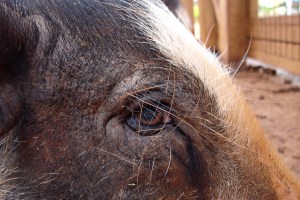
Photo by Kamuelaboy on Morguefile.

An article about a hog farm in Owensboro, Kentucky crossed my radar today, and pinged it for all the wrong reasons.  The farm, which is attempting to curb the spread of a rather horrible-sounding disease called porcine epidemic diarrhea, or PED, is in the news because its effort to protect its animals involves grinding up the intestines of dead piglets which have died from the disease and feeding the resulting “smoothie” to the adult sows.

The procedure, called “controlled exposure“, is actually standard practice.  It attempts to establish “herd immunity” in an infected farm by exposing all adult animals on the farm to the disease as quickly as possible.  (The virus has a mortality rate approaching 100% in suckling piglets, but most adult animals recover without incident.)  Since PED is an intestinal pathogen, adult animals are most easily infected by exposure to the “intestinal tract” of “infected neonatal piglets”, which should be “sacrificed” within the first six hours of clinical signs for “maximum viral content”.  Once they recover, the now-immune adult sows will pass on antibodies against the infection in their milk to future litters of piglets, keeping those piglets protected from the virus and giving the farm time to perform some serious hygienic measures and actually eradicate the virus.

Okay, so there might theoretically be a point to the farm’s actions.  (And note that the swine industry is not the only one that feeds dead animal parts to live ones, either as a medical treatment or as a standard feed additive.)  I do, however, note that this paper, from the site of the American Association of Swine Veterinarians, recommends that adult pigs simply be exposed to the feces of that poor doomed first wave of sick piglets, as the feces of live piglets contains up to 10,000 times the viral load of the viscera of dead piglets and is therefore a much more effective infectious agent.  It is therefore not necessary to grind up the piglets or feed them to their own mothers.  And besides, in the words of the above paper, “Collecting viscera is time-consuming and provides unnecessary fodder for the scrutiny of public perceptions.”

photo via HSUS and Wikimedia Commons

Gestation crates.  Photo from HSUS, via Wikimedia Commons.

The Humane Society of the United States, which broke the original story, points out that keeping pigs in natural conditions is a more ideal way to prevent the spread of diseases such as PED than feeding dead animals to live ones.  (It also notes that feeding dead animals to live ones is against state law in any case, although I cannot find that reference online at the moment.)  The farm in question is a large factory farm and its sows are maintained in industry-standard gestation and/or farrowing crates, which are noted for providing just as much room as a pig needs to exist (not turn around, not move, just exist) and not an inch more, on the grounds of “protection” for the sows from each other, and for piglets from the vast and frightening bulk of their mother.  The sows spend their lives crammed shoulder to shoulder in steel frame boxes the exact length and width of their bodies, churning out litters of piglets.  This kind of atmosphere does not promote healthy, happy animals.

Which brings me to what pinged my radar: the name of the farm in question is Iron Maiden Hog FarmIron Maiden Hog Farm!  I am at a loss to think of a more classless name for a pig breeding operation.  I somehow cannot bring myself to believe the facility is named after the band, can you?
Ambient Temperature Shown to Affect Results of Cancer Research on Mice

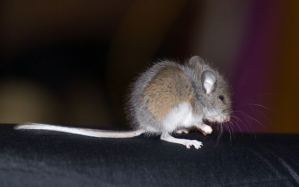
Photo by gracey at www.morguefile.com

Photo by gracey at http://www.morguefile.com

Scientists have finally “asked” lab mice their preferred ambient temperature.  They discovered the mice prefer warmer temperatures than have been traditionally provided, and that, furthermore, their bodies behave differently at their preferred, warmer, temperatures.  (Here’s the original article, by Kathleen M. Kokolus et. al., published in Proceedings of the Natural Academy of Sciences.)

I think the scariest thing about this paper is that it mentions that it has already been shown that mice prefer warmer temperatures than currently mandated, and that the colder temperatures in which they are currently kept induce “cold stress” and accompanying biological changes (references 3-7 in original article, dated from 2009-2012).  Has anyone been fighting to raise the standard ambient temperature for laboratory mice since 2009?  It seems to be taking the threat of these issues affecting the results of research to make scientists care whether or not the mice are in temperatures they’d prefer.

Beyond that — for how many years have we been doing research on mice at these recommended temperatures?  How much research has already been done with populations of mice affected by chronic cold stress?  Would we have gotten the same results in labs kept at 86 degrees Fahrenheit?  What results which we currently take for granted might be wrong?

What other variables might be sub-par for our research animals, and what effect might those things have on their responses to, say, cancer-causing chemicals?

Would an Animal Shelter Import a Puppy?

In an article decrying (with some justification) the tendency of animal-rescuing persons to refer to animal-breeding persons with derogatory names, the author stated (emphasis theirs):

Animal shelters in the USA have been casting a wide net to fill their kennels for years. According to the US Public Health Service, Chicago O’Hare was the destination airport for 10,125 dogs imported from overseas in 2006, half of which weren’t vaccinated. Scientists from the Center of Disease Control estimated that over 199,000 dogs (38,100 unvaccinated) came into the country through the Mexican border that year alone, and in 2007, one organization in Puerto Rico by itself shipped more than 14,000 strays in seven years to the United States for adoption at shelters. ABC News reported that according to G. Gale Galland, veterinarian in the CDC’s Division of Global Migration and Quarantine, as many as 300,000 puppies a year – most from countries with little or no health safeguards, are being imported to satisfy the demand for puppies at shelters.

This set off my WTF detector, because, in my experience, I think the last thing the workers at the shelter where I work would ever want to do would be to purchase, with money, more animals for the shelter.  People walk in their door every day with baskets of puppies, often purebred.  At this exact second they have four purebred Beagles, a purebred German Shepherd, a Labrador retriever, a handsome white Boxer, and a mother Pug with two puppies.  Speaking of puppies, there is also a litter of five little Lab/Beagle mixes, at least three other, single, puppies, and some lovely juvenile (teenage) dogs, as well as possibly an infinite number of kittens.  Every cage is full.  For what possible reason would they want to ask for more dogs?

The original G. Gale Galland quote, in a 2007 article about how importation of unvaccinated dogs is prompting concerns about rabies, does indeed say that “as many as 300,000 puppies a year” are being imported — but it does not say that all the animals are specifically going to shelters.  Two paragraphs down in the same article, the Border Puppy Task Force in California describes the puppies as being “sold for $1,000 each in shopping center parking lots on the street”.  The Task Force web site exhorts people not to “pay in cash” for a puppy “on a street corner, in an alley or parking lot, or at a swap meet”.  Most shelters do not sell dogs on the street for $1,000 cash.   Perhaps these imported dogs are not all going directly to shelters?

from Kenny123 on morguefile.com

from Kenny123 on morguefile.com

I was surprised to learn that the bit about getting “14,000 strays in seven years” shipped in from Puerto Rico was true, but again, the quote is incomplete: these animals (known as Satos, or Sato dogs) are not just puppies, they are dogs of all ages.  The shelters say that they are being shipped from an area where there isn’t a lot of help available for them to places where they are more likely to be adopted. Critics say that shelters in areas where there aren’t a lot of stray dogs are importing strays from Puerto Rico rather than “go out of business”.  This letter from someone decrying the practice and its matching rebuttal do a pretty good job of summing up this mess.

This National Animal Interest Alliance (NAIA) paper appears to be the source of the “10,125 dogs imported through Chicago” as well as the “199,100 dogs entered from Mexico” statements.  Note that the paper refers to dogs, not puppies.  When considering where these animals go, the same paper states: “Some of these increases [in importation] may be explained by the apparent recent expansion in a high-volume international commercial puppy trade.  Breeders overseas and across borders ship puppies to the United States for sale through commercial pet stores, flea markets, and internet trading sites.”  Then it adds, “In addition to imports for commercial sale, several animal rescue operations import dogs from other countries for adoption in the United States.  For example…a humane rescue organization imported 295 dogs to the United States from the Middle East.”  Again, the true answer seems to lie right in the middle: yes, there are clearly shelters importing dogs (and puppies).  There are also breeders and commercial facilities importing puppies.

There seems to be a shouting match going on concerning shelters shipping in animals from other rescues.  My animal shelter would tell you that this process (NAIA calls it “humane relocation”) is a great thing; they are thrilled to be able to send animals to shelters in other states so they have room for the new ones constantly walking in the door.  NAIA (which is headed by a number of people who love animals, many of whom also happen to perform animal research, and also breed dogs) seems to have a number of articles putting down this practice as “money-making” on the part of the receiving shelters.  It’s likely that both sides of the story are true, depending on which shelter you look at, and where you live.  This shelter in Atlanta may well be slowly becoming a for-profit organization and is shipping in animals to keep itself financially afloat, but not all shelters behave like this one, and not all relocation programs are primarily intended to raise money for the receiving shelters.

While it is true that some shelters import pets, from both other US shelters and shelters in other countries, it feels to me as though this is more about NAIA (the primary source of a lot of articles, as well as the term “humane relocation” referring to movement of animals between shelters) using articles about a real concern (unvaccinated imported animals bringing in zoonotic diseases) to support an attack against animal rescue groups’ negative attitude toward pet breeders.  I can see (some of) the thought behind their position: in general, dog (and cat, ferret, horse, etc.) fanciers who take good care of their animals should always be encouraged, be their animals from (reputable) breeder or (reputable) shelter, and, in fact, some breeders are also rescuers.  (Responsibly) breeding pets is not intrinsically a terrible act.  On the other hand, portraying all shelters as money-grubbing, fanatical and untrustworthy “pet shops”, and denouncing a program that (at least sometimes) allows animals unlikely to be adopted in one area to be shipped to another for faster adoption, is not good for the one thing we all love best here: the animals.

How You Can Help The Moira, NY Horse (Or Any Sad Animal)

Moira NY Horse in Need

Let’s repost this with hope it reaches someone who can help >This horse belongs to Frank Burgess and Brenda Waite of the Best Road in Moira NY. The state police have been alerted to the condition of their horses. Please help to keep the heat on their owners so that they are taken away. Not fair.

EDIT: These horses have been helped!  According to the comments below, the NY State Police have been informed about their situation.  It’s not entirely clear whether the horse(s) have been moved, or whether they are still at the site, but various sources strongly indicate that action is being taken.  Also, it seems that Brenda’s last name is Wattie, not Waite.  Thanks everyone!

UPDATES: the first news article, from the Utica Observer-Dispatch.

The local paper, the Daily Courier-Observer, pitches in with its own update on 8/27/13.

And the beautiful mare above is named Dreamer, and has arrived at the Adirondack Equine Center for rehab.  See some photos here!

This morning my Facebook feed turned up the above photo, with attached caption.  It exhorted me to forward the photo on, until “it reaches someone who can help”.  It occurs to me that simply sharing a photo on Facebook is not helpful to this horse in any way.  How can I help this horse?

First, some minimal research.  Like photos of lost children, photos of abused animals tend to persist indefinitely.  Long after the crisis is over, people will continue to forward the photos, trying to help without first checking to see if the animal is even still in danger.  Also, not every forwarded photo of an emaciated animal has the full story — there is no way to verify in this case that the caption matches the photo.  Maybe this animal is already under veterinary care, or this is a “before” photo “borrowed” from an unrelated animal rescue site.  Before taking action, I should check to see if someone else has seen this first.

A quick Google Search By Image for the above picture reveals no immediate matches, so next I search for the names and location in Google.  This reveals only the Facebook posting, which appears to be rather recent because there are not a lot of links.  I also try phrases like “animal control burgess waite Moira NY” and get nothing, so…okay, our initial search reveals that there’s nothing on Snopes or any large sites yet to tell me if this is real or not.  (Often, during research I’ll find local newspaper stories or police blotter postings confirming the story or filling in details.)

One link in particular (as well as the original “share” I saw on Facebook) describes the Facebook post as originating when “[poster] shared Rob Carlsen‘s photo.”  The original post may in fact be here (I looked for Rob Carlsen on Facebook)…it contains the above information and nothing else.  (It also has about 14,000 shares as of this moment…!)  It also does have at least one comment on it from someone promising to look into this, so there’s hope!

In this case I’ll assume, because I love horses, and I’d like to help this one, that this photo has some basis in reality.  Just sharing it on Facebook will only result in the propagation of the photo.  How do I help this horse, from where I am?

First, locate the proper authorities: Google will also tell me where the local humane societies, right near Best Road in Moira, NY, are.  Clicking on the individual links gives me web sites and phone numbers:

  • Potsdam Animal Shelter (315) 265-3199 potsdamhumanesociety.org
  • North Country Animal Shelter (518) 483-8079
  • Tri-Lakes Humane Society (518) 891-0017 tlhsny.webs.com
  • Massena Humane Society (315) 764-1330

The New York State Police has an office in nearby Malone as well: (518) 483-5000.  Searching for “Moira, NY horse rescue” turns up a couple of helpful links:

(I have not researched any of these sites, past looking at their web pages.  I can only assume they are legitimate organizations — either way, calling them will not hurt!)  The next step is to call or email these institutions and politely ask if they have investigated this photo.  Since it’s roaming around on Facebook, they are probably receiving 200+ calls an hour about the picture, so remember to be polite, be brief, and do not waste their time.  In the unlikely event that they don’t know about the photo yet, you’ve informed them of its existence.  If they do know, you’ll be (gently!) nudging them to fully investigate.  If I had friends in New York I would probably mention this to them as well — it is likely they know of other places one could call to try to get confirmation that this horse is, in fact, in trouble, and, if so, to get help to it.  If you have something to offer (time, money, information) you could also consider contacting the lady who answered the original post and offered to drive by.

I suspect that, very shortly, there will be news stories about this horse telling us what really happened to it — I leave the investigative reporting to the people on the ground in New York.  However, when I find out the rest of the story I’ll be sure to add it to this post, to try to close up the story of this horse so when other people find the photo and research it, they’ll be able to see whether their help is still needed or not.

Much better than just hitting “share”, don’t you think?  And not much more effort!  Good luck, anonymous horse!

One Possible Cause of Farm Worker Shortage

This is just an “interesting choice of photo” moment — but today I saw an article called “Want a Job?  Agriculture Industry Teeming With Them“.  What interests me is not so much the content of the article as the photo that USA Today chose to go along with it:

(Photo: Alvis Upitis, Getty Images file)

(Photo: Alvis Upitis, Getty Images file)

My original thought was “veal calves” — although the original photo source says “Holstein dairy calves” on a Wisconsin farm, and these do appear to be dairy calves.  There are theoretically good reasons to keep dairy calves this way; however, for a huge variety of reasons, this is not a location in which I’d personally be comfortable working.  Maybe that’s why there’s a shortage of workers?

(The shortage might also have something to do with the low paydangerous and unpleasant working conditions, and other problems, but those aren’t in the photo.)

It’s Okay To Shoot Kittens As Long As We Can’t See

Multiple sources.

Multiple sources.

A sadly tiny blip across the “WTF” radar was the shooting of five kittens by an Ohio policeman named Bob (or Barry) Accorti on June 10, 2013.  The story in brief: homeowner has litter of feral cats in her woodpile; calls police; police send Accorti (a “part-time humane officer”, according to the North Ridgeville, OH, police web site).  The homeowner assumes, and Accorti tells the homeowner specifically, that the cats will be “euthanized” as “the shelters are all full”.  Homeowner pictures “euthanasia” involving the cats being trapped and taken to a shelter and euthanized there.  Accorti, however, conforms to the traditional police method of euthanasia (another link, another link) for “nuisance animals” — and instead shoots the 8-10-week old kittens, right in front of the homeowner and her young children who are watching through the windows.

The department has cleared him of any wrongdoing, concluding that the officer acted as required to remove the nuisance animals and that “research and other animal organizations accept shooting as an acceptable means of euthanasia.”  (Well, yes, they do, but “with conditions” and only in “emergency situations”, requiring that personnel be “highly skilled” and that “pre-euthanasia sedation is recommended” because cats “may be difficult to shoot humanely” (section S1.3.3).)  He was, perhaps, extremely tactless about it, but he did the job he was called to do, and did it in a legally acceptable manner.

Using phrases like “screaming kids” and “helpless kittens“, multiple individuals and organizations are trying to get Accorti punished, somehow, for shooting the kittens.  However, they can’t punish him for shooting the kittens, because shooting kittens is, technically, a viable option, and legal (at least in Ohio) — so instead they’re trying to punish him for shooting the kittens in front of the children.

I am of two minds on this point: I believe we should at least be open and honest about the horrible things we do to animals (only by publicly acknowledging that these things are being done can we stop them being done).  If you’re going to shoot kittens, you should not be able to do it in secret — you should have to do it right out in the open so everybody knows it’s happening, and has ample opportunity to object and/or stop you.  However, I also believe there is a required maturity level juvenile humans should reach before being confronted with concepts like “things die” and “sometimes we cause things to die”, and that the officer was not in a position to dictate whether or not those kids were at that maturity level.  In any case, the officer probably should have at least warned the homeowner before firing, so she could choose whether or not she wanted to educate her children about those ideas at that exact moment.

I think the bigger point, however, is this: if we’re offended and horrified by the shooting of kittens, so much so that we don’t want our children exposed to it, and don’t want to see it ourselves — why don’t we attack, and call to ban, “the shooting of kittens” instead of “the shooting of kittens in front of children“?  Officer Accorti, and his actions, are not the problem here — the problem is that our legal system still regards “gunshot to the head” as a viable method of euthanasia for cats (and a bunch of other animals, including dogs).  If we think that’s so horrible that we’re willing to lynch a guy for doing it, maybe we ought to consider passing legislation prohibiting that method of “euthanasia”.

Cheerios is 99.99% Vegan; So Am I

I made one of my usual tactical errors the other day, and decided to check whether Cheerios, my breakfast cereal of choice, is, in fact, vegan.  I’d just managed to wean myself off of traditional dairy based milk onto soy milk (and boy, did that suck — sorry, cows); I was feeling proud of myself and wanted to verify that I’d finally gotten breakfast fully vegan.

The answer is interesting: no, Cheerios is not vegan, because the vitamin D3 which is added to the cereal is made from lanolin, which of course comes from sheep.  Technically, this may make the cereal just vegetarian rather than vegan, but since there’s no way to tell if the wool was sheared off living sheep or skinned off dead sheep, it may also technically be “animal based”.  This means that any “fortified” cereal (or any “fortified” food, such as orange juice!) may contain vitamin D3 or other “slaughterhouse by-products”.  Also, if the “sugar” in the Cheerios is white cane sugar, it was likely whitened using the calcium carbonate from animal bones.  So my “vegan” breakfast, well, isn’t.  Arrgh!

My experience wasn’t special.  Non-vegan products are hiding inside apparently vegan food all the time.  What is really interesting about this is that one of the first links I found when starting my search for nutritional information on Cheerios was PETA’s “Accidentally Vegan” web site, which — sometime in the past — listed Cheerios, saying it was vegan and making no mention of the treacherous lanolin-based vitamin D3.  When people complained about this (and other foods on the list which were not actually vegan), PETA responded thusly:

While PETA supports a strict adherence to veganism, we put the task of vigorously reducing animal suffering ahead of personal purity. Boycotting products that are 99.9 percent vegan sends the message to manufacturers that there is no market for this food, which ends up hurting more animals.

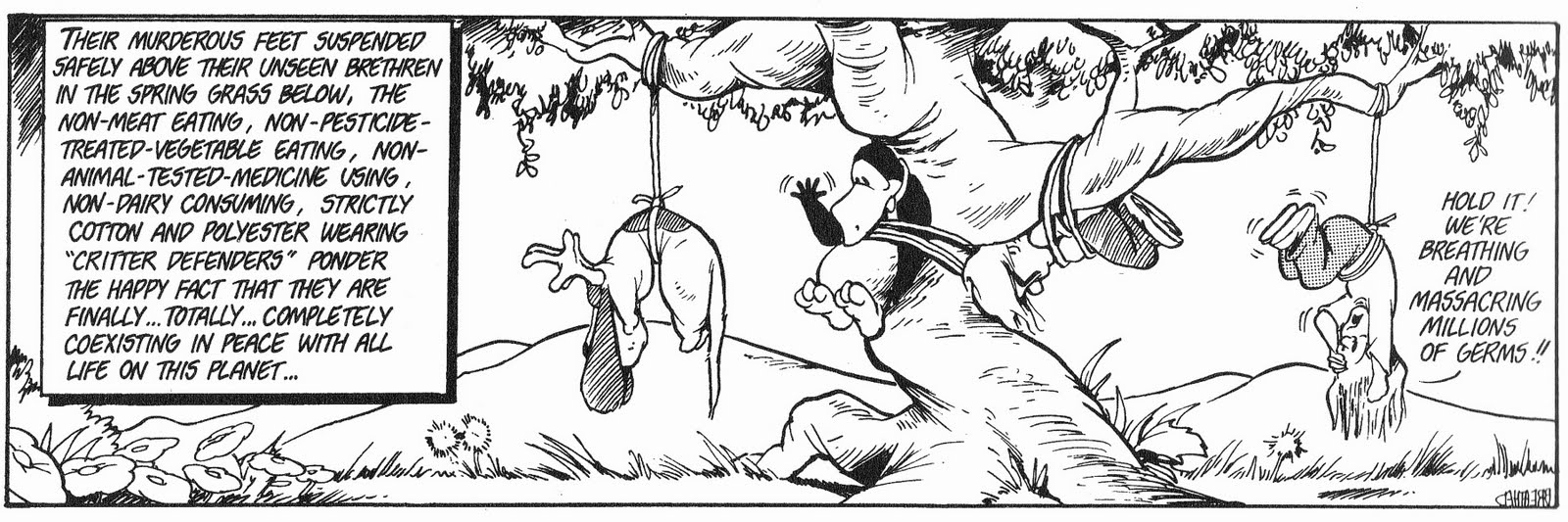
So where should I draw the line?  Do I spend four times as much on a “vegan” version of Cheerios, or is 99.9% vegan “close enough”?  (Maybe, maybe not — PETA did eventually take Cheerios, and some other non-vegan foods, off the “accidentally vegan” list.)  But what about animal products hidden in other places (like car tires and plastic bags) that are often impossible to spot?  How far do I go to ensure that I never eat another animal?  How far should I go to never indirectly harm another animal?  How crazy should I get, avoiding having any kind of impact on any other living being, anywhere?

Bloom County, by Berkeley Breathed.

Comic from Bloom County, by Berkeley Breathed.

I finally found the “Bloom County” cartoon I’ve been looking for, which shows veganism taken to its logical extreme.  Because we’re on this planet, we’re using resources, and that’s necessarily going to impact other living things, sometimes negatively.  That’s okay.  That’s something we can’t help.  However, that’s no reason to ignore the issue.  Even if I can’t completely remove my impact on the planet, my choosing to not eat animal products in as much as I possibly can is still reducing my impact by a measurable percentage.  Isn’t that better than nothing?  At least I’m trying, and I can only get better at it.  (Next project: switch breakfast to fruit-without-animal-based-wax-coatings and vegan-bread toast….)

I’m Vegetarian, You’re Not, That’s Okay

Today, I got dragged along to a family dinner. Some idiot invited my douchebag vegan uncle, who spent half the night making condescending remarks and lecturing us on how disgusting it was to have steak on offer at the table. A fistfight eventually erupted, and the cops were called. FML

This particular “F My Life” is followed by pages and pages of interesting commentary from people (justified or not) who feel they have been offended by vegans/vegetarians trying to make them feel bad about eating meat.

This is why I haven’t figured out how to tell a lot of people, including my parents, that I stopped eating meat.  Their first question will be Why did you do that?!? … and then I will have to tell them why, and I can’t figure out how to transmit that information without coming off as an overbearing asshole trying to push my belief system on them.

Image found at prettyfakes.com

From “Animal Man” by Grant Morrison and DC Comics. Pencils by Chas Truog; inks by Doug Hazlewood; letters by John Costanza; colors by Tatjana Wood.

It’s not like I’m planning to belittle them for not having the same ideas I do, or complain that they don’t share my thoughts.  If they have not arrived at the same conclusions I have about the world, that does not make them bad people.  But how do I say, “I stopped eating meat because they’re torturing animals needlessly and gratuitously to get it,” without also silently implying that, since my parents have not also stopped eating meat, they are implicitly supporting that process, and are therefore bad persons?

(I like to think I’ve struck a happy balance with my husband, who still consumes the occasional meat-based nom, but recognizes that I have a point of view and that I must have put some work into it to reach it, but not all people are as copacetic as my husband.)

I’m interested in how the comments compare proselytizing vegans/vegetarians to proselytizing religious persons.  I suppose they’re all belief systems, and the whole point is to be able to share one’s point of view without stuffing it down anyone’s throat (foie gras, anyone?).  Hmmm.

Scientists’ View of Humane Science

Image by mensatic via morguefile.com

Image by mensatic via morguefile.com.

If you are interested in how scientists are currently viewing animal-based research, there is a free online course available, taught by employees of Johns Hopkins University (one of the big animal research “players”), Alan Goldberg and James Owiny.  The course is called Enhancing Humane Science – Improving Animal Research.  It is sponsored by the Center for Alternatives to Animal Testing, which sounds great until you realize it’s also part of Johns Hopkins.  This course is absolutely not in any way unbiased.  Johns Hopkins has a lot of big stakes in animal-based research.

I’ll admit I haven’t listened to the whole course yet, but it reeks of the stuff I had to read while working in animal research.  It appears to be a pretty accurate picture of the scientists’ point of view concerning animal welfare.

I’m not defending or attacking anybody here.  This mess, and my opinion of it, is too huge and complicated for me to summarize it in one journal post.  But if you were looking for a good introduction to how scientists look at animal research, and where they are coming from when they say, “But we are doing everything we can for the animals in our care,” this is where a lot of them are standing right now.  The jargon and the general attitudes are appropriate and seem pretty representative.

They aren’t cackling and rubbing their hands together, drooling over the prospect of thousands of dead mice.  On the other hand, these animals routinely undergo experiences we would not inflict on our pets.

From Pasture To Plate In 0.06 Seconds

Popeye Explodes a Bull

I found this little gif interesting.  Is this humane slaughter?  It’s certainly extremely efficient.

Research to find the cartoon’s title tells me that this animation comes from an episode called “I Eats My Spinach”, which involves Popeye briefly engaging in a bullfight, with the ending pictured above.  However, the same research also leads to a synopsis of an episode called “Bulldozing the Bull” where Popeye refuses to attend a bullfight on ethical grounds — “It’s cruelty to aminals” — and later befriends the bull.

Nothing profound here, just a little glimpse of something.  Also, the one cut of kosher meat intrigues me.