A Meaty Amusement

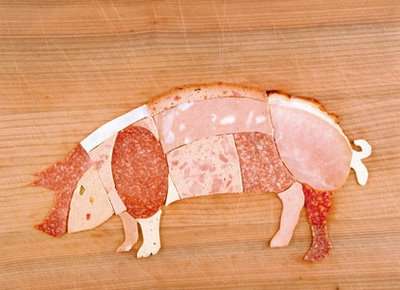
image by Sarah Illenberger

Having gone to a slightly less meat-infused lifestyle, I find it more difficult than it used to be to order in restaurants.  I never realized how pervasive meat was until I tried to find a dish without any in it.

Not that any one restaurant seems to be worse than any other, here’s the lunch and dinner menu from Cracker Barrel.  Even just looking at the photos, everything has meat in it, even the salads (and, yes, the baked beans are made the old-fashioned way, with ham).  Only the desserts come without meat!

And here’s the menu from IHOP, one of my other favorites.  They’re a little better because of the preponderance of (generally meat-free) pancakes, but still — sausage, ham, bacon, eggs, steak, and the “Bacon-N-Beef Burger”, burger with bacon mixed in.

Also, when you order an entree without meat from most of my favorite restaurants, the waitress will ask you, as though you may have forgotten, “Did you want any meat with that?”  I know it’s a required upsell — meat is profitable for them — but sometimes it just sounds macabre!

Other times, the menus remind me strongly of the “Spam” Sketch from Monty Python.  “Meat, meat, meat, meat with beans, meat with rice, meat with potatoes, roasted meat, baked meat, boiled meat, sliced meat, curried meat, raw meat, burnt meat, meat salad, meat pie, meat omelet, meat stir fry, meat sandwich, meat fried rice, meat with more meat, meat with eggs, meat with bread, meat with sauce, meat with pasta…or Lobster Thermidor á Crevétte with a mornay sauce served in a Provençale manner with shallots and aubergines garnished with truffle paté, brandy and with a fried egg on top and meat.”

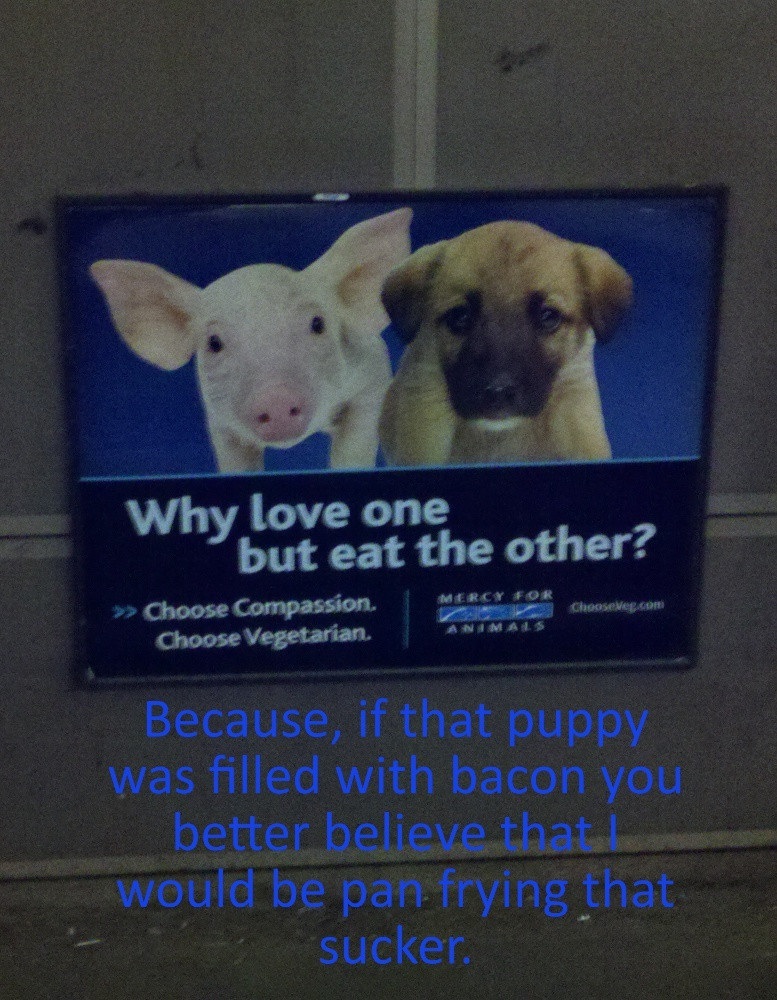
Pig or Puppy, the System Still Sucks

I was raised by wolves, or at least by a pack of consummate carnivores.  I find that not a lot of my friends want to talk to me about animal welfare because they think that, by objecting to how we treat our meat and research animals, I’ve become a brainwashed, tree-hugging hippie who’s trying to convert them to veganism.  They like eating their meat, and they get grumpy when they think someone is trying to take it away.

All right.  We all love bacon.  Pigs provide bacon.  You gotta kill pigs to get bacon.  Fine.

Now imagine that there are two ways to get bacon out of a pig (or a puppy).

The first way is an old, slow, traditional way: you raise the pig in a nice big space, let it exercise the muscles you’re going to eat, feed and water it properly, give it love, health care, and shelter, and kill it as humanely as possible.  You clean the carcass carefully, use as much of it as you can, and only keep and slaughter as many pigs as you can kindly handle.  Because you have a lot of time to work with individual animals and to make sure your facilities are clean, this produces clean, fresh bacon — and a lot more of it, off fatter, healthier pigs (or puppies).

The second way is the new, fast, modern way: you raise hundreds of thousands of pigs in small metal boxes in the dark.  You grow them so big, so fast, their legs break.  You fill them to the eyes with antibiotics so they don’t get sick.  You can’t process all the pigs yourself, so you hire (and abuse) minimum-wage workers to do the slaughtering in a partially automated process.  Processing 3,000 pigs an hour (one every two seconds), not all the pigs die before being dismembered.  Something like 20-30% are “legged”, gutted, and dissected alive.  Everything moves so fast there’s no time to clean properly, and carcasses (and everything else) are covered in feces, blood, and other materials.  There’s no time to inspect carcasses properly, either, and diseased animals are packaged up for sale.  When disease is inevitably discovered in your product, instead of slowing down the line, you wash the meat down in chlorine before you package it.

Either way, you end up eating bacon.  But the first way, you’re getting good meat, and the second way, you’re getting meat full of chemical washes, pus, E. coli, and sawdust.

Just for this moment, we’re gonna skip all the animal welfare issues, the worker welfare issues, the adorable little kids dying of E. coli poisoning, and the really cute part where the plants are run and “overseen” by the rich, fat-cat assholes in Washington that you hate, who are even now passing laws to make it easier for them to churn out tainted, sawdust-flavored crap and sell it everywhere.  Boiled down to the basic facts: the current system of food production, which supplies most grocery stores and restaurants, turns out horrible, diseased, scary meat which is doused in chemicals and potentially dangerous for you.

Your status as a carnivore is not in question.  The question is, which pig (or puppy) would you rather eat?

Someone Else Can See It

It’s not that the scientists are lying, exactly, about what they’re doing.  It’s not that they’re hiding it, either, really.  Everything they do is written down as a proposal, approved by various subcommittees, recorded as results, and stored in case someone wants to look at it.  The problem is more one of communication:

“Yes, [I found it],” said Arthur.  “Yes, I did.  It was on display in the bottom of a locked filing cabinet stuck in a disused lavatory with a sign on the door saying ‘Beware of the Leopard’.”

Like the plans to demolish Arthur Dent’s house, the descriptions of what people are doing in laboratory experiments are there — just very, very difficult to find.  Most people don’t bother, or aren’t even aware that there are any descriptions out there to find.

For example, you can find, if you search online, some perfectly ordinary “rodent guillotines“.  You may be able to find a page, as well, explaining why some research animals might need to be euthanized via guillotine (it allows the researchers to collect samples uncontaminated by euthanasia chemicals).  Here’s a page describing research reassuring scientists that decapitation is painless (notice that it’s in response to research saying decapitation isn’t painless, and that it corroborates the original findings, but simply chooses to interpret them differently).  You can find masses of pages describing the euthanasia techniques, including decapitation, used by different facilities (look at all those colleges!  Did you know that your college tuition funded this kind of thing?  Would you have gone to that college if you’d known?)

…how would you know to look for this if you hadn’t worked in one of these facilities?  I wouldn’t have been able to come up with the search terms (“decapitation”, “euthanasia”, “rodent”, and “SOP”, if you’re wondering).  It wouldn’t have occurred to me that this even went on.  What other practices do we just need to know the search terms to find?  (Try “cervical dislocation”, “neonates” and “scissors”, “captive bolt”, “hog stunner”, and finish up with “AVMA guidelines euthanasia” to see the full list.)  It’s not like the information isn’t out there…it’s just that nobody is calling it to our attention.

What triggered this today was a random blog post from someone else mentioning that, hey, we’re not really saying a lot about this, are we?  Has anyone else noticed that people are being really quiet about this?  Why?

“No Nonsense Guide” Contains Nonsense

In my search for What The Hell Is Going On I have been reading a lot of different books from a variety of sources.  Today I was leafing through a copy of The No Nonsense Guide to Animal Rights, by Catharine Grant, which has a foreword by Ingrid Newkirk of PETA and a definite animal-liberation bias.  I tend to avoid such books not because I entirely disagree with them, but because they tend to prefer emotional arguments over logical ones.  In their search for a black and white view of the world, they also occasionally take logic a little too far: Following a description of a visit to a pretty much idyllic little English farm, wherein the animals all had enough space, affection, shelter, food, water, and medical care, with owners who knew them all by name, the book immediately adds: “However, even organically reared animals are raised to be killed…[and so] many animal rightists believe that all husbandry is inherently unjust.”  Take that, caring and affectionate farmers who put so much time and work into your animals!

Anyway, the part that got me was in the book’s description of the farming of sheep for wool:  “Most sheep…live outside.  Free-roaming sheep are a common sight in many parts of Britain, South Africa, Australia, and New Zealand.  The sheep are largely left to themselves until they are herded for shearing.”  Sounds as good as sheep can have it, doesn’t it?  So what’s wrong with this hands-off approach to sheep husbandry?  The book notes that, because the sheep are left to themselves, “many sheep die of exposure or neglect every year.”

Where is the happy ground here?  If the farmers provide good (but barn- and pasture-based) care for their sheep (or cows), the sheep are healthy and protected from harm but are still captives in thrall to their evil human overlords, which is Wrong.  But if the farmers let the sheep loose to graze freely and without interference over the countryside, they are abandoning the poor defenseless sheep to the cruel vagaries of nature.

Assuming we stopped all human use of animals tomorrow, and we could just let all domestic species loose and they would be able to fend for themselves…aren’t we just abandoning them to whatever horrible death nature has in store?  Is living for 7-10 years well loved, well fed, warm, and healthy in a barn, under the care of humans, really less preferable to being eaten by a mountain lion or starving to death when one’s teeth wear down with age?  Nature does not offer a guarantee of a peaceful death.  Neither do humans right now (although such a guarantee should be a part of humans taking responsibility for an animal) — however, living with humans, even under current conditions, gives a much greater probability of a humane death than does living in the wild.

If the issue is about freedom, and freedom of choice, for the animal…would (at least some) animals not choose warmth, safety and protection with humans if given the opportunity?  Feral cats and dogs choose this option all the time, as do rats, cockroaches, coyotes, foxes, rabbits, raccoons, squirrels, chipmunks, and all the myriad species who live in close contact with human habitation.

It sounds like letting animals loose to roam and not protecting them is just as horrible as keeping them in barns and pastures.  Are we required by this book’s extra-compassionate moral code to not only stop using animals but also then to spend the rest of our lives following around the wild animals and protecting them from harm?  We are all fighting together against the big, scary thing that is the universe, life, and death.  Why not do it literally?

Good Advice on a Lot of Levels

“My advice to you: Get several books. When you get confused, if all of the books tell you to do the same thing, believe it. If they tell you to do completely different things, someone if not everyone is talking out their ass.”

via The Story About the Baby, Volume 2.

This is posted on a blog about raising an infant human, but, honestly, this is good advice on any front.

Home Sweet WTF

“The goal of managing any mouse colony … should be to maintain adequate numbers of animals in as little shelf space as possible….”

Husbandry protocol, University of California, Irvine

The image to the right is of a standard laboratory mouse cage.  This is considered a pretty cutting edge mouse habitat these days.  The unit is actually fairly airtight — the blue and red things are valves through which air enters and exits the chamber when the cage is inserted into a “ventilated rack system” (described below).  These cages are designed to work with the rack system keep the environment the mice are in separate from the outside environment, usually by running any air going into or out of the cage through a replaceable HEPA filter in the top of the cage (not visible in the picture).  This keeps immunocompromised mice from getting sick, and keeps lab workers from catching anything the mice might have.

According to the manufacturer’s web site, these palatial enclosures have 75 square inches of floor space.  That might sound like a lot, but that translates to about 7 3/4″ wide by 12″ long in a cage 6 1/2″ high — about the size of a sheet of typing paper.  (The cages are commonly called “shoebox cages” for a reason.)  That measurement also doesn’t count the intrusion into the living space of the enormous food hopper, under which the mice must squeeze to get from one side of the cage to the other.  These cages are of course perfectly within guidelines for the absolute minimum space requirements per adult mouse.  (Here is an amusing page comparing mouse cage sizes to human equivalents.)

Generally, facilities limit the number of adult mice in such a cage to five, which works out to fifteen square inches of space per mouse — the size of a three by five index card.  In practice, these cages are often far more full even than this.  For example, breeding colonies often keep two adult females with an adult male and, either through protocol or lack of finesse on the part of the researcher or technician, may allow the resultant litters to remain in the breeding cage until they are weaned at about 21 days.  At left is an image of a 21-day-old mouse next to an adult.  Average litter size for a laboratory mouse is between 6-8 pups (although as many as 20 can be born at one time).  Imagine the cage just before weaning, with three (or more!) adults and potentially more than twenty “pups” that are fully half the size of the grown mice.  I have picked up cages in which the bedding was not visible through the mass of mice inside.  They do make larger cages which can be used for breeding, but these require more space, are more difficult to change and sterilize, and are more expensive to purchase, and are not always used.

Here is a photo of a ventilated rack system made by Allentown, Inc., a primary rodent housing supplier.  These racks are, again, the cutting edge for keeping a lot of mice in a very small space.  Previously, mice were placed on shelves on rolling racks; in this technologically advanced age we have perfected a model for keeping mice in almost the absolute minimum space possible.  These racks hold 100-200 cages apiece, with a single “standard” size mouse room able to potentially hold three to twenty racks.  I worked in a facility which had six 150-cage racks in a single room (one of many mouse rooms).  One technician was assigned to oversee all 900 cages in this room.  How diligent do you think that person could be when inspecting individual mice (remember, 1-5 mice per cage, potentially 4,500 mice in this room) for disease?

The boxes on top of the rack are the intake and exhaust blowers, which force air through the system and keep the rack either positively (no outside germs get in) or negatively (no inside germs get out) pressurized.  Although all cages receive equal amounts of fresh air (at 40-60 full air exchanges per minute, it must be like living in a wind tunnel), light is definitely in short supply down on those bottom racks.  The techs I worked with used to carry flashlights to see the bottom rows.

Note that there aren’t actually laws dictating minimum required living conditions for mice and rats.  Rodents are not covered under USDA regulations (which is one reason they are so popular as laboratory animals).  “Minimum living space” for mice and rats right now is “whatever we want it to be”.  Currently, more or less voluntary standards for this are set by the laboratories themselves, under the guise of the National Research Council, which could be considered to be just a bit biased in favor of the scientists.  There is a voluntary system of conforming to these standards via accreditation, but no federal agency is involved in enforcing them.  In fact, here is a page wherein the federal government is currently busy trying to buy a rack with even smaller (61-square-inch) cages for its own use.

It’s Everywhere

Today I was using Microsoft Publisher 2010, part of the Office software suite, to make a flyer for my place of work.  I was looking through the standard, included templates, trying to find a template with tear-off strips for phone numbers at the bottom.  Among the three or four templates with that design I noticed one with a little dog icon and a suggested sample caption of “FREE Puppies or Kittens”.

The template can be found under “templates/flyers/all marketing” if you’re interested in seeing it yourself.  I can’t find a link to it on Microsoft’s site, but here’s an excerpt from a Publisher “how to” book, telling you how to use an extremely similar template (“Free Kittens!”) in Publisher 2007.

The dangers of “Free to Good Home” ads aside…this is just a scary little picture of how pervasive the idea of “animal as object” is in our society.  It’s so thoroughly ingrained that someone thinking I need to make a sample flyer with tear-off strips immediately came up with “giving away unwanted animals” as a subject for their sample flyer.

Cow Enters Rescue Group’s Monkeysphere

A little while ago I posted about the Monkeysphere, and how there is a maximum number (Dunbar’s number) of social relationships that social animals (including humans) can simultaneously maintain.  If a person (or animal) is outside your monkeysphere, you do not view him/her/it as a social companion, and may find it difficult to generate empathy for him/her/it.

Here’s an example of that happening now.  Bavaria (like other countries) sends, probably, hundreds of thousands of cows to the slaughterhouse annually, but here’s a group frantically trying to save one loose, wandering cow.

It’s not that I disagree with the idea — and, from a fundraising point of view, it makes a lot of sense.  Having a name and a face on your campaign will definitely help raise money.  “We’re trying to save Yvonne!” will get more people interested in your cause than “We’re trying to save 100,000 anonymous cows!”  It’s just a fascinating example of the Monkeysphere in action.  Yvonne entered these people’s monkeysphere, and suddenly they can see her as a social companion, and suddenly it becomes worth purchasing not only her, but a former “stall mate” of hers, as well as mobilizing search and rescue units on all-terrain vehicles, to rescue her.

The other cows in Yvonne’s herd?  Too many faces — won’t fit in the monkeysphere.  Off they go.

(Not saying anything bad or good here.  We all do our best with what we have.  The rescue certainly cannot take in 100,000 cows every year, and Yvonne will definitely help them with their mission, benefiting the other cows indirectly by being their “ambassador”.  There’s no right or wrong here.  Just…pausing to look at the world as it goes by.)

(On  a similar note, this article “introducing you to the truck driver you just flipped off” is trying to get you to add truck drivers, in general, to your monkeysphere in order to get you to empathize with them and reduce incidents of road rage.  Did it work?)

Glow F**k Yourself

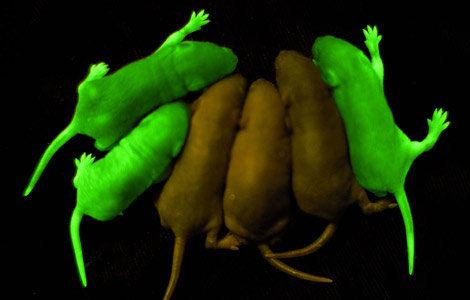
Photo via http://kidsblogs.nationalgeographic.com/kidsnews/2009/05/glowing-animals-gallery.htmlI believe that, at this time, we have mastered the technology of making glow-in-the-dark animals.  First there were the glowing mice, then the rats, the commercially-available atrocity the “glo-fish“,  Alba, the glowing rabbit who was also an “art installation”, pigs, and a whole host of other critters, and now, apparently, we have the glow-in-the-dark beagle.

What our intrepid scientists are doing, really, is stuffing extra genes into an animal to see if they can.  (Yes, that’s apparently all the justification they need.  They probably put the word “cancer” in the grant application, though.  You never know, this might be it!)  When scientists want to swap a gene from one organism to another, they choose to transfer a gene which makes the target animal, which ordinarily does not glow, produce a glowing protein.  They do this because that kind of thing is really easy to spot and doesn’t require complicated blood testing to see if it’s taken hold.  If the resultant animal glows, voila! — you have successfully transplanted a gene.

Why do they feel that making more glowing animals is necessary at this time?  I think we’ve passed the point of “required replication” of that original first experiment and entered the world of “unnecessary duplication of results”.  We’ve been shuffling genes around for years, as evidenced by that impressive list above.  We’ve even done beagles before, in 2009.  I think we’ve certainly seen that “we can” make glowing animals.  Now that “we can”, what are we doing with this amazing new technology?

To quote from the beagle article:

“[ByeongChun] Lee said the genes injected to make the dog glow could be substituted with genes that trigger fatal diseases. He and his team would then be able to chart the course of Alzheimer’s, Parkinson’s and more, better understanding how such diseases develop.”

It is fascinating how that paragraph doesn’t say, “The creation of transgenic beagles will allow us to give laboratory dogs a whole host of genetic diseases they don’t normally get, so that we can study how those diseases affect dogs, as if that were somehow relevant to how they affect people!

Yes.  The whole point of this ludicrous enterprise is that eventually, we will have man-made “animal models” for diseases that animals don’t normally even get — as though studying how these transplanted diseases behave in their new, unnatural hosts will tell us a damn thing about how they behave in humans.  We have reams and reams of evidence — including some generated from actual scientists doing animal-related experiments — that animal and human systems are not identical, and therefore we cannot extrapolate directly from one to the other, and here these people are, wasting time, money, and animals on making more animals to chew through while flailing helplessly in circles blathering about how they can cure cancer if only they can grind up a few more mice.

Ever notice how none of the articles point that out?  None of them say, “This will allow us to kill hundreds, maybe thousands, more dogs every year while searching for cures for human diseases.”  It’s always “Ooh, look at this adorable puppy — which may be a cure for cancer!

Am I saying that we should never, ever investigate recombinant DNA?  No.  Am I saying that perhaps we should think about using our newfound power of shuffling genes about to create hardier or more fruitful food crops that could feed impoverished nations, rather than new “animal models”, “designer fish” and “art installations”?  Yes.  We do not need to learn to cure artificially-induced Alzheimer’s disease in dogs.  We need to learn to cure it as it occurs naturally in people.

“We have learned well how to treat cancer in mice and rats but we still can’t cure people.”

— Professor Colin Garner, quoted in Genetic Engineering & Biotechnology News

I love science.  I love learning new things, and exploring new ideas.  I understand that we can learn things from animal research we cannot learn anywhere else.  This?  This is a grotesque parody of research.  This is an absolute waste of funds.  There are human-based studies at my local VA hospital desperate for funding to help wounded veterans overcome combat injuries.  There are developers who could really use grants to help design new prosthetic limbs.  Why are we wasting money on this?

But ooooh, lookit the cute glowing beagle!

The Monkeysphere

The online magazine Cracked, which is primarily known for cramming the maximum amount of four-letter words into the minimum amount of space but still occasionally tosses out some utter brilliance, in 2007 put out an article called “What is the Monkeysphere?”  The article presented the concept of Dunbar’s number, the theoretical maximum number of social relationships any given animal (including humans) can form and maintain at any given time.

The theory goes: Think about having a pet.  A dog, for example.  Your dog has a name (“Gozer the Magnificent”) and wears a funny hat and likes eating frozen rhubarb.  Now imagine you have five dogs.  Their names and personalities are a little harder to remember, but you can still keep them straight.  Now try to picture owning a hundred dogs.  Likely, you can’t even picture that many dogs, much less think of individual names or personalities for each.  The maximum number of dogs (or people, etc) with whom you can form caring social relationships is somewhere between five and one hundred.  That’s Dunbar’s number.  That’s the biggest social sphere we, as “monkeys”, can create.  That’s our monkeysphere.

Dunbar’s number varies from person to person and from species to species, but the basic principle is the same.  Where animal research, farming, zoos, and the pet industry — animal industry in general — goes wrong is about the point where the number of animals being cared for by any one person becomes greater than Dunbar’s number.

If a lab tech is told to care for ten mice, they all get names, personalities and individual identities.  A lab tech caring for a room full of 500 mouse cages, each containing between one and five mice, barely has time to count the mice as they blur past during each daily check.  A slaughter worker tasked with “stunning” four cows an hour can move slowly and patiently, properly aim the “stunning” device, and make sure each animal is dead before the rendering process begins.  A slaughter worker tasked with “stunning” one hundred cows an hour — as many currently are — is “processing” something like one cow every thirty seconds.  There is no time for patience or proper aim.  A zoo or wildlife park worker who cares for ten to fifteen animals has names for each one, and the animals are often treated as personal friends.  A zoo director, overseeing a collection of five hundred to two thousand animals, starts to see them as “units” rather than social companions.

Other factors — primarily money — come into it as well, but there is something about reaching Dunbar’s number that really damages the structure.  Once the humans can’t form social relationships with the individual animals anymore, they stop treating the animals as beings with which you might form social relationships — and that starts the whole downward spiral, where “what we should be doing” begins to look more and more different from “what we are actually doing”.

Just a thought.