Category Archives: the Machine

How It’s Made (Well, Partially Anyway)

From the “tactful omission of information” department:

The other day I was on Netflix, eagerly absorbing episodes of a show called How It’s Made, which is like little pieces of mind-candy — bite-sized nuggets of How They Make cast iron cookware, ketchup, swiss army knives, contact lenses…fascinating stuff.

In amongst these mostly neutral items are individual episodes which mention how they make things like pet food, hot dogs, deli sausage, fur coats, smoked ham, black pudding, and bacon.  To watch this show, none of these things seem to involve living animals in production — fur coats, for example, begin with a stack of tanned beaver pelts which apparently grow on trees or simply appear out of some other dimension.  Hot dogs begin with “trimmings”, the origin of which is not discussed in detail.  Hams “come from the hind leg of a pig”, but how they get them off the pig is not mentioned.  In the “pet food” episode, no meat is mentioned, until the very end where they mention that “animal fat” is sprayed on the (up til then) apparently completely vegetarian, wheat- and corn-based food “to make it palatable”.

I know the show isn’t about animal rights or animal welfare, and adding the bit about how they kill the pig/beaver/etc is extraneous to their message.  I just find it interesting (not bad, just interesting) how they gloss over the, er, “sticky” bits of information in their pursuit of a neutral-as-possible sound bite.

It’s Everywhere

Today I was using Microsoft Publisher 2010, part of the Office software suite, to make a flyer for my place of work.  I was looking through the standard, included templates, trying to find a template with tear-off strips for phone numbers at the bottom.  Among the three or four templates with that design I noticed one with a little dog icon and a suggested sample caption of “FREE Puppies or Kittens”.

The template can be found under “templates/flyers/all marketing” if you’re interested in seeing it yourself.  I can’t find a link to it on Microsoft’s site, but here’s an excerpt from a Publisher “how to” book, telling you how to use an extremely similar template (“Free Kittens!”) in Publisher 2007.

The dangers of “Free to Good Home” ads aside…this is just a scary little picture of how pervasive the idea of “animal as object” is in our society.  It’s so thoroughly ingrained that someone thinking I need to make a sample flyer with tear-off strips immediately came up with “giving away unwanted animals” as a subject for their sample flyer.

Glow F**k Yourself

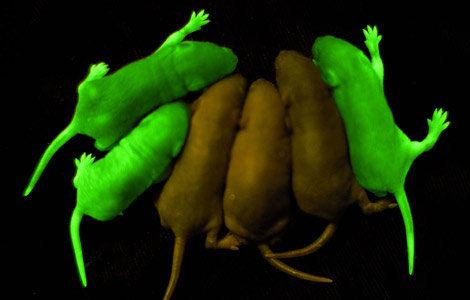
Photo via http://kidsblogs.nationalgeographic.com/kidsnews/2009/05/glowing-animals-gallery.htmlI believe that, at this time, we have mastered the technology of making glow-in-the-dark animals.  First there were the glowing mice, then the rats, the commercially-available atrocity the “glo-fish“,  Alba, the glowing rabbit who was also an “art installation”, pigs, and a whole host of other critters, and now, apparently, we have the glow-in-the-dark beagle.

What our intrepid scientists are doing, really, is stuffing extra genes into an animal to see if they can.  (Yes, that’s apparently all the justification they need.  They probably put the word “cancer” in the grant application, though.  You never know, this might be it!)  When scientists want to swap a gene from one organism to another, they choose to transfer a gene which makes the target animal, which ordinarily does not glow, produce a glowing protein.  They do this because that kind of thing is really easy to spot and doesn’t require complicated blood testing to see if it’s taken hold.  If the resultant animal glows, voila! — you have successfully transplanted a gene.

Why do they feel that making more glowing animals is necessary at this time?  I think we’ve passed the point of “required replication” of that original first experiment and entered the world of “unnecessary duplication of results”.  We’ve been shuffling genes around for years, as evidenced by that impressive list above.  We’ve even done beagles before, in 2009.  I think we’ve certainly seen that “we can” make glowing animals.  Now that “we can”, what are we doing with this amazing new technology?

To quote from the beagle article:

“[ByeongChun] Lee said the genes injected to make the dog glow could be substituted with genes that trigger fatal diseases. He and his team would then be able to chart the course of Alzheimer’s, Parkinson’s and more, better understanding how such diseases develop.”

It is fascinating how that paragraph doesn’t say, “The creation of transgenic beagles will allow us to give laboratory dogs a whole host of genetic diseases they don’t normally get, so that we can study how those diseases affect dogs, as if that were somehow relevant to how they affect people!

Yes.  The whole point of this ludicrous enterprise is that eventually, we will have man-made “animal models” for diseases that animals don’t normally even get — as though studying how these transplanted diseases behave in their new, unnatural hosts will tell us a damn thing about how they behave in humans.  We have reams and reams of evidence — including some generated from actual scientists doing animal-related experiments — that animal and human systems are not identical, and therefore we cannot extrapolate directly from one to the other, and here these people are, wasting time, money, and animals on making more animals to chew through while flailing helplessly in circles blathering about how they can cure cancer if only they can grind up a few more mice.

Ever notice how none of the articles point that out?  None of them say, “This will allow us to kill hundreds, maybe thousands, more dogs every year while searching for cures for human diseases.”  It’s always “Ooh, look at this adorable puppy — which may be a cure for cancer!

Am I saying that we should never, ever investigate recombinant DNA?  No.  Am I saying that perhaps we should think about using our newfound power of shuffling genes about to create hardier or more fruitful food crops that could feed impoverished nations, rather than new “animal models”, “designer fish” and “art installations”?  Yes.  We do not need to learn to cure artificially-induced Alzheimer’s disease in dogs.  We need to learn to cure it as it occurs naturally in people.

“We have learned well how to treat cancer in mice and rats but we still can’t cure people.”

— Professor Colin Garner, quoted in Genetic Engineering & Biotechnology News

I love science.  I love learning new things, and exploring new ideas.  I understand that we can learn things from animal research we cannot learn anywhere else.  This?  This is a grotesque parody of research.  This is an absolute waste of funds.  There are human-based studies at my local VA hospital desperate for funding to help wounded veterans overcome combat injuries.  There are developers who could really use grants to help design new prosthetic limbs.  Why are we wasting money on this?

But ooooh, lookit the cute glowing beagle!

The Monkeysphere

The online magazine Cracked, which is primarily known for cramming the maximum amount of four-letter words into the minimum amount of space but still occasionally tosses out some utter brilliance, in 2007 put out an article called “What is the Monkeysphere?”  The article presented the concept of Dunbar’s number, the theoretical maximum number of social relationships any given animal (including humans) can form and maintain at any given time.

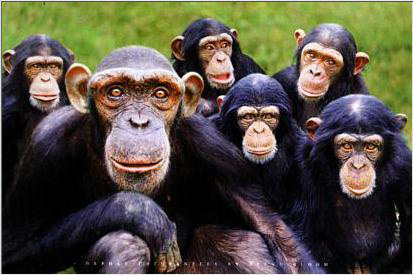
The theory goes: Think about having a pet.  A dog, for example.  Your dog has a name (“Gozer the Magnificent”) and wears a funny hat and likes eating frozen rhubarb.  Now imagine you have five dogs.  Their names and personalities are a little harder to remember, but you can still keep them straight.  Now try to picture owning a hundred dogs.  Likely, you can’t even picture that many dogs, much less think of individual names or personalities for each.  The maximum number of dogs (or people, etc) with whom you can form caring social relationships is somewhere between five and one hundred.  That’s Dunbar’s number.  That’s the biggest social sphere we, as “monkeys”, can create.  That’s our monkeysphere.

Dunbar’s number varies from person to person and from species to species, but the basic principle is the same.  Where animal research, farming, zoos, and the pet industry — animal industry in general — goes wrong is about the point where the number of animals being cared for by any one person becomes greater than Dunbar’s number.

If a lab tech is told to care for ten mice, they all get names, personalities and individual identities.  A lab tech caring for a room full of 500 mouse cages, each containing between one and five mice, barely has time to count the mice as they blur past during each daily check.  A slaughter worker tasked with “stunning” four cows an hour can move slowly and patiently, properly aim the “stunning” device, and make sure each animal is dead before the rendering process begins.  A slaughter worker tasked with “stunning” one hundred cows an hour — as many currently are — is “processing” something like one cow every thirty seconds.  There is no time for patience or proper aim.  A zoo or wildlife park worker who cares for ten to fifteen animals has names for each one, and the animals are often treated as personal friends.  A zoo director, overseeing a collection of five hundred to two thousand animals, starts to see them as “units” rather than social companions.

Other factors — primarily money — come into it as well, but there is something about reaching Dunbar’s number that really damages the structure.  Once the humans can’t form social relationships with the individual animals anymore, they stop treating the animals as beings with which you might form social relationships — and that starts the whole downward spiral, where “what we should be doing” begins to look more and more different from “what we are actually doing”.

Just a thought.

This.

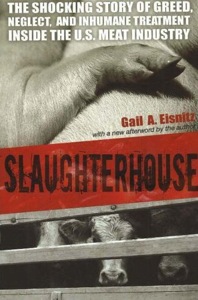
Slaughterhouse by Gail EisnitzWhen I first started working in the laboratory animal industry, and got my first taste of the Machine, my immediate reaction was that I was hallucinating.  I could not possibly be seeing what I was seeing, I reasoned, and I immediately went researching.  Surely there was an explanation for the things I saw happening.  Surely I was wrong!

It disturbed me beyond measure to discover that not only was I not wrong, but that I was only getting a miniscule taste of what was really happening.  The more research I did, the more horrified I became, until I eventually had to put things down and walk away.  Every time I tried to write something about a I would do research on a and then learn about x, y, and z as well.  Then I would have to research them, and….

These days I’m a little calmer, and I can pick up books and do research again.  My most recent acquisition, Slaughterhouse, by Gail Eisnitz, is the closest thing I have so far seen to what happened to my brain when I saw the laboratory animal industry for the first time.  Due to the “shock value” cover and title, I’d been avoiding it, but it turns out to be a well-written, rational, well-researched volume which makes its statement simply and reasonably (well, as reasonably as it’s possible to be in this case).  It follows Gail, a journalist for an animal welfare group, from the moment a USDA inspector writes her saying “Something’s wrong here” to her struggle to get someone, anyone, to break the story, and through it you see, through her eyes, her unbelievable, terrible discoveries.  Every piece of awful information leads to two more pieces of awful information, and the higher she climbs in the bureaucracy, looking for the source of it all, the more distressing it becomes as she realizes that the people in charge know, and they don’t care.

This is a book you will read with your mouth open, drop at the end, and say, “No.”  No, this isn’t true.  This does not happen.  She’s a journalist; she’s being sensational.  She’s biased.  She’s just selling a story.  Speaking as someone who’s seen another facet of the Machine at work — the laboratory side — Eisnitz is not lying.  The things she is describing are real.  They are happening right now.

It’s such a relief, and it’s so scary, to know that someone else sees it too.  Through my research, I’ve actually amassed quite a collection of books over the past few years, and most of the books actually corroborate to varying degrees what I personally saw, but Slaughterhouse is the first to describe the entire eye-opening journey of discovery.

I strongly recommend it, although I would suggest not reading it while eating a hamburger.

So Much To Write and So Few Pages

One thing learned from the initiation of video auditing on a large scale is that some people should not be handling livestock. — Temple Grandin

I recently picked up a book about slaughterhouses, and have had my hair standing on end reading it, realizing how much that process is like the processing of laboratory animals that I experienced.  I want to say more about that — I have a lot to say about that book — but in the meantime, I was doing some background research on the book itself and ended up on the web site of Temple Grandin, a PhD who has dedicated herself to improving the welfare of animals in slaughter plants, with some hopeful results.

Since the book I am reading was written in 1997, I skimmed Dr. Grandin’s web site, which had some up to date slaughterhouse audits (as recent as 2010), to see how things might be going nowadays.  Apparently they are now employing video monitoring in slaughter plants, which, depending on how exactly that is achieved, and who exactly is doing the monitoring, is a huge step forward for the conditions of both animals and humans there.  However, if the quote above is anything to go by, conditions haven’t really changed all that much since the book was written.

Cruelty: Woman Ties Puppies To Fence

“HATTIESBURG, MS (WDAM) – An employee of the Southern Pines Animal Shelter arrived at work Monday morning and found 11 Shepard[sic] mix puppies tied to the gate.

Surveillance video at the shelter showed a woman taking two puppies at a time by the neck from her vehicle and using zip ties and baling wire to tie them to the fence. The zip ties had been tightened around their neck.”  (7/12/11)

The full article can be found here.

It’s possible that it simply did not occur to the woman that zip ties are, perhaps, a less than appropriate method for attaching puppies to a fence.  That sort of thing is what brings one to add the tags “puppies” and “ignorance” to the same article (and mourn the state of a world in which that happens).

However, ignorance of puppy-tying methods aside, this sort of behavior — breeding unwanted litters of puppies, abandoning the puppies at all, dropping them off at the shelter after hours to avoid hassles — is the kind of thing that happens when humans stop viewing animals as living things and begin viewing them as just things.

This is the kind of thing that we, as a culture, as a species, need to fight.  The ability to view another living creature (human or animal) as an object to which we owe no responsibility is behind, well, a lot of our problems.

99% of the Time, the System Sucks

I am not a vegetarian, but, 99% of the time, I will not eat meat.

I was raised a confirmed carnivore, and, having worked with animals for many years, I appreciate the food chain as well as anyone else, including the human position on (or near) its top.  I double majored in biology and animal behavior.  I understand that we are all protein in different packages, and that protein moves around the system most efficiently via predation.

The people who taught me that animals are intelligent, living things with their own needs and personalities also taught me that everyone in the household — including the animals — works for their living.  While I took out the trash and cleaned the house, the dog defended it and provided ambiance; the cat caught the mice in the kitchen; the horse carted me around on its back in return for food and care.  Cows, pigs, sheep, and chickens (should) likewise enjoy a peaceful life being cared for, fed, sheltered, and watered before turning in their service, feeding the rest of the household.

Thus I feel that there is no moral imperative not to eat meat.  We are all (and this includes humans) required to work for our place in the world.  If I feed, water, and shelter a cow, and provide her with medical care — if I treat her like any other member of my family — I should be able to ask her for her milk, and, at time of need, provide her with a humane death, and eat her.  She will feed my family (and others!) for a month, properly apportioned.  If I stopped working and paying the bills, I would soon not have a house to live in, or any food to eat.  In the wild, animals work to obtain their own food, water, and shelter.  Why should a cow not have to work for her living?

My issue arises when the life of a captive animal moves from “work” to “slavery” — when the animal is no longer paid for its efforts.  This happens somewhere along the continuum from “small family farm” to “enormous animal factory”.  A farmer handling 20 head of cattle can call each one by name, tell you her birthday and her social rank in the herd, her likes and dislikes, and her medical history.  A farmer with 200 head of cattle has little time to spend with each individual.  A corporation with 200,000 cattle uses a computer to tag and electronically track its bovine “assets”, which become managed by electronic gates and subsystems and by several tiers of employees.

Today, an unimaginable number of animals are “processed” each day.  Large corporations, each encompassing dozens of farms, each farm managing hundreds of thousands of animals, provide most of our meat.  The entropy of such a system is enormous, and even if it began with the animals fed, watered, sheltered, and vetted, soon the edges will wear and corners will be cut.  Animals cannot be paid for their work — they can barely be counted.  When one “unit” “breaks down”, it is simply discarded — there are millions of others to take its place.  There is no time, when herding 10,000 cows a day through the milker, to be patient with a nervous cow, to notice impending mastitis, to separate a single animal to treat a small wound.  The process cannot be stopped.  In such a system, a dead animal is simply one who has reached the end of the assembly line early.  It can still be used: if not for human food, then for pet food, fertilizer, cosmetics.

The animals receive the bare minimum of care necessary to maintain them in an “alive” state, because they are (marginally) more useful alive and certainly easier to transport.  No time can be devoted to anything more than the minimum.  In the rush, things get delayed, ignored, forgotten.  Employees get overwhelmed and frustrated, and take out their anger on the animals.  Procedures are performed en masse, and if individuals cannot cope, they are culled.  The budget is tight, and animals cannot form a union and strike for better pay.

The methods of an animal’s eventual death under such a system — the “humane slaughter” which is such an unbelievable oxymoron it makes my eyes water — is a topic for another post, or perhaps a hundred posts.  It suffices to say that it isn’t, in any sense, the quick death free of pain and fear that all living things should receive.  Nothing about the factory farming system works — especially not for the animals.

Most of our commercially available meat today comes from these titanic animal factories.  While I love eating meat, and do not have any personal problem with eating another animal, I have all sorts of personal issues with the treatment of animals in such factories, and I will not eat animals which came from such places.  This leaves me out of luck at restaurants, most public venues, and other people’s homes — basically anywhere that does not get its meat from a small, family farm which still has a low enough number of animals that they can afford to handle them humanely.  These still exist, fortunately, and are becoming more popular, so now, with careful planning and researching, I am able to locate occasional meat-based products that do not involve the Great Machine.  And thus I am not a vegetarian; but in 99% of cases, I will not eat meat.

Euphemisms

When I shop for eggs, I wish to buy eggs which have not been factory farmed.  I know that standard living conditions for factory farmed laying hens in the United States involve up to five hens being crammed into a wire cage approximately one foot cubed, suspended above a trough full of droppings.  I appreciate the effort that the hens have put into creating those eggs for me to eat, and I do not show my appreciation for hard work by cramming birds into tiny spaces and watching them peck each other to death.  I don’t know.  Maybe I’m weird that way.

I want to fund the farmers who “pay” their laying hens (and any other animals they may have) with the standard package anyone should get for hard work: food, water, shelter, and medical care.  The problem is finding these farmers, because all the other farmers (or, rather, the massive corporations who employ those farmers, who produce most of our commercially raised eggs) have figured out that most people don’t like picturing chickens crammed into little cages.  They don’t want to actually stop doing that — that would be inconvenient and expensive for them — but they want us to think they have, so we’ll keep buying their eggs.  So they use euphemisms.

They started by calling the eggs “organic”.  That sounds nice.  We associate “organic” with things made without pesticides, without additional hormones, without dosing the animals with unnecessary antibiotics.  Surely animals being raised in “organic” conditions are happily out at pasture, frolicking with the butterflies?  Nope.  “Organic” does not imply a single thing about an animal’s housing conditions.  “Organic” eggs may come from hens which are not chemically treated, or at least not chemically treated above and beyond some extremely loose standards set (sometimes) by the USDA, but the hens are still crammed in little cages.  Little “organic” cages, possibly.

I’ve also heard “pesticide-free” and “vegan diet”.  All right, those are nice — I’d prefer not to eat pesticide-laced chicken, and I know that some large factory farms feed their living animals the ground-up remains of their unusable, dead animals — but neither one really affects the day to day existence of the chickens.  They’re still in little cages, although they are now a little less chemically altered, and less likely to catch horrible diseases from eating their ground-up predecessors on the assembly line.

A euphemism that’s becoming more popular now is “cage free”.  That sounds good, doesn’t it?  In fact, I bought “cage free” eggs (at twice the factory-farmed price) for a couple years before doing the research I should have done earlier.  “Cage free” does mean that the chickens are not crammed into tiny cages, yes.  But instead they are crammed shoulder to shoulder into huge barns, where they fight and have panic attacks every time the overhead lights turn on or off.  (In fact, many barns are kept dark most of the time, to “calm” the birds.)  They can technically move around, but there are thousands of other chickens in the way.  This may be better than standard, but it is still hardly a bucolic idyll.

In a similar vein, I have seen eggs from hens with “outdoor access”.  This means they cut a small hole in the side of the barn, with a yard about big enough for ten hens.  The remaining 10,000 hens in the barn never see this hole, or the yard.  But, technically, they have “outdoor access”.

The phrase which turns out to accurately describe “hens which are allowed to live much like hens should” is “pasture-raised” (or, as on the eggs that I buy, the legend “Our hens are kept on grass 24/7!”).  This means the hens are actually, honestly, kept outdoors.  It can be done, you know.  Even with a couple of hundred hens.  You bring them in at night and they lay eggs for you, and then during the day they go out and are hens.  You rotate them to new pastures regularly, so the old ones have time to regrow and recover, and you get some fine eggs from those happy, happy hens.

You know the big corporations are not pasture-raising their hens.  If they were, it would be all over the carton, because I am happy to pay six dollars a dozen for eggs if I know (and I do research to the best of my ability) that the hens which produced the eggs in question have been appropriately, handsomely paid for their work on my behalf, and I am sure the big corporations would love to get six dollars a dozen for their eggs.  (Standard, factory farmed eggs in my area go for a dollar fifty to two dollars a dozen, normally.)  Likewise, I pay twice the normal price for “pasture kept” milk and butter (“guaranteed kept on grass” and not “grass finished” or “organic” or “hormone-free”, although generally pasture-kept animals are also “organic” and “hormone-free” as well).

(I keep saying “the normal price” when I mean “the price of factory-farmed eggs”.  This reflects somewhat on our culture, and it also annoys me.  “Factory farmed” may be considered “normal” right now, but it should not be.)

Anyway, this whole mess offends me.  It’s part of a bigger picture, where scientists replace “lab rat” with “animal model”, and use even more horribly twisted language to disguise, as much as possible, that they’re letting kids slice up live mice for fun.  I can’t get into that right now, but this little mess, with “cage free” and “pasture”, is a start.

Step One

I have a message to communicate.

Over a two-and-a-half-year period from 2007 to 2010, I learned something.  It is a huge thing, an unimaginably complex thing, and it is horrible.  In this era of gratuitous exaggeration I hesitate to use a phrase like “it ripped chunks out of my soul”, but at times it felt like that was happening.  It snuck up on me slowly, aggregating imperceptibly out of little fragments of information, and then abruptly it was visible.  It was not a pleasant thing to learn.  Having it in my head now is difficult.  Knowing what I know, I have an urge to communicate it.  This is the kind of thing that I feel everyone should know.  It is awful, but it is fixable, and the first step to fixing it is to tell someone else about it.

I want to tell someone else.  I don’t know where to start.

The idea is so complex, I can’t fit it into a sound bite.  I can’t casually mention it over dinner.  And it’s unpleasant, so it’s not something you can take in all at once.  The mind just stops processing.  It took me two years to see it, and I was seeing little bits of it every day.  When the picture came into focus, it was breathtaking — but that focus rested on two years of accumulated pieces of data.  I can’t fit that into a blog post.  I can’t fit that into a piece of writing someone will want to read.  It’s too big to fit through a pencil, a keyboard.  The scream, waiting to get out of my head, is huge.

So I’m having to take the thing apart, piece by piece, and try to reconstruct the original fragments of data which led me to my original epiphany.  I’m probably going to do it wrong.  Some things I’m not remembering correctly, and some things are too painful to think about, even now.  But I want to tell someone.  I must tell someone.

When I figure out where to begin, I’ll get on with it.