
Category Archives: random

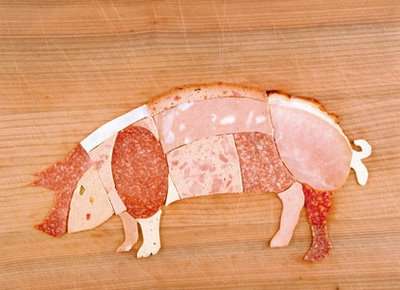
A Meaty Amusement

image by Sarah Illenberger

Having gone to a slightly less meat-infused lifestyle, I find it more difficult than it used to be to order in restaurants.  I never realized how pervasive meat was until I tried to find a dish without any in it.

Not that any one restaurant seems to be worse than any other, here’s the lunch and dinner menu from Cracker Barrel.  Even just looking at the photos, everything has meat in it, even the salads (and, yes, the baked beans are made the old-fashioned way, with ham).  Only the desserts come without meat!

And here’s the menu from IHOP, one of my other favorites.  They’re a little better because of the preponderance of (generally meat-free) pancakes, but still — sausage, ham, bacon, eggs, steak, and the “Bacon-N-Beef Burger”, burger with bacon mixed in.

Also, when you order an entree without meat from most of my favorite restaurants, the waitress will ask you, as though you may have forgotten, “Did you want any meat with that?”  I know it’s a required upsell — meat is profitable for them — but sometimes it just sounds macabre!

Other times, the menus remind me strongly of the “Spam” Sketch from Monty Python.  “Meat, meat, meat, meat with beans, meat with rice, meat with potatoes, roasted meat, baked meat, boiled meat, sliced meat, curried meat, raw meat, burnt meat, meat salad, meat pie, meat omelet, meat stir fry, meat sandwich, meat fried rice, meat with more meat, meat with eggs, meat with bread, meat with sauce, meat with pasta…or Lobster Thermidor á Crevétte with a mornay sauce served in a Provençale manner with shallots and aubergines garnished with truffle paté, brandy and with a fried egg on top and meat.”

Someone Else Can See It

It’s not that the scientists are lying, exactly, about what they’re doing.  It’s not that they’re hiding it, either, really.  Everything they do is written down as a proposal, approved by various subcommittees, recorded as results, and stored in case someone wants to look at it.  The problem is more one of communication:

“Yes, [I found it],” said Arthur.  “Yes, I did.  It was on display in the bottom of a locked filing cabinet stuck in a disused lavatory with a sign on the door saying ‘Beware of the Leopard’.”

Like the plans to demolish Arthur Dent’s house, the descriptions of what people are doing in laboratory experiments are there — just very, very difficult to find.  Most people don’t bother, or aren’t even aware that there are any descriptions out there to find.

For example, you can find, if you search online, some perfectly ordinary “rodent guillotines“.  You may be able to find a page, as well, explaining why some research animals might need to be euthanized via guillotine (it allows the researchers to collect samples uncontaminated by euthanasia chemicals).  Here’s a page describing research reassuring scientists that decapitation is painless (notice that it’s in response to research saying decapitation isn’t painless, and that it corroborates the original findings, but simply chooses to interpret them differently).  You can find masses of pages describing the euthanasia techniques, including decapitation, used by different facilities (look at all those colleges!  Did you know that your college tuition funded this kind of thing?  Would you have gone to that college if you’d known?)

…how would you know to look for this if you hadn’t worked in one of these facilities?  I wouldn’t have been able to come up with the search terms (“decapitation”, “euthanasia”, “rodent”, and “SOP”, if you’re wondering).  It wouldn’t have occurred to me that this even went on.  What other practices do we just need to know the search terms to find?  (Try “cervical dislocation”, “neonates” and “scissors”, “captive bolt”, “hog stunner”, and finish up with “AVMA guidelines euthanasia” to see the full list.)  It’s not like the information isn’t out there…it’s just that nobody is calling it to our attention.

What triggered this today was a random blog post from someone else mentioning that, hey, we’re not really saying a lot about this, are we?  Has anyone else noticed that people are being really quiet about this?  Why?

Good Advice on a Lot of Levels

“My advice to you: Get several books. When you get confused, if all of the books tell you to do the same thing, believe it. If they tell you to do completely different things, someone if not everyone is talking out their ass.”

via The Story About the Baby, Volume 2.

This is posted on a blog about raising an infant human, but, honestly, this is good advice on any front.

It’s Everywhere

Today I was using Microsoft Publisher 2010, part of the Office software suite, to make a flyer for my place of work.  I was looking through the standard, included templates, trying to find a template with tear-off strips for phone numbers at the bottom.  Among the three or four templates with that design I noticed one with a little dog icon and a suggested sample caption of “FREE Puppies or Kittens”.

The template can be found under “templates/flyers/all marketing” if you’re interested in seeing it yourself.  I can’t find a link to it on Microsoft’s site, but here’s an excerpt from a Publisher “how to” book, telling you how to use an extremely similar template (“Free Kittens!”) in Publisher 2007.

The dangers of “Free to Good Home” ads aside…this is just a scary little picture of how pervasive the idea of “animal as object” is in our society.  It’s so thoroughly ingrained that someone thinking I need to make a sample flyer with tear-off strips immediately came up with “giving away unwanted animals” as a subject for their sample flyer.

Euphemisms

Making it even harder to figure out what exactly is actually going on, people keep using obfuscatory words to make sure nobody knows what they are talking about:

Research:

  • lab animal – “animal model”, or even just “model”, “organism”, “subject”
  • monkey, ape, chimp – “nonhuman primate”
  • cage – “housing system”
  • euthanize – “terminate”, “cull”, “cut from the study”  (They’re actually even trying to stop using “euthanize” now, because it’s such a “charged word”)

Meat Industry:

  • killing – “stunning”

(Note: this is just a list of ideas to which I intend to return later.  Additions are welcome.)

So Much To Write and So Few Pages

One thing learned from the initiation of video auditing on a large scale is that some people should not be handling livestock. — Temple Grandin

I recently picked up a book about slaughterhouses, and have had my hair standing on end reading it, realizing how much that process is like the processing of laboratory animals that I experienced.  I want to say more about that — I have a lot to say about that book — but in the meantime, I was doing some background research on the book itself and ended up on the web site of Temple Grandin, a PhD who has dedicated herself to improving the welfare of animals in slaughter plants, with some hopeful results.

Since the book I am reading was written in 1997, I skimmed Dr. Grandin’s web site, which had some up to date slaughterhouse audits (as recent as 2010), to see how things might be going nowadays.  Apparently they are now employing video monitoring in slaughter plants, which, depending on how exactly that is achieved, and who exactly is doing the monitoring, is a huge step forward for the conditions of both animals and humans there.  However, if the quote above is anything to go by, conditions haven’t really changed all that much since the book was written.