Tag Archives: 2013

Celebrating the Deformed

This deformed cat is not funny“Grumpy Cat” — whose actual name is “Tard“, theoretically short for “Tartar Sauce” — is just one of many “oh look at the cute animal” memes that have gone past my radar over the past few years.  I’ve seen Sam, once voted the World’s Ugliest Dog; Thumbelina, billed as the world’s smallest horse; and an infinite number of critters on sites like Cute Overload.

I have a difficult time enjoying such photos.  The animals in them are not natural.  Their appearance is generally the result of man messing with animal genes; of overzealous (over)selection for extremely specialized traits; and of practices such as “line-breeding” (a polite term for inbreeding).  Animals don’t look like that naturally (the rare ones which do generally do not pass on their genes).  Those mutations — usually extremes of the brachycephalic mutation wherein the bones of the face stop growing before the rest of the head — give the animals “human” expressions — and incidentally produce malocclusion of the teeth, tear duct abnormalities, facial deformities, and a variety of other ailments.  (Another “popular” mutation for internet-photo-sharing is dwarfism, producing animals with short, twisted limbs, overlarge heads, and, again, a variety of other problems.)

These are not happy animals.  I cannot laugh at them, not even if they are humorously posed and captioned.  They look the way they do because some humans got together and thought, Wouldn’t it be great if dogs/cats looked more like human babies? and bred siblings to each other until the offspring looked sufficiently funny.  The fact that the animal can’t breathe, can’t see, and can’t eat is meaningless — look how cute it is!  It almost looks human!

I am not arguing that we should not breed, for example, Persian cats, because breed-standard Persian cats do not necessarily look like “Tard”.  (It should be noted, however, that there are good arguments against extreme type-breeding in purebred animals.)  I am arguing that, when man’s interference with nature produces its inevitable sports, we not give the poor things contracts to do television commercials and buy T-shirts celebrating them (and, indirectly, the process which produced them).  I don’t support irresponsible animal breeding — why should I support its byproducts?

Real Chicken, with Artificial Chicken Flavor

Another reason (as though we needed another) not to eat factory farmed meat — we’ve “streamlined” the process so thoroughly that the poor chickens who go through it never have time to develop anything that would provide flavor.  They shoot out the other side as essentially large blocks of tofu — thus, a factory farmed chicken must be chemically treated in order to taste like chicken.

Take three different whole chickens, [Marie Wright, chief flavorist at German flavoring company Wild] said — an average, low-priced frozen one from the supermarket; a mass-produced organic version like Bell and Evans; and what she termed a “happy chicken.” This was a bird that had spent its life outside running around and eating an evolutionary diet of grass, seeds, bugs and worms. Roast them in your kitchen and note the taste. The cheap chicken, she said, will have minimal flavor, thanks to its short life span, lack of sunlight and monotonous diet of corn and soy. The Bell and Evans will have a few “roast notes and fatty notes,” and the happy chicken will be “incomparable,” with a deep, succulent, nutty taste.

While I am slowly weaning myself off of eggs and dairy — mostly because of the byproducts of these industries — I have in the meantime at least switched to the eggs of “happy chickens” — not just “free range” but “pasture raised” — from small local farmers (the egg cartons have hand-written expiration dates, and one farm even includes newsletters from their chickens).  I note that the eggs are immediately identifiable as such.  They are huge, and they taste wonderful.  There is really no comparison.

It’s kind of frightening how many chemicals need to be poured over (and fed to) factory-farmed products so they are recognizable to the consumer.  Even if you aren’t particularly interested in how the animals who produce your food are treated, you might be interested in what you could be missing (or adding!) when you consume factory farmed meat.

Bonus link: a look behind the scenes at American flavoring company Givaudan, courtesy of the Huffington Post.

Tigers Being Bred for Trade in China

So tiger parts sell for more money than you’ve ever seen, but it’s hard to find them in the wild any more for some reason.  What’s an enterprising businessman to do?  Why, build a tiger farm, of course.  Grab a few tigers, start a “conservation” operation or a “zoo”, and once you get 500 animals you can get a permit to sell your surplus to make “tiger bone” wine:

[Alas, this excellent article on the Asian tiger trade will not embed here.  Please visit it in person (it’s free to view).]

Wildlife traffickers don’t even have to actually breed tigers.  They can just set up a location where it looks like they are captive-breeding tigers, then poach tigers from the wild and sell the parts as though they were from captive bred animals.  This apparently works for any species, not just tigers.

Although it does certainly appear that people are breeding captive tigers to sell for parts (in what way does this significantly differ from modern cattle operations?), I have been unable to verify whether or not the farms are also, specifically, starving tigers to death to satisfy nebulous legal issues requiring that the animal have died of “natural causes” for its parts to be sold, as in the following image I found floating around today.  The image appears to be a scan of this news article, sourced from this blog entry from the TigerTime web site, which appears to reference a paper called the Straits-Times but was written by a TigerTime employee with no readily apparent source.

117

This image was what originally made me look into this subject.  It just seems too awful to be completely true, and it isn’t.  The report quoted above does not mention any requirement in Chinese law stating that animals which have died naturally are specifically legal (it just requires that the parts be “legally obtained”), and research suggests that the starving tigers are a different, though quasi-related, event: the tigers in question appear to have been starved (actually, fed “cheap cuts of chicken”, leading to malnourishment) when the facilities handling them “went into financial difficulties”.  Not that it’s much of a relief, especially to the tigers, but it does not look like they were starved specifically so their parts could be sold legally (although I suspect the facility owners did not object to the “happy” appearance of an “extra” carcass or two).  It just looks like that’s a “normal byproduct” of their “farming” operation.  (Why does that distinction matter to me?  Is “inconceivably terrible husbandry practices” better in some way than “deliberately starving animals to death”?  Is it even different?)

Just another place where minor curiosity (“Hmmm, that headline looks a mite sensationalistic”) leads to a major facepalm moment: even “wildlife” is being factory farmedEverything is being factory farmed, somewhere — and factory farming is never pretty.  (Check out that National Geographic photo gallery for a picture of what it looks like when humans “captive breed” snakes for the pet trade, if you’re interested.)

Sometimes I Know Too Much

Today, on my Facebook feed, amongst the photos of kittens with yarn and puppies adorably chewing their own feet, this photo of a pile of euthanized dogs wandered past:

source unknown

source unknown

It was accompanied by a bland but well-meaning glurge poem in which a dog wonders why it had to die despite solvable behavior problems.  Now, I completely agree that solvable behavior problems are no reason to drop your dog off at the shelter (I believe firmly in Not Shooting The Dog), but the poem, alas, misses the point: the horror of this photo does not lie solely in that there are dead dogs in it.  It lies at least partly in how they died: these poor things are in a gas chamber, and have just been gassed to death, likely with CO2.  This is the view the shelter technician saw upon opening the door afterwards.  (When this image is fed into Google image search, it turns up dozens of articles on gas chambers, and how horrible they are.)

That animals are euthanized at all, because people still view them as property, as a commodity, as something to be “dumped” when they become obnoxious or ill or old or inconvenient, is a terrible thing.  That animals are still “euthanized” by CO2 is an even more terrible thing.  The people spreading this photo are missing a huge opportunity to note that not only did these dogs die because people are occasionally irresponsible morons, they died in a terrible, awful, unbelievably frightening and ugly way.  (Click on that link, which contains video, at your peril.)  They were twice the victims of human carelessness: the first time by the actions of those who landed them in the shelter, and the second by the actions of those who thought “lowest cost” was the primary requirement when choosing a method of humane euthanasia.

This is one of those sad points where I have to give up and flail helplessly at the screen.  The words all mush together into one big AUGH.  I applaud the people trying to spread the word about what we are doing to our companion animals, and can’t fault them for their choice of photo.  I wish that the Machine wasn’t so huge that thinking about one part of it (“convenience dumping” of “excess” animals) didn’t lead to the discovery of another, equally awful part (“euthanasia” of dogs by CO2).  I think what is scaring me the most, right now, though, is that I know enough about the world to glance at this photo and immediately recognize it as a gas chamber rather than a freezer.  I’m glad I know about it — I’d rather know than not — but sometimes I miss the quiet-in-the-head of not knowing this is happening.  It was rather peaceful.

Roadside Distraction

Every year for the last ten-ish years, I have driven through Florida on vacation, and have noted garish billboards for a chain of gas station/tourist traps, which promise such inviting sights as jams, shell sculptures, and “gator heads”.  Previously I’ve successfully avoided stopping at one, but this year the car got thirsty and I ended up gazing at…probably not the most garish collection of tourist tchotchkes I’ve ever witnessed, but definitely one of the top five.

Amongst a mind-boggling array of products based on the loosely local products of rum, sea shells, and oranges, I found these sad little creatures.

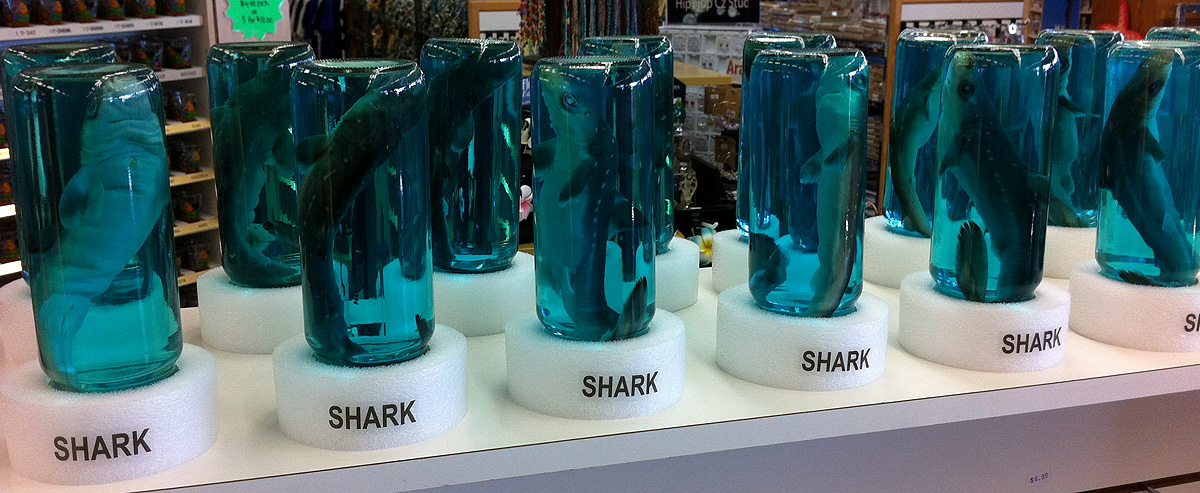
dog sharks in jars

They appear to be juvenile dogfish sharks (a formerly reasonably common species which is becoming, for some reason, a tad overfished) and the word “SHARK” under them is the extent of their labeling, except for the price ($19.95) on a sticker underneath.  The jars are just jammed into those circles of styrofoam.  Educational?  Decorative?  Surely they are not meant to be gifts?

In trying to find the origin of the “shark in a jar” concept (what motivates this kind of behavior?), I note that this has been going on for a while, and is not an isolated phenomenon (although I am glad to note it seems confined to “tropical” locales).  In fact, if you for some reason need a jarred shark, you can get one online right now, in large quantities if need be.

Where are all these baby sharks coming from?  They are almost certainly a byproduct of another business, probably fishing the adult sharks for meat or research.  Should we be happy that we’re at least using all the parts of the sharks, even for a purpose this frivolous?  Or should we be terrified that we are processing so many of these sharks that we have this many — specifically juvenile, specifically this size — left over?  What is happening to the other non-meat bits of the sharks?  To the babies which happen to be smaller or larger than these jars?

Either way, I won’t be buying one for my friends back home.  If these are meant to be decorative, surely there is something else which can replace them on a shelf; if they are supposed to be educational, surely there is something more detailed and useful which can be used for reference; and, if they are meant as gifts, surely there is some other way to show affection.

Charlie and the OMG Factory

I once heard it said that you would never eat a hot dog if you knew how it was made.

From Perry Bible Fellowship

From Perry Bible Fellowship

It’s interesting to me how little we talk about meat production.  You can’t find a lot of detail, honestly — and what detail you do find is not generally produced by “real” journalists, but by animal rights organizations, so there’s this tendency to dismiss it.  Mainstream journalism does not show you the killing floor.  We show World War II and the evening news but we just don’t mention to each other how sausage is made.

Isn’t this the kind of thing you’d want to know?  Don’t we want our kids to be informed consumers?  I ate hot dogs for *ahem* years before I found out — not what they’re made of, but how they kill the animals that go into them — I’m not sure at what age it would have been appropriate to explain the concept to me, but I strongly suspect I would have stopped eating hot dogs a lot earlier if someone had shown me what was going on.  All I saw growing up were watered-down, polite news stories, which had very little detail.  I got the vague feeling I wouldn’t like what I saw in there, but I never had the chance to see it, and I didn’t look into it in detail.  I grew up pre-internet — there wasn’t a lot of media available on the topic at the time.

It might also be argued that, when my grandparents bought sausage, the pig involved was personally slaughtered, as humanely as possible, in a low-volume slaughterhouse, and had likely spent a reasonably happy life in a grassy field, doing nothing much.  When my parents asked my grandparents how sausage was made, they got that story.  That’s the story that got passed on to me.  Meanwhile, out of everyone’s sight, technology was changing….

Maybe there ought to be school field trips, or contests — although I’d probably pass on having to yank a soggy “Bacon Ticket” from the inside of a sausage.  Clearly this needs to be a reality TV show.

There’s a lot more to this, of course, and I’m interested in whacking around the idea that constant exposure to this kind of thing renders it “normal”, and that’s why, say, cattle ranchers don’t understand why vegetarians are so squeamish about eating meat.  Moving past that idea…if exposure to it renders it “normal” — do we then want to tell people about it?  How do we tell people about it?  If we hear about it, in graphic detail, every day, will we still be as horrified, as motivated to act?

One Cow Versus 100,000 Smaller Organisms

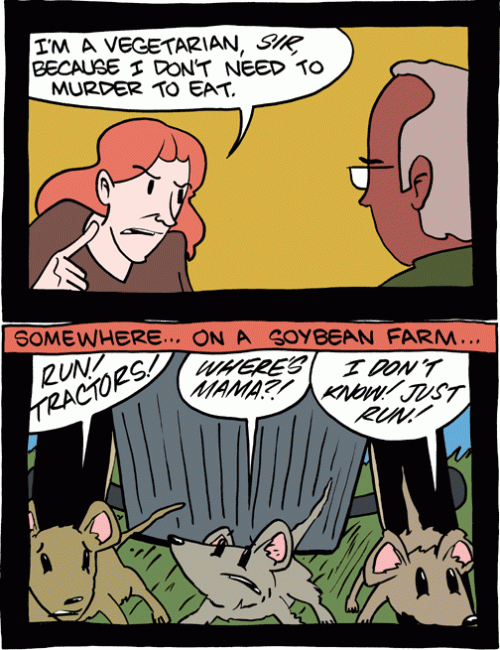
I once saw a cartoon which depicted vegetarianism in an unflattering light: it showed a closeup of the front of a combine harvester, before which fled an array of inoffensive woodland creatures, yelling things like “Where’s mama?!?” and “I don’t know, just run!”

Edit: found it.  It’s from Saturday Morning Breakfast Cereal:

20091207

Agriculture is not without its damage to the environment, and to animals.  A field of wheat or corn is home to mice, rats, birds, rabbits, various insects, and a host of other creatures, at least some of which are inevitably ground up along with the harvestThis recent article on an Australian web site suggests that the many small lives we grind up to harvest a crop in an area of land outweigh the lives of the cows which would graze that land were it devoted to pasture.  (If you’re interested, this article wanders into the notion a little further.)

The presentation of the issue is somewhat simplistic: it assumes that only a few cows are raised in the hypothetical pasture (i.e., it’s not a feedlot, the American standard); that “pasture” is equivalent to unspoiled natural land; that all the wildlife in the field are killed by the plow; etc.  I think it’s a valid notion, but the solution to this issue is not to have everyone eat nothing but red meat.  The problem lies more with how we produce our food, and what methods we’ve adopted to produce that food cheaply, and less with exactly what food we are producing.  For example, we can certainly develop methods to raise and harvest crops more sustainably and with less “collateral damage”.

I don’t think we’re really able to exist, at all, without causing some damage to the world.  It’s in our nature as consumers of energy — it’s got to come from somewhere.  However, we can choose to minimize the amount of damage we cause, and try to choose the least damaging places to cause it.