Category Archives: news

Letter from an Anonymous Shelter Manager Rings True

This has been traveling around with no reference of source:

“I think our society needs a huge “Wake-up” call. As a shelter manager, I am going to share a little insight with you all…a view from the inside if you will.

First off, all of you breeders/sellers should be made to work in the “back” of an animal shelter for just one day. Maybe if you saw the life drain from a few sad, lost, confused eyes, you would change your mind about breeding and selling to people you don’t even know.”

….click here for the rest.

Speaking as someone who has worked with rescue people, and interviewed (if not worked) and volunteered at multiple animal shelters, I’d just like to second this, and point out that, while the language is a bit emphatic and there may be slight exaggeration for emphasis, the exaggeration is slight.  And the picture of the pile of cats?  Absolutely, 100% true to life, or, rather, true to death.  That’s a full-size walk in freezer, and imagine how many animals the pictured facility must “handle” per year that they needed to purchase such a thing.  And that’s one facility.

Does this piss you off?  Scare you?  Make you want to hug your kitties?  Do something about it.  Donate to your local shelter so it can keep animals longer or pay for kennel cough treatment.  Ask how you can help educate people about adoption and encourage people to adopt.  Above all, don’t get mad at the shelters…they are just dealing, as best they can, with the problem.  They didn’t cause it.  Does this photo, this article, make you sick?  Help your local animal shelter.  Help fix the problem.

Horse Slaughter in the US May Have Hidden Up Side

from morguefile.comThis past holiday weekend, I listened to someone announce that they had “euthanized” their problem horse (who really did need to be put down — it had a vet-diagnosed neurological condition and was aggressively dangerous).  I was thinking of commending them for taking responsibility for the animal and not just selling the problem along to an unsuspecting buyer when they said they had “euthanized” the horse by selling him for slaughter.  (“Bam!” they said.  “Bolt to the head.”)

Clearly they missed out on the part where horse slaughter was not, at that time, legal in the US — before their horse was “euthanized”, it rode many hours in an open air cargo van — perhaps one designed for horses, perhaps one designed for pigs or cattle — with no food or water, to reach a slaughter plant in Canada.  The horse may not have even reached the killing box and its captive bolt gun — it may have died along the way, kicked at the feedlot, crushed or trampled in the truck, or suffering from exposure or dehydration.

There is hope that things may be changing.  Recently, Congress has, without fanfare, quietly lifted a five-year-old ban on funding for inspection of horse meat, which indirectly paves the way for re-opening of domestic horse slaughter plants by providing for the inspection of meat produced at those plants.  There isn’t currently a budget for horse meat inspection, so the process might be slow, but people who have been witness to the issues surrounding the lack of appropriate facilities in the US are scrambling to get one going, to prevent trips like the one my acquaintance’s horse took.

The closure of domestic slaughter plants in 2007 has not resulted in a reduction of the amount of US horses being slaughtered.  They are simply being trucked over the border to be slaughtered in Canada and Mexico, doing nothing but adding a 24 to 72 hour trip in a packed cargo truck — here’s animal behaviorist and slaughter reformist Temple Grandin describing one version of that experience — to the doomed horses’ woes.

We certainly do need to alter a lot of things about the process that is allowing companion horses to be slaughtered for food — including providing education for horse owners, finding help for families who, through no fault of their own, can no longer support their animals, and initiating improvements in slaughter practices and how all slaughter plants (not just ones for horses) are run.  There are a lot of problems with this industry, in all countries (graphic link).  However, sending horses off to Mexico and Canada is not the answer.  Providing a good support network for distressed owners, increasing public education, and bringing the slaughter plants under USDA control won’t fix the problem, but would be a huge step in the right direction.

An Animal Control Officer Rants…Twice

An Animal Control Officer Rants, Quits On Craigslist (via Buzzfeed)

This is almost certainly not real — in the sense that it is likely not written by a quitting animal control officer in Comox Valley, British Columbia, as an official grumbling rant, at least.  In fact, here it is in a prior (and not necessarily its original) form, as a “best of” Craigslist post from 2006.

Its sentiments certainly ring true, however, despite the dubious veracity of its origin, which is likely why it’s being passed on.  I’ve certainly had similar sentiments occasionally.

It is interesting that these sentiments most often crop up anonymously.  We forward this and repost it, agreeing with it implicitly — why are we not saying it ourselves?

Cow Enters Rescue Group’s Monkeysphere

A little while ago I posted about the Monkeysphere, and how there is a maximum number (Dunbar’s number) of social relationships that social animals (including humans) can simultaneously maintain.  If a person (or animal) is outside your monkeysphere, you do not view him/her/it as a social companion, and may find it difficult to generate empathy for him/her/it.

Here’s an example of that happening now.  Bavaria (like other countries) sends, probably, hundreds of thousands of cows to the slaughterhouse annually, but here’s a group frantically trying to save one loose, wandering cow.

It’s not that I disagree with the idea — and, from a fundraising point of view, it makes a lot of sense.  Having a name and a face on your campaign will definitely help raise money.  “We’re trying to save Yvonne!” will get more people interested in your cause than “We’re trying to save 100,000 anonymous cows!”  It’s just a fascinating example of the Monkeysphere in action.  Yvonne entered these people’s monkeysphere, and suddenly they can see her as a social companion, and suddenly it becomes worth purchasing not only her, but a former “stall mate” of hers, as well as mobilizing search and rescue units on all-terrain vehicles, to rescue her.

The other cows in Yvonne’s herd?  Too many faces — won’t fit in the monkeysphere.  Off they go.

(Not saying anything bad or good here.  We all do our best with what we have.  The rescue certainly cannot take in 100,000 cows every year, and Yvonne will definitely help them with their mission, benefiting the other cows indirectly by being their “ambassador”.  There’s no right or wrong here.  Just…pausing to look at the world as it goes by.)

(On  a similar note, this article “introducing you to the truck driver you just flipped off” is trying to get you to add truck drivers, in general, to your monkeysphere in order to get you to empathize with them and reduce incidents of road rage.  Did it work?)

Glow F**k Yourself

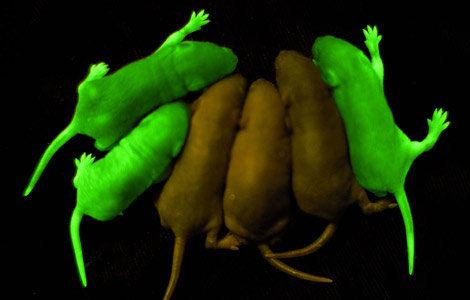
Photo via http://kidsblogs.nationalgeographic.com/kidsnews/2009/05/glowing-animals-gallery.htmlI believe that, at this time, we have mastered the technology of making glow-in-the-dark animals.  First there were the glowing mice, then the rats, the commercially-available atrocity the “glo-fish“,  Alba, the glowing rabbit who was also an “art installation”, pigs, and a whole host of other critters, and now, apparently, we have the glow-in-the-dark beagle.

What our intrepid scientists are doing, really, is stuffing extra genes into an animal to see if they can.  (Yes, that’s apparently all the justification they need.  They probably put the word “cancer” in the grant application, though.  You never know, this might be it!)  When scientists want to swap a gene from one organism to another, they choose to transfer a gene which makes the target animal, which ordinarily does not glow, produce a glowing protein.  They do this because that kind of thing is really easy to spot and doesn’t require complicated blood testing to see if it’s taken hold.  If the resultant animal glows, voila! — you have successfully transplanted a gene.

Why do they feel that making more glowing animals is necessary at this time?  I think we’ve passed the point of “required replication” of that original first experiment and entered the world of “unnecessary duplication of results”.  We’ve been shuffling genes around for years, as evidenced by that impressive list above.  We’ve even done beagles before, in 2009.  I think we’ve certainly seen that “we can” make glowing animals.  Now that “we can”, what are we doing with this amazing new technology?

To quote from the beagle article:

“[ByeongChun] Lee said the genes injected to make the dog glow could be substituted with genes that trigger fatal diseases. He and his team would then be able to chart the course of Alzheimer’s, Parkinson’s and more, better understanding how such diseases develop.”

It is fascinating how that paragraph doesn’t say, “The creation of transgenic beagles will allow us to give laboratory dogs a whole host of genetic diseases they don’t normally get, so that we can study how those diseases affect dogs, as if that were somehow relevant to how they affect people!

Yes.  The whole point of this ludicrous enterprise is that eventually, we will have man-made “animal models” for diseases that animals don’t normally even get — as though studying how these transplanted diseases behave in their new, unnatural hosts will tell us a damn thing about how they behave in humans.  We have reams and reams of evidence — including some generated from actual scientists doing animal-related experiments — that animal and human systems are not identical, and therefore we cannot extrapolate directly from one to the other, and here these people are, wasting time, money, and animals on making more animals to chew through while flailing helplessly in circles blathering about how they can cure cancer if only they can grind up a few more mice.

Ever notice how none of the articles point that out?  None of them say, “This will allow us to kill hundreds, maybe thousands, more dogs every year while searching for cures for human diseases.”  It’s always “Ooh, look at this adorable puppy — which may be a cure for cancer!

Am I saying that we should never, ever investigate recombinant DNA?  No.  Am I saying that perhaps we should think about using our newfound power of shuffling genes about to create hardier or more fruitful food crops that could feed impoverished nations, rather than new “animal models”, “designer fish” and “art installations”?  Yes.  We do not need to learn to cure artificially-induced Alzheimer’s disease in dogs.  We need to learn to cure it as it occurs naturally in people.

“We have learned well how to treat cancer in mice and rats but we still can’t cure people.”

— Professor Colin Garner, quoted in Genetic Engineering & Biotechnology News

I love science.  I love learning new things, and exploring new ideas.  I understand that we can learn things from animal research we cannot learn anywhere else.  This?  This is a grotesque parody of research.  This is an absolute waste of funds.  There are human-based studies at my local VA hospital desperate for funding to help wounded veterans overcome combat injuries.  There are developers who could really use grants to help design new prosthetic limbs.  Why are we wasting money on this?

But ooooh, lookit the cute glowing beagle!

Cruelty: Woman Ties Puppies To Fence

“HATTIESBURG, MS (WDAM) – An employee of the Southern Pines Animal Shelter arrived at work Monday morning and found 11 Shepard[sic] mix puppies tied to the gate.

Surveillance video at the shelter showed a woman taking two puppies at a time by the neck from her vehicle and using zip ties and baling wire to tie them to the fence. The zip ties had been tightened around their neck.”  (7/12/11)

The full article can be found here.

It’s possible that it simply did not occur to the woman that zip ties are, perhaps, a less than appropriate method for attaching puppies to a fence.  That sort of thing is what brings one to add the tags “puppies” and “ignorance” to the same article (and mourn the state of a world in which that happens).

However, ignorance of puppy-tying methods aside, this sort of behavior — breeding unwanted litters of puppies, abandoning the puppies at all, dropping them off at the shelter after hours to avoid hassles — is the kind of thing that happens when humans stop viewing animals as living things and begin viewing them as just things.

This is the kind of thing that we, as a culture, as a species, need to fight.  The ability to view another living creature (human or animal) as an object to which we owe no responsibility is behind, well, a lot of our problems.