
Category Archives: meat processing

This.

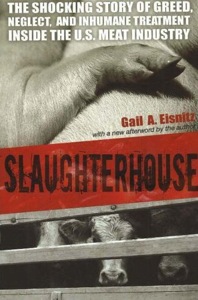
Slaughterhouse by Gail EisnitzWhen I first started working in the laboratory animal industry, and got my first taste of the Machine, my immediate reaction was that I was hallucinating.  I could not possibly be seeing what I was seeing, I reasoned, and I immediately went researching.  Surely there was an explanation for the things I saw happening.  Surely I was wrong!

It disturbed me beyond measure to discover that not only was I not wrong, but that I was only getting a miniscule taste of what was really happening.  The more research I did, the more horrified I became, until I eventually had to put things down and walk away.  Every time I tried to write something about a I would do research on a and then learn about x, y, and z as well.  Then I would have to research them, and….

These days I’m a little calmer, and I can pick up books and do research again.  My most recent acquisition, Slaughterhouse, by Gail Eisnitz, is the closest thing I have so far seen to what happened to my brain when I saw the laboratory animal industry for the first time.  Due to the “shock value” cover and title, I’d been avoiding it, but it turns out to be a well-written, rational, well-researched volume which makes its statement simply and reasonably (well, as reasonably as it’s possible to be in this case).  It follows Gail, a journalist for an animal welfare group, from the moment a USDA inspector writes her saying “Something’s wrong here” to her struggle to get someone, anyone, to break the story, and through it you see, through her eyes, her unbelievable, terrible discoveries.  Every piece of awful information leads to two more pieces of awful information, and the higher she climbs in the bureaucracy, looking for the source of it all, the more distressing it becomes as she realizes that the people in charge know, and they don’t care.

This is a book you will read with your mouth open, drop at the end, and say, “No.”  No, this isn’t true.  This does not happen.  She’s a journalist; she’s being sensational.  She’s biased.  She’s just selling a story.  Speaking as someone who’s seen another facet of the Machine at work — the laboratory side — Eisnitz is not lying.  The things she is describing are real.  They are happening right now.

It’s such a relief, and it’s so scary, to know that someone else sees it too.  Through my research, I’ve actually amassed quite a collection of books over the past few years, and most of the books actually corroborate to varying degrees what I personally saw, but Slaughterhouse is the first to describe the entire eye-opening journey of discovery.

I strongly recommend it, although I would suggest not reading it while eating a hamburger.

So Much To Write and So Few Pages

One thing learned from the initiation of video auditing on a large scale is that some people should not be handling livestock. — Temple Grandin

I recently picked up a book about slaughterhouses, and have had my hair standing on end reading it, realizing how much that process is like the processing of laboratory animals that I experienced.  I want to say more about that — I have a lot to say about that book — but in the meantime, I was doing some background research on the book itself and ended up on the web site of Temple Grandin, a PhD who has dedicated herself to improving the welfare of animals in slaughter plants, with some hopeful results.

Since the book I am reading was written in 1997, I skimmed Dr. Grandin’s web site, which had some up to date slaughterhouse audits (as recent as 2010), to see how things might be going nowadays.  Apparently they are now employing video monitoring in slaughter plants, which, depending on how exactly that is achieved, and who exactly is doing the monitoring, is a huge step forward for the conditions of both animals and humans there.  However, if the quote above is anything to go by, conditions haven’t really changed all that much since the book was written.

I Wish to Register a Complaint

I miss meat.  As I’ve mentioned elsewhere, I believe in (compassionate) carnivory and I do not believe there is a moral failing in consuming an animal you have appropriately “paid” (with food, water, shelter, care and affection) for its contributions to your household.  I am happy to eat meat.  However, I prefer not to pay the companies who do not adequately compensate their animals — thus, I do not eat meat at restaurants, picnics, fast food joints, what have you, because they buy their meat from enormous, horrible factory farms.  This leaves me searching, often vainly, for meat which has been slaughtered humanely and raised kindly.  I don’t eat a lot of meat anymore.

It is possible, if one hunts diligently, to find small local farms where the animals see grass and daylight during their lives, have adequate vet care and space, and even (gasp) enjoy species-appropriate social groups.  (I am happy that, because of the prevailing change in attitudes, it is slowly becoming more possible to find these farms.)  I find that my best chance of locating non-factory-farmed meat is at the local, “community” grocery stores.  These stores appear to make at least a token effort to find these humane farms and carry their products.  In turn, I happily give these places my money.  I wish to encourage this behavior.

However, I still find that the meat selection in these stores can leave much to be desired, and the watchwords caveat emptor still apply.  Unless the meat says “free range” (and sometimes not even then), you’re likely looking at factory farmed meat.  Yes, even if there’s a picture of a smiling pig on the wrapper.  Yes, even if it says “organic” and “hormone-free” all over it.  Today, I was almost ambushed by some elk stew meat, ambiguously labeled “Broadleaf”.

In my experience, it is generally very difficult to factory-farm wild game.  I worked with bison for ten years; they are larger and smarter than domestic cattle, and do not tolerate herding, hitting, crowded conditions, or running through cattle chutes — all requirements for “economical”, assembly-line processing — well.  I was initially attracted to the elk meat for this reason.  Fortunately, I still made the wise choice to look up “Broadleaf”, which after much research turned out to likely be Broadleaf Game, based out of California.  Broadleaf sells bison, elk, alligator and boar, which are quite unlikely to be factory farmed due to husbandry issues similar to those mentioned above, but they also sell beef, chicken, various “poultry”, veal and “farm-raised” rabbit, which are very easy to factory farm.  They say things like “hormone-free” on their site, but only the lamb is (vaguely) intimated to be living on grass, and most species do not have any description of their living facilities.

Alas, this is another brand name I won’t be rewarding with my money.  To demonstrate that it is possible to raise and slaughter wild game (or any animal!) kindly, and to advertise it properly, here is the web page for Broken Arrow Ranch, in Texas, and a description of its “field harvesting” technique, which I believe is the most humane way I’ve ever seen to kill an animal, for meat or otherwise (provided the person behind the gun is an excellent shot).

Of course, checking out the web site is only a small part of thorough research on a brand.  Typing search terms like “Broken Arrow Ranch USDA” and “Broken Arrow Ranch humane” into Google would be a good followup, checking for news articles concerning their handling practices and articles on other sites describing the facility.  Sometimes you can find reviews from people who have actually visited the farm, or a Facebook page from the farm with photos.  Ideally, one would be able to visit each facility personally, but, well.  In this exciting old world we can only do our best.