Category Archives: meat processing

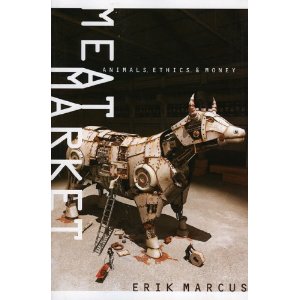
Book Review: Meat Market: Animals, Ethics, and Money

Meat Market: Animals Ethics and MoneyMeat Market: Animals, Ethics, and Money, by Erik Marcus, is an interesting, if brief, read, and a good answer to the question “What are these hippie freaks whining about, anyway?”  It’s not a perfect introduction — I’m still looking for the best way to suggest to, say, my parents that they not eat factory-farmed animal products — but it’s a good explanation of where one is coming from which doesn’t involve showing one’s audience graphic video of a slaughter plant.

The book begins with a glimpse of how and why small-farm practices become factory farm practices, follows up with an excellent, reasonably impartial, description of common factory farming practices for chickens, pigs, and cattle, and describes some options for what could be done to alter the status quo, along with what is currently being done.  It examines the three facets of the current what-the-hell-is-going-on-here movement (animal welfarists, animal rightists, and vegetarians), describes their goals, actions, and methods, looks at what is working and what isn’t, and suggests an alternative option (complete dismantlement of the system).

The book ends in a flurry of interesting essays and appendices, with subjects ranging from Starting a Local Vegetarian Society to The Ethics of Hunting.  It’s a lot of different viewpoints (although, toward the end, the vegan viewpoint grabs center stage and holds it), and, more, it’s thought-provoking material.

For example, it thoughtfully compares the relative quality of life — inasmuch as we can measure “quality of life” for another species — of various factory-farmed animals.  If you only give up one thing to make farmed animals just a little happier, Marcus says, give up eggs: the hens producing them are confined in ludicrously tiny cages their entire lives, debeaked, crippled, repeatedly force starved, and then slaughtered at the end.  The animal with the “best” relative life is the beef calf, which has a pretty good time of it (out at pasture, with mom) until about six months of age (after which it all goes to hell, but briefly compared to the two years’ close imprisonment of the laying hen).

The other thing that hit me was the reminder that, even though I am carefully purchasing milk from “certified pasture-kept” (and, theoretically, happy) cows, by purchasing milk at all I am contributing to the veal industry.  I am ashamed it didn’t occur to me before — of course!  What are they doing with all the male calves? — but now that I know I am trying to figure out how to get milk out of my diet, or at least minimize it.  Alas, soy milk tastes like liquid Lucky Charms, and unsweetened soy milk has the texture of Elmer’s glue — I am working on it.  In the meantime, I do my best to minimize consumption of milk and cheese….

If you are just starting to look at vegetarianism or veganism or know someone who is, Meat Market isn’t a bad start.  It is not overly preachy and does not use “We can’t kill animals because they are so CUTE!” faux logic — it produces rational, empirical examples which make it difficult not to listen.  I kind of wish it hadn’t ruined milk for me, but I can’t honestly blame the messenger.

Art: Humans as Meat

Today I encountered for the first time the work of artist Cang Xin.  According to his biography on the Saatchi Gallery, Xin “approaches his work as a means to promote harmonious communication with nature. His works have included bathing with lizards, adorning the clothing of strangers, and prostrating himself on icy glaciers: each act representing a ritual of becoming the other.”

Shamanism series, variation one, by Cang Xin, detail

On the topic of becoming the other I found interesting a small pencil triptych of his entitled the Shamanism Series.  The three images each feature dangling animal carcasses above lovingly rendered, disembodied, animal heads; the carcasses are interspersed with hanging, headless, male human torsos, strung up by one leg as if presented, along with the carcasses of the animals, for sale and consumption.  As you move through the triptych the carcasses do not significantly change in detail, but the heads do.  In the first image the heads are all animal (although there is one human foot present); in the second, there are two adult male heads with eyes closed; and in the third, three infantile human heads stare wide-eyed directly at the viewer.  Over the course of the viewing one is more and more directly confronted with the idea of humans as carcasses, humans as meat, humans as nothing more (or less) than the animals pictured around them.

What interests me most about this series of images is that, in endeavoring to transmit to the viewer the idea of humans as meat, the artist cannot bring himself to actually picture the humans as meat.  The animal carcasses are skinned, gutted, dismembered; the humans are missing only their heads, and occasionally their off legs.  They have not had their internal organs or skin removed; they have not had their hands and feet cut off; they are certainly not shredded like some of the animal parts.  They are not strung up by a hook under the Achilles tendon as are real meat animal carcasses, but instead suspended via ropes around the ankle.  The animals are as meat as it is possible to get; the humans are still very human-shaped.

I’m probably missing some deep symbolism here, and perhaps the art is about something entirely other (try as I might, I cannot find an artist commentary for the images).  Maybe it was just very, very difficult to find artist’s models for gutted human torsos (and that is a good thing).  Maybe properly dressed human carcasses did not look human enough to be identifiable, and did not completely make the artist’s point.  However, it really does interest me that in a series of images seemingly devoted to humans becoming the other, becoming the meat animals we consume, the artist could not quite bring himself to completely depict humans as meat.

One Step Forward, One Step Back: Gassing Chickens

via Cheetah100, Flickr Creative Commons

As described in many, many, many books and videos (but especially accessibly by this book, in case you’re interested), large slaughterhouses can process so many animals per hour that workers on the assembly line can have to deal with as many as one animal every five seconds (depending on species).  This causes “sloppy workmanship” on the part of the workers, manifesting itself in animals “stunned” badly or not at all, injuries to animals and workers as conscious animals are “stuck”, “legged”, or dunked in tanks of scalding water…um, anyway, high speeds in large slaughterhouses are bad, primarily because handling so many animals, so quickly, makes it possible for humane killing methods to “miss”, and for animals to go through the butchering process not only alive, but conscious.

There seems to be a movement afoot that at first looks like a great idea: some factories here and there have picked up on the idea of “sedating”/”stunning”/”gassing” the animals with carbon dioxide to make sure they are unconscious before being killed.  On the one hand, this is a great step forward.  A slaughterhouse is actually considering the needs of the animals it is processing and trying to make the experience less stressful for them.  Yes, the slaughterhouse will benefit from this: the birds will be less damaged on packaging (less wasted meat) and of course they will be able to put “humanely slaughtered” on all their packaging, so it’s not as though it’s all altruistic, but still: baby steps.

On the other hand — speaking as someone who has personally “euthanized” hundreds of mice via carbon dioxide and seen others do so — this is not a foolproof answer.  CO2 euthanasia is only a quiet, peaceful death if it is performed very slowly, very carefully, on one animal at a time.  (Even that’s debatable — there’s still a happy section of science cheerfully turning out papers on whether or not CO2 euthanasia is “euthanasia” at all.)  I strongly suspect that the fast-paced world of the high-volume slaughterhouse is not going to combine well with the slow and careful process of humane CO2 euthanasia.  Captive-bolt stunning, which is already used by the factories, is, in itself, a humane procedure.  However, the speed at which a large slaughterhouse operates renders captive-bolt stunning inhumane because proper procedures are unable to be followed and the animals are not properly stunned.  I think the same issues will affect CO2 euthanasia if it is used in high-volume slaughterhouse operations.

First, the size of the operation itself is going to induce pressure to make the process of filling the gas chamber, which should be a carefully monitored, slow procedure, a quick-and-dirty one.  The chicken factory mentioned in the link above, at least, appears to be talking about processing hundreds of birds at a time — according to the article, the containers in which the birds are shipped to the plant will go into a huge CO2 chamber, which will need to be room sized at least.  How to fill such a room?  Recommendations vary, but the average is something like 10% of room air replaced with CO2 per minute — that’s at least ten minutes to fill the chamber with gas.  (There are arguments for and against pre-filling the chamber with gas, or using faster filling speeds, but that discussion must be saved for a different article.)  The chamber will then need to be cleared of gas before workers enter and remove the birds (or the workers will need breathing apparatus).  This is all going to take time, which high-speed workers do not have.

Second, the size of the room is going to affect the facility’s ability to deliver gas properly to every animal.  Birds further from the gas vents will be affected at different rates than birds next to the vents.  Also, since CO2 is heavier than air, the birds at the top of the room will be affected differently than birds at the bottom.  What will assure that every animal: a) is rendered completely unconscious, b) remains unconscious for butchering?  In a room of sufficient size it is possible for the outermost birds at the bottom of the room to be dead while the birds in the center on the top are still conscious.  If workers are filling and emptying the room at high speeds, this problem is actually quite likely.  (There are already documented reports of dogs surviving similar gas chambers at humane shelters.)

Third, many laboratory euthanasia standards recommend euthanizing animals by CO2 one at a time (or in small familiar groups in their home cages).  (However, it should be noted that the official AVMA line on this is that the gas “chambers should not be overcrowded”, and indeed, some facilities routinely toss a bunch of animals all into one cage for euthanasia to save time.)  This is because animals can detect the intrusion of CO2.  They often become alarmed and disoriented before they go down, running, kicking, squealing, and generally acting agitated.  This does not promote quiet, calm, peaceful behavior — this promotes a room full of shrieking, flapping, alarmed and disoriented birds.

Apparently they’ve been trying CO2 euthanasia on pigs tooThis article suggests that all the agitation takes place after loss of consciousness and that the pigs are completely out cold while “convulsions, vocalization, reflex struggling, breath holding, and tachypnea” occur.  I’ll admit I’ve never seen a pig euthanized by CO2, but I must say I have some reservations about how “unconscious” the mice and rats I euthanized were while they underwent “Guedel’s second stage of anesthesia“.

I applaud these factories for trying to make the treatment of the animals with whom they are working more humane.  (I am an animal trainer at heart, and I know to reward “baby steps”, no matter how small.)  However, I believe these factories are not treating the correct problem (which is generally that the facility is trying to process too many animals for its capacity, and using pressured, underpaid, and under-trained workers).

Horse Slaughter in the US May Have Hidden Up Side

from morguefile.comThis past holiday weekend, I listened to someone announce that they had “euthanized” their problem horse (who really did need to be put down — it had a vet-diagnosed neurological condition and was aggressively dangerous).  I was thinking of commending them for taking responsibility for the animal and not just selling the problem along to an unsuspecting buyer when they said they had “euthanized” the horse by selling him for slaughter.  (“Bam!” they said.  “Bolt to the head.”)

Clearly they missed out on the part where horse slaughter was not, at that time, legal in the US — before their horse was “euthanized”, it rode many hours in an open air cargo van — perhaps one designed for horses, perhaps one designed for pigs or cattle — with no food or water, to reach a slaughter plant in Canada.  The horse may not have even reached the killing box and its captive bolt gun — it may have died along the way, kicked at the feedlot, crushed or trampled in the truck, or suffering from exposure or dehydration.

There is hope that things may be changing.  Recently, Congress has, without fanfare, quietly lifted a five-year-old ban on funding for inspection of horse meat, which indirectly paves the way for re-opening of domestic horse slaughter plants by providing for the inspection of meat produced at those plants.  There isn’t currently a budget for horse meat inspection, so the process might be slow, but people who have been witness to the issues surrounding the lack of appropriate facilities in the US are scrambling to get one going, to prevent trips like the one my acquaintance’s horse took.

The closure of domestic slaughter plants in 2007 has not resulted in a reduction of the amount of US horses being slaughtered.  They are simply being trucked over the border to be slaughtered in Canada and Mexico, doing nothing but adding a 24 to 72 hour trip in a packed cargo truck — here’s animal behaviorist and slaughter reformist Temple Grandin describing one version of that experience — to the doomed horses’ woes.

We certainly do need to alter a lot of things about the process that is allowing companion horses to be slaughtered for food — including providing education for horse owners, finding help for families who, through no fault of their own, can no longer support their animals, and initiating improvements in slaughter practices and how all slaughter plants (not just ones for horses) are run.  There are a lot of problems with this industry, in all countries (graphic link).  However, sending horses off to Mexico and Canada is not the answer.  Providing a good support network for distressed owners, increasing public education, and bringing the slaughter plants under USDA control won’t fix the problem, but would be a huge step in the right direction.

Why I Ate A Thanksgiving Turkey

I am not technically vegetarian; I consider myself a compassionate carnivore.  Alas, in this day and age, this results in essential vegetarianism unless I have personally bought the meat/eggs/milk involved.  It’s kind of nice, actually.  I don’t miss meat a lot, and it’s really helping on my diet.  However, this Thanksgiving I did help to dismember and consume a whole turkey as part of some quasi-traditional ritual much of the country seems to go through around this time.

First — since my mother-in-law is lucky enough to live in an area where she can essentially walk out of her house and meet the pasture-raised, humanely-treated turkey in question, she got a bird which had the kindest life anyone could have given it, and whose death was about as humane as it gets.  This qualifies, in my book, as humanely-raised meat.  The bird was appropriately “paid” for its efforts to the household — with food, water, shelter, medical care, and, in the case of this particular bird, even access to the outdoors and conspecifics.  We (via the farmer) gave the turkey a good life in return for several excellent dinners.

Second — we used the whole turkey.  Every little bit of meat, including giblets, bones, neck, bits, and pieces, got thrown into the stock pot and will be used to flavor soups, make noodles, etc., for the next several weeks.  Three families were fed by that bird.  Nothing was wasted, which is only appropriate when you are consuming something so important as another animal.  That turkey was not wasted.

Third — Thanksgiving, or, rather, a family get-together and overall bonding occasion, is not the point to stand up and grind it into people’s faces that their lifestyle choices disagree with yours.  I once had to put down a “vegetarianism for beginners” book which recommended that, when “thoughtlessly” offered meat at a restaurant, I essentially stand up, throw down my napkin, and rip the innocent waitperson a new orifice for daring to offer me animal flesh.  We are all imperfect, and shouting at people is a great way to guarantee they won’t be listening.  There are better times for these delicate, paradigm-rocking conversations.

During the holiday, I also consumed two pieces of not-at-all-humanely-raised sausage, because some poor pig (or, likely, between two and twenty pigs) died for that sausage, and it was going to be thrown away if someone did not eat it.  While I would prefer that humans in general not purchase or eat factory-farmed meat, if someone has purchased it, I would prefer that it not go to waste.  I consider it a crowning injustice to torment, damage, and otherwise torture a living animal only to toss the meat away at the end.  There’s probably another way to look at all this, but that’s how I’m looking at it right now.

Some meat I did not eat this holiday: The path to and from the mother-in-law’s passed a favorite restaurant of mine, at which I have not eaten in years, since long before my switch away from factory-farmed meat.  Despite a distinct fondness for their burgers, the great time which had passed since my last such experience, and the general inaccessibility of the restaurant to me these days, I could not justify the purchase or consumption of meat from that restaurant.  It would not be wasted if I did not eat it, and purchasing it would directly contribute to factory farming; so fries it was.  It wasn’t quite the same without a burger on the side, but I’d rather miss out on a meat patty than contribute to what usually happens to make a commercial, fast-food burger.

Seeing About Seafood

Since I am both highly calorie-restricted and also doing my level best to avoid factory-farmed meat, it is extremely rare these days to open a menu and see more than one thing I can calorically and morally afford.  I find myself leaning towards seafood these days, for sources of low-calorie, lean protein which are unlikely to involve ghastly intensive farming practices, but of course anything purchased in a restaurant is suspect until investigated.

Today, I took a look at shrimp, which is delightfully low-calorie (when not coated with heavy sauce, or fried), and easily raised domestically, so I am unlikely to be decimating dwindling wild populations.  Shrimp “harvesting” is also reasonably fast and does not involve the inhumane slaughter methods common with large mammals.

Shrimp farming is popular and widespread, which of course invites unfortunate habits by shrimp farmers trying to increase the number of animals they can produce/sustain in an individual pond.  Certainly I cannot cover the entirety of “shrimp farming” in a bite-size blog post, but here is a basic overview of U.S. shrimp farming in .pdf form from Auburn University; here is a more in-depth description from Kentucky State University; and here is a formal collection of overall information from the National Oceanic and Atmospheric Administration.  Here’s one for the Gulf of Mexico from NASA.  For comparison, here is a (likely virus-free) .doc file from the Association  of Southeast Asian Nations (unfortunately with no date) describing shrimp farms in its member countries.

It’s hard to form a universal rule on store-bought or restaurant-purchased shrimp, since it’s coming from so many sources, but fortunately a lot of restaurants are wising up and at least giving lip service to sustainable (and reasonably kind) farming practices.  Here’s the info for Red Lobster, whose menu caused my initial investigation re: seafood.  Hmm, pretty vague on farming practices, but I like that they’ve teamed with an aquarium.  Purchasing the fish at a specialty grocery store is usually safer: here’s the info for Whole Foods Market, which both reassures me that they’re at least trying, and paints a terrifying picture of what some shrimp farms must be doing, in order for Whole Foods to require rules such as these.

Seafood as a whole is generally suspect due to overfishing and overfarming, but there are some good options out there.  Here’s some good advice on picking “kind” and healthy seafood from the Monterey Bay Aquarium, including the Seafood Watch app for Android and iPhone, which can be used to find local restaurants which have chosen to purchase their seafood sustainably.

I’m Not The Only One Seeing It….

The 6 Most Horrifying Lies The Food Industry is Feeding You, courtesy of Cracked.com.

And there’s “ammonia-infused hamburger”, right there — a direct result of the meat industry soaking your meat with chemicals rather than slow down the lines so it doesn’t get contaminated in the first place.  Below that we have “free range” chickens raised in giant sheds…which is technically “free range” compared to the industry-standard “five birds to a cage” plan, but is still nothing like the wide open fields you’re thinking about when you see the words “free range”.

Just another note to myself, I’m not the only one seeing this thing….

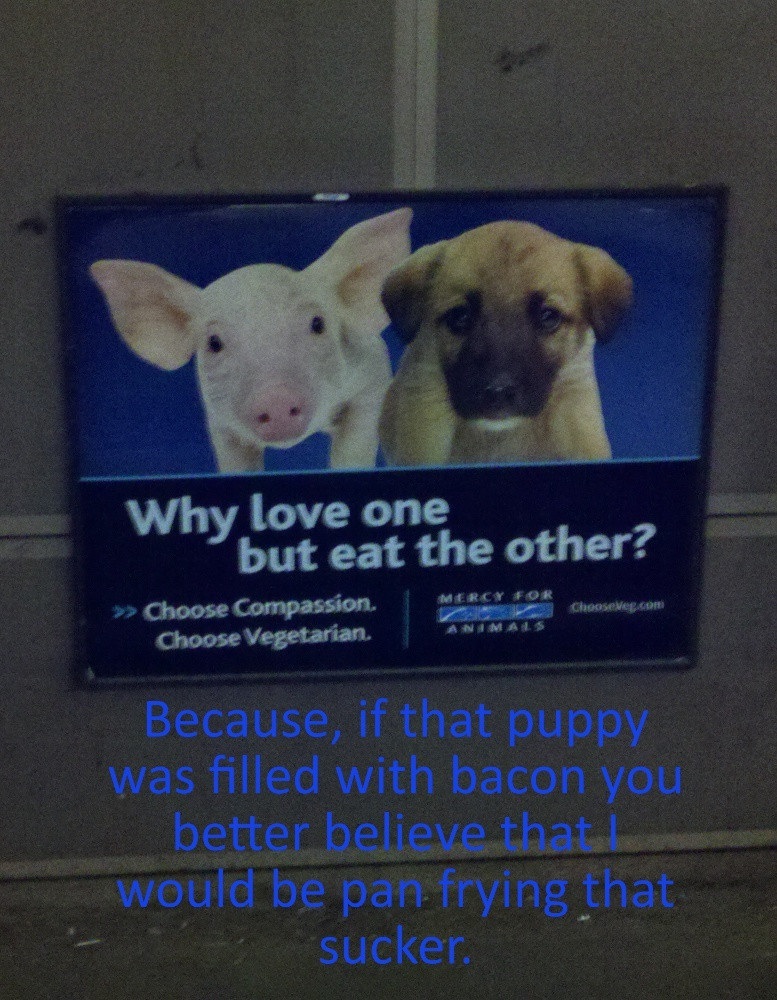
Pig or Puppy, the System Still Sucks

I was raised by wolves, or at least by a pack of consummate carnivores.  I find that not a lot of my friends want to talk to me about animal welfare because they think that, by objecting to how we treat our meat and research animals, I’ve become a brainwashed, tree-hugging hippie who’s trying to convert them to veganism.  They like eating their meat, and they get grumpy when they think someone is trying to take it away.

All right.  We all love bacon.  Pigs provide bacon.  You gotta kill pigs to get bacon.  Fine.

Now imagine that there are two ways to get bacon out of a pig (or a puppy).

The first way is an old, slow, traditional way: you raise the pig in a nice big space, let it exercise the muscles you’re going to eat, feed and water it properly, give it love, health care, and shelter, and kill it as humanely as possible.  You clean the carcass carefully, use as much of it as you can, and only keep and slaughter as many pigs as you can kindly handle.  Because you have a lot of time to work with individual animals and to make sure your facilities are clean, this produces clean, fresh bacon — and a lot more of it, off fatter, healthier pigs (or puppies).

The second way is the new, fast, modern way: you raise hundreds of thousands of pigs in small metal boxes in the dark.  You grow them so big, so fast, their legs break.  You fill them to the eyes with antibiotics so they don’t get sick.  You can’t process all the pigs yourself, so you hire (and abuse) minimum-wage workers to do the slaughtering in a partially automated process.  Processing 3,000 pigs an hour (one every two seconds), not all the pigs die before being dismembered.  Something like 20-30% are “legged”, gutted, and dissected alive.  Everything moves so fast there’s no time to clean properly, and carcasses (and everything else) are covered in feces, blood, and other materials.  There’s no time to inspect carcasses properly, either, and diseased animals are packaged up for sale.  When disease is inevitably discovered in your product, instead of slowing down the line, you wash the meat down in chlorine before you package it.

Either way, you end up eating bacon.  But the first way, you’re getting good meat, and the second way, you’re getting meat full of chemical washes, pus, E. coli, and sawdust.

Just for this moment, we’re gonna skip all the animal welfare issues, the worker welfare issues, the adorable little kids dying of E. coli poisoning, and the really cute part where the plants are run and “overseen” by the rich, fat-cat assholes in Washington that you hate, who are even now passing laws to make it easier for them to churn out tainted, sawdust-flavored crap and sell it everywhere.  Boiled down to the basic facts: the current system of food production, which supplies most grocery stores and restaurants, turns out horrible, diseased, scary meat which is doused in chemicals and potentially dangerous for you.

Your status as a carnivore is not in question.  The question is, which pig (or puppy) would you rather eat?

Cow Enters Rescue Group’s Monkeysphere

A little while ago I posted about the Monkeysphere, and how there is a maximum number (Dunbar’s number) of social relationships that social animals (including humans) can simultaneously maintain.  If a person (or animal) is outside your monkeysphere, you do not view him/her/it as a social companion, and may find it difficult to generate empathy for him/her/it.

Here’s an example of that happening now.  Bavaria (like other countries) sends, probably, hundreds of thousands of cows to the slaughterhouse annually, but here’s a group frantically trying to save one loose, wandering cow.

It’s not that I disagree with the idea — and, from a fundraising point of view, it makes a lot of sense.  Having a name and a face on your campaign will definitely help raise money.  “We’re trying to save Yvonne!” will get more people interested in your cause than “We’re trying to save 100,000 anonymous cows!”  It’s just a fascinating example of the Monkeysphere in action.  Yvonne entered these people’s monkeysphere, and suddenly they can see her as a social companion, and suddenly it becomes worth purchasing not only her, but a former “stall mate” of hers, as well as mobilizing search and rescue units on all-terrain vehicles, to rescue her.

The other cows in Yvonne’s herd?  Too many faces — won’t fit in the monkeysphere.  Off they go.

(Not saying anything bad or good here.  We all do our best with what we have.  The rescue certainly cannot take in 100,000 cows every year, and Yvonne will definitely help them with their mission, benefiting the other cows indirectly by being their “ambassador”.  There’s no right or wrong here.  Just…pausing to look at the world as it goes by.)

(On  a similar note, this article “introducing you to the truck driver you just flipped off” is trying to get you to add truck drivers, in general, to your monkeysphere in order to get you to empathize with them and reduce incidents of road rage.  Did it work?)

The Monkeysphere

The online magazine Cracked, which is primarily known for cramming the maximum amount of four-letter words into the minimum amount of space but still occasionally tosses out some utter brilliance, in 2007 put out an article called “What is the Monkeysphere?”  The article presented the concept of Dunbar’s number, the theoretical maximum number of social relationships any given animal (including humans) can form and maintain at any given time.

The theory goes: Think about having a pet.  A dog, for example.  Your dog has a name (“Gozer the Magnificent”) and wears a funny hat and likes eating frozen rhubarb.  Now imagine you have five dogs.  Their names and personalities are a little harder to remember, but you can still keep them straight.  Now try to picture owning a hundred dogs.  Likely, you can’t even picture that many dogs, much less think of individual names or personalities for each.  The maximum number of dogs (or people, etc) with whom you can form caring social relationships is somewhere between five and one hundred.  That’s Dunbar’s number.  That’s the biggest social sphere we, as “monkeys”, can create.  That’s our monkeysphere.

Dunbar’s number varies from person to person and from species to species, but the basic principle is the same.  Where animal research, farming, zoos, and the pet industry — animal industry in general — goes wrong is about the point where the number of animals being cared for by any one person becomes greater than Dunbar’s number.

If a lab tech is told to care for ten mice, they all get names, personalities and individual identities.  A lab tech caring for a room full of 500 mouse cages, each containing between one and five mice, barely has time to count the mice as they blur past during each daily check.  A slaughter worker tasked with “stunning” four cows an hour can move slowly and patiently, properly aim the “stunning” device, and make sure each animal is dead before the rendering process begins.  A slaughter worker tasked with “stunning” one hundred cows an hour — as many currently are — is “processing” something like one cow every thirty seconds.  There is no time for patience or proper aim.  A zoo or wildlife park worker who cares for ten to fifteen animals has names for each one, and the animals are often treated as personal friends.  A zoo director, overseeing a collection of five hundred to two thousand animals, starts to see them as “units” rather than social companions.

Other factors — primarily money — come into it as well, but there is something about reaching Dunbar’s number that really damages the structure.  Once the humans can’t form social relationships with the individual animals anymore, they stop treating the animals as beings with which you might form social relationships — and that starts the whole downward spiral, where “what we should be doing” begins to look more and more different from “what we are actually doing”.

Just a thought.