Category Archives: animal research

Someone Else Can See It

It’s not that the scientists are lying, exactly, about what they’re doing.  It’s not that they’re hiding it, either, really.  Everything they do is written down as a proposal, approved by various subcommittees, recorded as results, and stored in case someone wants to look at it.  The problem is more one of communication:
“Yes, [I found it],” said Arthur.  “Yes, I did.  It was on display in the bottom of a locked filing cabinet stuck in a disused lavatory with a sign on the door saying ‘Beware of the Leopard’.”

Like the plans to demolish Arthur Dent’s house, the descriptions of what people are doing in laboratory experiments are there — just very, very difficult to find.  Most people don’t bother, or aren’t even aware that there are any descriptions out there to find.

For example, you can find, if you search online, some perfectly ordinary “rodent guillotines“.  You may be able to find a page, as well, explaining why some research animals might need to be euthanized via guillotine (it allows the researchers to collect samples uncontaminated by euthanasia chemicals).  Here’s a page describing research reassuring scientists that decapitation is painless (notice that it’s in response to research saying decapitation isn’t painless, and that it corroborates the original findings, but simply chooses to interpret them differently).  You can find masses of pages describing the euthanasia techniques, including decapitation, used by different facilities (look at all those colleges!  Did you know that your college tuition funded this kind of thing?  Would you have gone to that college if you’d known?)

…how would you know to look for this if you hadn’t worked in one of these facilities?  I wouldn’t have been able to come up with the search terms (“decapitation”, “euthanasia”, “rodent”, and “SOP”, if you’re wondering).  It wouldn’t have occurred to me that this even went on.  What other practices do we just need to know the search terms to find?  (Try “cervical dislocation”, “neonates” and “scissors”, “captive bolt”, “hog stunner”, and finish up with “AVMA guidelines euthanasia” to see the full list.)  It’s not like the information isn’t out there…it’s just that nobody is calling it to our attention.

What triggered this today was a random blog post from someone else mentioning that, hey, we’re not really saying a lot about this, are we?  Has anyone else noticed that people are being really quiet about this?  Why?

Home Sweet WTF

“The goal of managing any mouse colony … should be to maintain adequate numbers of animals in as little shelf space as possible….”

Husbandry protocol, University of California, Irvine

The image to the right is of a standard laboratory mouse cage.  This is considered a pretty cutting edge mouse habitat these days.  The unit is actually fairly airtight — the blue and red things are valves through which air enters and exits the chamber when the cage is inserted into a “ventilated rack system” (described below).  These cages are designed to work with the rack system keep the environment the mice are in separate from the outside environment, usually by running any air going into or out of the cage through a replaceable HEPA filter in the top of the cage (not visible in the picture).  This keeps immunocompromised mice from getting sick, and keeps lab workers from catching anything the mice might have.

According to the manufacturer’s web site, these palatial enclosures have 75 square inches of floor space.  That might sound like a lot, but that translates to about 7 3/4″ wide by 12″ long in a cage 6 1/2″ high — about the size of a sheet of typing paper.  (The cages are commonly called “shoebox cages” for a reason.)  That measurement also doesn’t count the intrusion into the living space of the enormous food hopper, under which the mice must squeeze to get from one side of the cage to the other.  These cages are of course perfectly within guidelines for the absolute minimum space requirements per adult mouse.  (Here is an amusing page comparing mouse cage sizes to human equivalents.)

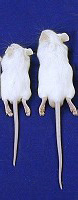
Generally, facilities limit the number of adult mice in such a cage to five, which works out to fifteen square inches of space per mouse — the size of a three by five index card.  In practice, these cages are often far more full even than this.  For example, breeding colonies often keep two adult females with an adult male and, either through protocol or lack of finesse on the part of the researcher or technician, may allow the resultant litters to remain in the breeding cage until they are weaned at about 21 days.  At left is an image of a 21-day-old mouse next to an adult.  Average litter size for a laboratory mouse is between 6-8 pups (although as many as 20 can be born at one time).  Imagine the cage just before weaning, with three (or more!) adults and potentially more than twenty “pups” that are fully half the size of the grown mice.  I have picked up cages in which the bedding was not visible through the mass of mice inside.  They do make larger cages which can be used for breeding, but these require more space, are more difficult to change and sterilize, and are more expensive to purchase, and are not always used.

Here is a photo of a ventilated rack system made by Allentown, Inc., a primary rodent housing supplier.  These racks are, again, the cutting edge for keeping a lot of mice in a very small space.  Previously, mice were placed on shelves on rolling racks; in this technologically advanced age we have perfected a model for keeping mice in almost the absolute minimum space possible.  These racks hold 100-200 cages apiece, with a single “standard” size mouse room able to potentially hold three to twenty racks.  I worked in a facility which had six 150-cage racks in a single room (one of many mouse rooms).  One technician was assigned to oversee all 900 cages in this room.  How diligent do you think that person could be when inspecting individual mice (remember, 1-5 mice per cage, potentially 4,500 mice in this room) for disease?

The boxes on top of the rack are the intake and exhaust blowers, which force air through the system and keep the rack either positively (no outside germs get in) or negatively (no inside germs get out) pressurized.  Although all cages receive equal amounts of fresh air (at 40-60 full air exchanges per minute, it must be like living in a wind tunnel), light is definitely in short supply down on those bottom racks.  The techs I worked with used to carry flashlights to see the bottom rows.

Note that there aren’t actually laws dictating minimum required living conditions for mice and rats.  Rodents are not covered under USDA regulations (which is one reason they are so popular as laboratory animals).  “Minimum living space” for mice and rats right now is “whatever we want it to be”.  Currently, more or less voluntary standards for this are set by the laboratories themselves, under the guise of the National Research Council, which could be considered to be just a bit biased in favor of the scientists.  There is a voluntary system of conforming to these standards via accreditation, but no federal agency is involved in enforcing them.  In fact, here is a page wherein the federal government is currently busy trying to buy a rack with even smaller (61-square-inch) cages for its own use.

Glow F**k Yourself

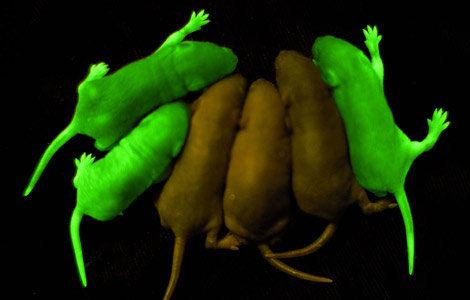
Photo via http://kidsblogs.nationalgeographic.com/kidsnews/2009/05/glowing-animals-gallery.htmlI believe that, at this time, we have mastered the technology of making glow-in-the-dark animals.  First there were the glowing mice, then the rats, the commercially-available atrocity the “glo-fish“,  Alba, the glowing rabbit who was also an “art installation”, pigs, and a whole host of other critters, and now, apparently, we have the glow-in-the-dark beagle.

What our intrepid scientists are doing, really, is stuffing extra genes into an animal to see if they can.  (Yes, that’s apparently all the justification they need.  They probably put the word “cancer” in the grant application, though.  You never know, this might be it!)  When scientists want to swap a gene from one organism to another, they choose to transfer a gene which makes the target animal, which ordinarily does not glow, produce a glowing protein.  They do this because that kind of thing is really easy to spot and doesn’t require complicated blood testing to see if it’s taken hold.  If the resultant animal glows, voila! — you have successfully transplanted a gene.

Why do they feel that making more glowing animals is necessary at this time?  I think we’ve passed the point of “required replication” of that original first experiment and entered the world of “unnecessary duplication of results”.  We’ve been shuffling genes around for years, as evidenced by that impressive list above.  We’ve even done beagles before, in 2009.  I think we’ve certainly seen that “we can” make glowing animals.  Now that “we can”, what are we doing with this amazing new technology?

To quote from the beagle article:

“[ByeongChun] Lee said the genes injected to make the dog glow could be substituted with genes that trigger fatal diseases. He and his team would then be able to chart the course of Alzheimer’s, Parkinson’s and more, better understanding how such diseases develop.”

It is fascinating how that paragraph doesn’t say, “The creation of transgenic beagles will allow us to give laboratory dogs a whole host of genetic diseases they don’t normally get, so that we can study how those diseases affect dogs, as if that were somehow relevant to how they affect people!

Yes.  The whole point of this ludicrous enterprise is that eventually, we will have man-made “animal models” for diseases that animals don’t normally even get — as though studying how these transplanted diseases behave in their new, unnatural hosts will tell us a damn thing about how they behave in humans.  We have reams and reams of evidence — including some generated from actual scientists doing animal-related experiments — that animal and human systems are not identical, and therefore we cannot extrapolate directly from one to the other, and here these people are, wasting time, money, and animals on making more animals to chew through while flailing helplessly in circles blathering about how they can cure cancer if only they can grind up a few more mice.

Ever notice how none of the articles point that out?  None of them say, “This will allow us to kill hundreds, maybe thousands, more dogs every year while searching for cures for human diseases.”  It’s always “Ooh, look at this adorable puppy — which may be a cure for cancer!

Am I saying that we should never, ever investigate recombinant DNA?  No.  Am I saying that perhaps we should think about using our newfound power of shuffling genes about to create hardier or more fruitful food crops that could feed impoverished nations, rather than new “animal models”, “designer fish” and “art installations”?  Yes.  We do not need to learn to cure artificially-induced Alzheimer’s disease in dogs.  We need to learn to cure it as it occurs naturally in people.

“We have learned well how to treat cancer in mice and rats but we still can’t cure people.”

— Professor Colin Garner, quoted in Genetic Engineering & Biotechnology News

I love science.  I love learning new things, and exploring new ideas.  I understand that we can learn things from animal research we cannot learn anywhere else.  This?  This is a grotesque parody of research.  This is an absolute waste of funds.  There are human-based studies at my local VA hospital desperate for funding to help wounded veterans overcome combat injuries.  There are developers who could really use grants to help design new prosthetic limbs.  Why are we wasting money on this?

But ooooh, lookit the cute glowing beagle!

The Monkeysphere

The online magazine Cracked, which is primarily known for cramming the maximum amount of four-letter words into the minimum amount of space but still occasionally tosses out some utter brilliance, in 2007 put out an article called “What is the Monkeysphere?”  The article presented the concept of Dunbar’s number, the theoretical maximum number of social relationships any given animal (including humans) can form and maintain at any given time.

The theory goes: Think about having a pet.  A dog, for example.  Your dog has a name (“Gozer the Magnificent”) and wears a funny hat and likes eating frozen rhubarb.  Now imagine you have five dogs.  Their names and personalities are a little harder to remember, but you can still keep them straight.  Now try to picture owning a hundred dogs.  Likely, you can’t even picture that many dogs, much less think of individual names or personalities for each.  The maximum number of dogs (or people, etc) with whom you can form caring social relationships is somewhere between five and one hundred.  That’s Dunbar’s number.  That’s the biggest social sphere we, as “monkeys”, can create.  That’s our monkeysphere.

Dunbar’s number varies from person to person and from species to species, but the basic principle is the same.  Where animal research, farming, zoos, and the pet industry — animal industry in general — goes wrong is about the point where the number of animals being cared for by any one person becomes greater than Dunbar’s number.

If a lab tech is told to care for ten mice, they all get names, personalities and individual identities.  A lab tech caring for a room full of 500 mouse cages, each containing between one and five mice, barely has time to count the mice as they blur past during each daily check.  A slaughter worker tasked with “stunning” four cows an hour can move slowly and patiently, properly aim the “stunning” device, and make sure each animal is dead before the rendering process begins.  A slaughter worker tasked with “stunning” one hundred cows an hour — as many currently are — is “processing” something like one cow every thirty seconds.  There is no time for patience or proper aim.  A zoo or wildlife park worker who cares for ten to fifteen animals has names for each one, and the animals are often treated as personal friends.  A zoo director, overseeing a collection of five hundred to two thousand animals, starts to see them as “units” rather than social companions.

Other factors — primarily money — come into it as well, but there is something about reaching Dunbar’s number that really damages the structure.  Once the humans can’t form social relationships with the individual animals anymore, they stop treating the animals as beings with which you might form social relationships — and that starts the whole downward spiral, where “what we should be doing” begins to look more and more different from “what we are actually doing”.

Just a thought.

Euphemisms

When I shop for eggs, I wish to buy eggs which have not been factory farmed.  I know that standard living conditions for factory farmed laying hens in the United States involve up to five hens being crammed into a wire cage approximately one foot cubed, suspended above a trough full of droppings.  I appreciate the effort that the hens have put into creating those eggs for me to eat, and I do not show my appreciation for hard work by cramming birds into tiny spaces and watching them peck each other to death.  I don’t know.  Maybe I’m weird that way.

I want to fund the farmers who “pay” their laying hens (and any other animals they may have) with the standard package anyone should get for hard work: food, water, shelter, and medical care.  The problem is finding these farmers, because all the other farmers (or, rather, the massive corporations who employ those farmers, who produce most of our commercially raised eggs) have figured out that most people don’t like picturing chickens crammed into little cages.  They don’t want to actually stop doing that — that would be inconvenient and expensive for them — but they want us to think they have, so we’ll keep buying their eggs.  So they use euphemisms.

They started by calling the eggs “organic”.  That sounds nice.  We associate “organic” with things made without pesticides, without additional hormones, without dosing the animals with unnecessary antibiotics.  Surely animals being raised in “organic” conditions are happily out at pasture, frolicking with the butterflies?  Nope.  “Organic” does not imply a single thing about an animal’s housing conditions.  “Organic” eggs may come from hens which are not chemically treated, or at least not chemically treated above and beyond some extremely loose standards set (sometimes) by the USDA, but the hens are still crammed in little cages.  Little “organic” cages, possibly.

I’ve also heard “pesticide-free” and “vegan diet”.  All right, those are nice — I’d prefer not to eat pesticide-laced chicken, and I know that some large factory farms feed their living animals the ground-up remains of their unusable, dead animals — but neither one really affects the day to day existence of the chickens.  They’re still in little cages, although they are now a little less chemically altered, and less likely to catch horrible diseases from eating their ground-up predecessors on the assembly line.

A euphemism that’s becoming more popular now is “cage free”.  That sounds good, doesn’t it?  In fact, I bought “cage free” eggs (at twice the factory-farmed price) for a couple years before doing the research I should have done earlier.  “Cage free” does mean that the chickens are not crammed into tiny cages, yes.  But instead they are crammed shoulder to shoulder into huge barns, where they fight and have panic attacks every time the overhead lights turn on or off.  (In fact, many barns are kept dark most of the time, to “calm” the birds.)  They can technically move around, but there are thousands of other chickens in the way.  This may be better than standard, but it is still hardly a bucolic idyll.

In a similar vein, I have seen eggs from hens with “outdoor access”.  This means they cut a small hole in the side of the barn, with a yard about big enough for ten hens.  The remaining 10,000 hens in the barn never see this hole, or the yard.  But, technically, they have “outdoor access”.

The phrase which turns out to accurately describe “hens which are allowed to live much like hens should” is “pasture-raised” (or, as on the eggs that I buy, the legend “Our hens are kept on grass 24/7!”).  This means the hens are actually, honestly, kept outdoors.  It can be done, you know.  Even with a couple of hundred hens.  You bring them in at night and they lay eggs for you, and then during the day they go out and are hens.  You rotate them to new pastures regularly, so the old ones have time to regrow and recover, and you get some fine eggs from those happy, happy hens.

You know the big corporations are not pasture-raising their hens.  If they were, it would be all over the carton, because I am happy to pay six dollars a dozen for eggs if I know (and I do research to the best of my ability) that the hens which produced the eggs in question have been appropriately, handsomely paid for their work on my behalf, and I am sure the big corporations would love to get six dollars a dozen for their eggs.  (Standard, factory farmed eggs in my area go for a dollar fifty to two dollars a dozen, normally.)  Likewise, I pay twice the normal price for “pasture kept” milk and butter (“guaranteed kept on grass” and not “grass finished” or “organic” or “hormone-free”, although generally pasture-kept animals are also “organic” and “hormone-free” as well).

(I keep saying “the normal price” when I mean “the price of factory-farmed eggs”.  This reflects somewhat on our culture, and it also annoys me.  “Factory farmed” may be considered “normal” right now, but it should not be.)

Anyway, this whole mess offends me.  It’s part of a bigger picture, where scientists replace “lab rat” with “animal model”, and use even more horribly twisted language to disguise, as much as possible, that they’re letting kids slice up live mice for fun.  I can’t get into that right now, but this little mess, with “cage free” and “pasture”, is a start.